
Before this war is over, every man and woman and child in Canada will feel it—you, Mary, will feel it—feel it to your heart’s core. You will weep tears of blood over it. The Piper has come—and he will pipe until every corner of the world has heard his awful and irresistible music. It will be years before the dance of death is over—years, Mary. And in those years millions of hearts will break.” Walter Blythe
It has been a long time since I have had such confusing reactions toward a book.
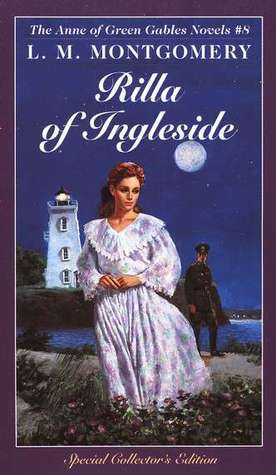
Rilla of Ingleside is the last book in the Anne of Green Gables series by L.M. Montgomery. It is the intensely personal and intimate account of a Canadian village caught up in the anxiety and hardships brought on by WWI.
I was captivated by 15 year-old Rilla and her young “chums” as they changed and grew through the struggles and sacrifices the war brought to their daily lives. I was impressed at the way they stepped up to adult responsibilities at home and on the battlefield. I especially liked how her family and the town at large waited expectantly each day for the newspaper, their fear and elation at battles lost and won as they poured over the daily paper and discussed their fate and that of Europe.
Rilla did her part as organizer of the Junior Red Cross Society and as surrogate mother to Jims, the war-baby whose father was at the front. This was an interesting fact for me, as I was surprised at the casualness of the handover of an infant to a non-related 15 year old girl. Did this really happen? Need some research here!
A knowledge of the preceding books in the series is not necessary to richly experience Rilla of Ingleside. This is a stand-alone book full of well-drawn main characters, who portray an honorable citizenry doing ‘what it takes” to keep up their spirits, their Canadian ethics and the “home fires burning” against the terror and evil prevailing over Europe.
When the word had come that Jem must go she had her cry out among the pines in Rainbow Valley and then she had gone to her mother. “Mother, I want to do something. I’m only a girl—I can’t do anything to win the war—but I must do something to help at home.”
“Don’t you think you could organize a Junior Red Cross among the young girls,” said Mrs. Blythe?
“Well”—Rilla took the plunge—“I’ll try, mother—if you’ll tell me how to begin. I have been thinking it all over and I have decided that I must be as brave and heroic and unselfish as I can possible be.”
What so distressed me about the book, was the death of Anne Shirley. Not her actual death, of course, but the slow fade-out of the once vibrant, dramatic, sensitive and smart Anne who, to use an appropriate description, was basically MIA. In fact, I resented Susan with her emotional outbursts, her sensibility and the way she mobilized the family’s patriotism. Because that should have been Anne.
To be fair, Anne really faded out in books six and seven as her children grew and took over the main story lines. But it seems to me Montgomery could have tried harder in the last book to give Anne a better send off. Just because Anne became a wife and mother is no reason to restrict her to a life of retiring domesticity as the noble mother who suffers in silence as she sends her boys off to war. In modern parlance, she got hardly any air time in this book and it is shattering. This is Anne Shirley we are talking about. SHE would not have faded into the old tropes of sacrificial wifedom and motherhood!
Maybe Montgomery felt this series was only for young adults and as such thought they would not be interested in characters over the age of 20. But I will always regret my last experiences with Anne of Green Gables were actually with her ghost.
I was just taking relief from the intolerable realities in a dream, Gilbert—a dream that all our children were home again—and all small again—playing in Rainbow Valley. It is always so silent now—but I was imagining I heard clear voices and gay, childish sounds coming up as I used to. I could hear Jem’s whistle and Walter’s yodel, and the twins’ laughter, and for just a few blessed minutes I forgot about the guns on the western front, and had a little false, sweet happiness.
I read somewhere that this was the first book to give a Canadian perspective of everyday life during the war. In that respect, it is a valuable resource and for that reason I do not regret the time I spent in reading this book. I do not resent Montgomery, either for not giving me the book I wanted. That is not a good way to review a book. She had her reasons for treating Anne, er, Mrs. Blythe the way she did I am sure and I like Montgomery enough to keep on reading through her vast array of work.
Rilla, the Piper will pipe me ‘west’ tomorrow….And Rilla, I’m not afraid. When you hear the news, remember that. I’ve won my own freedom here—freedom from all fear….I am not afraid, Rilla-my-Rilla, and I am not sorry that I came. I’m satisfied. I’ll never write the poems I once dreamed of writing—but I’ve helped to make Canada safe for the poets of the future—for the workers of the future—ay, and the dreamers, too—It isn’t only the fate of the little sea-born island I love that is in the balance—nor of Canada nor of England. It’s the fate of mankind. That is what we are fighting for. And we shall win….For it isn’t only the living who are fighting—the dead are fighting too. Such an army cannot be defeated.
 Classic Laurie