It is a law of nature we overlook, that intellectual versatility is the compensation for change….There is no intelligence where there is no change and no need of change.
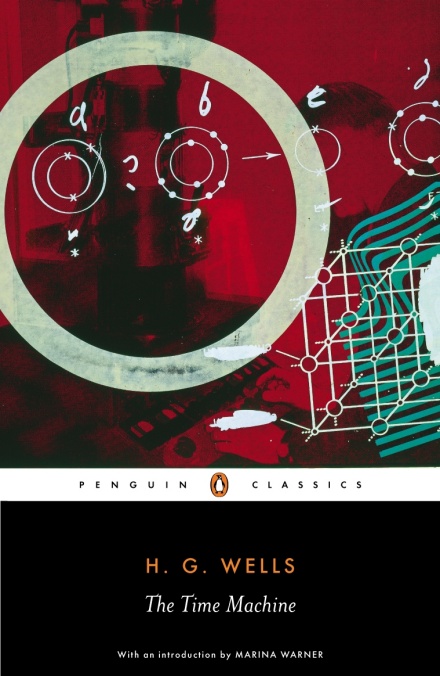
The Time Machine is one of H.G. Wells’s earliest works and as the title suggests a story about time travel. We are introduced to the Time Traveller and his guests at their weekly dinner in his home and laboratory. On this particular night after a rousing discussion on Time and Space and whether time travel is possible he surprises them with a model of his time machine, the full scale machine residing in his basement. At the next week’s dinner he shows up late, dirty, worn and distracted revealing that he took the time machine into the future! His guests are incredulous and disbelieving and clamor for details. Telling them he must clean up first he leaves the room.
The Time Traveller’s story is marked by first assumptions that prove mostly false. In fact, Wells structures the book so that we follow the Time Traveller as he meets each fork in the proverbial quest to understand the society into which he has been propelled.
As he comes into contact with what turns out to be the first of two groups of people in this future world and begins to grasp their simple language, he is confused and disappointed as to what humans have become. The Eloi, as they are called, are child-like in their activities and imagination, spending their days playing games, picking flowers and generally living without a purpose.
For a moment I was staggered: were these creatures fools? You see I had always anticipated that the people of the year Eight Hundred and Two Thousand odd would be incredibly in front of us in knowledge, art, everything. Then one of them suddenly asked me a question that showed him to be on the intellectual level of one of our five-year-old children—asked me, in fact, if I had once come from the sun in a thunderstorm!
He continues to piece together this civilization from what he can observe. He is surprised that they all seem to live and sleep together in great halls, where they also eat communally. But there are no gadgets, no appliances, no machinery for cooking or cleaning.
Yet these people were clothed in pleasant fabrics that must at times need renewal, and their sandals, though undecorated, were fairly complex specimens of metalwork. Somehow such things must be made. And the little people displayed no vestige of a creative tendency. There were no shops, no workshops, no sign of importations among them. They spent all their time in playing gently, in bathing in the river, in making love in a half-playful fashion, in eating fruit and sleeping. I could not see how things were kept going.
While surveying the land, the Time Traveller has noticed towers and has come upon wells, but is unclear as to their purpose. He periodically sees creatures darting past trees, bushes and buildings through the shadows during daylight hours. Where do these creatures live? By deduction of their white skin he puts two and two together and surmises that the towers are a ventilation system and they must live underground.
He finds a deep well with bars on the sides for gripping and climbs down. He hears machines and uses a box of matches found in his pocket to light his view. He sees large machine-like shapes and smells fresh blood. “Some way down the central vista was a little table of white metal, laid with what seemed a meal. ‘They …were carnivorous!’ ”But he couldn’t identify the large animal. As he moves through the corridors of this space, more and more of the Morlocks, as this species is known, are gathering around him and some are touching and pulling his arms. Their claim on him makes him sick. As the Morlocks close in on him, he lights a match, finds the climbing bars of the shaft and hurries up out into the sunlight.
As the Time Traveller recovers he tries to figure out how society split into these two groups. The Upperworld people might once have been the favored aristocracy, and the Morlocks their mechanical servants; but that had long since passed away….The Eloi…had decayed to a mere beautiful futility….The Morlocks made their garments, I inferred, and maintained them in their habitual needs…And suddenly there came into my head the memory of the meat I had seen in the Underworl….Like the cattle, they [the Eloi] knew of no enemies and provided against no needs. And their end was the same.
So this is the future. A Wellsian commentary on a successful society that degenerated turning people into predator and prey, carnivores and fruitarians; where the workers of the Underworld were actually the more advanced than the happy layabouts of the Upperworld.
…There is no intelligence where there is no change and no need of change. It was the necessity of food for the Underworlders, who were in contact with machinery that kept their initiative. [for] being in contact with machinery…still needs some little thought outside of habit…
This book really made me think about my own fantasies of the future. Even though the Time Traveller’s first assumption about the Eloi were not quite correct their image has stayed with me. I am not alone in hoping the future is much less violent and unequal than it is now. I think of an evolved state of peace, creativity, imagination and advances in medicine and science that gives us ease and health to the highest degree. I think of a spirituality that has so connected us to the Divine through individual and group experiences with It that we don’t fight and argue over religion anymore.
But I have never thought that if we are all so free, comfortable and taken care of we would become stupid, lacking in drive, initiative or creativity, because there is nothing spurring us on to fix or cure or comfort or make better. What a depressing notion…or maybe a warning?
 Classic Laurie