
Work is wholesome, and there is plenty for everyone; it keeps us from ennui and mischief, is good for health and spirits, and gives us a sense of power and independence better than money or fashion.
I like good strong words that mean something, replied Jo.
Apparently, Louisa May Alcott was not happy when her publisher asked her to write a “girl’s book.” She wanted to publish a collection of short stories and didn’t think she could write a successful book for girls. Nor did she enjoy writing it. “I plod away,” she wrote in her diary, “although I don’t enjoy this sort of thing.” After showing the completed manuscript to several girls, who found it “splendid,” Little Women was published to great success and to a surprised Alcott.
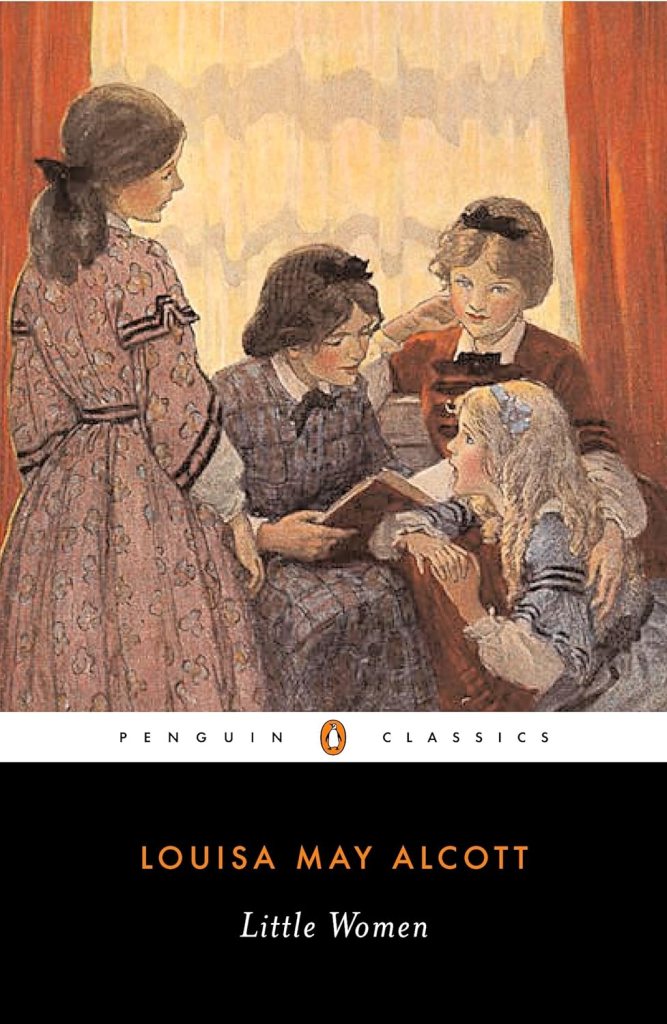
This was a first-time read for me and it was a slow process. I found myself totally immersed in the lives of the characters, each page rich in both the large and minute details of the daily life of the March women: pretty Meg is 16, plump and fair, with white hands, of which she was rather vain; Jo at 15 was slim and tall, with gray eyes that saw everything, a flyway look to her clothes and the “uncomfortable appearance of a girl who was rapidly shooting up into a woman and didn’t like it;” 13 year-old Beth was shy, but with a peaceful demeanor and was called ‘Little Tranquility’ by her father; the youngest is 12 year-old Amy, blue eyes, yellow hair and a very high opinion of herself. And of course, Marmee, Mrs. March, helping her girls to live and grow as best they can while feeling the absence of their chaplain father away on the front lines (of the Civil War).
If had to sum up in one sentence the theme of the book, I would say it is a morality tale for young women; how to know yourself, what makes you tick so that you can be a better person. So, it was fascinating to watch each daughter’s life journey, each one so different from the other bring their trials, questions, flaws in their character to their mother and with Pilgrim’s Progress as their guide (why is it that one book always leads to another?!) overcome these deficits or ‘burdens’ in their personalities and become independent grown women.
Marmee never scolded or condemned their behavior, but saw each challenge as something that kept them from living up to their best self. And through the normal jealousies, hurt feelings, missteps, growing pains, revelations of truth brought each daughter to her highest self.
So much interested me in this book that I imagine this will be the first of many posts. These are some of the things that struck me.
- Jo is continually described in masculine terms. She acts “gentlemanly,” she is described as “the man of the family.” Jo is like a boy because she is blunt in her words. Laurie calls her “my dear fellow.” However, these epithets are never used as a mockery or said in spite. They are merely descriptions of her behavior or personality. And it makes me wonder if this meant something different at that time than it does now where calling a woman ‘a gentleman’ has all kinds of negative associations and is often said in mockery toward certain types of women?
- Though most of the book centers on domestic life, Laurie’s and Amy’s travels in Europe helped both develop a direction for their lives in keeping with the knowing-yourself theme. As Amy says, “Foreign life polishes one in spite of one’s self….”
- The sympathetic defense of spinsters and old maids: “Don’t laugh at the spinsters, dear girls, for often very tender, tragic romances are hidden away in the hearts that beat so quietly under the sober gowns, and many silent sacrifices of youth, health, ambition, love itself, make the faded faces beautiful in God’s sight….and looking at them with compassion, not contempt, girls in their bloom should remember that they too may miss the blossom time; the rose cheeks don’t last forever, that sliver threads will come in the bonnie brown hair, and that, by-and-by kindness and respect will be as sweet as love and admiration now.
Gentleman, which means boys, be courteous to the old maids, no matter how poor and plain and prim, for the only chivalry worth having is that which is the readiest to pay deference to the old, protect the feeble, and serve womankind, regardless of rank, age, or color. Just recollect the good aunts who have not only lectured and fussed, but nursed and petted, too often without thanks; the scrapes they have helped you out of, the tips they have given you from their small store, the stitches the patient old fingers have set for you, the steps the willing old feet have taken, and gratefully pay the dear old ladies the little attentions that women love to receive as long as they live.”
- Limes! Who would ever think elementary school popularity was contingent upon the ability to provide limes to your friends? As Amy explains to Meg: “The girls are always buying them, and unless you want to be thought mean, you must do it, too. It’s nothing but limes now, for everyone is sucking them in their desks in the schooltime, and trading them off for pencils, bead rings, paper dolls, or something else, at recess. If one girl likes another, she gives her a lime; if she’s mad with her, she eats one before her face, and doesn’t offer even a suck. They treat by turns, and I’ve had ever so many but haven’t returned them, and I ought, for they are debts of honor, you know.”
- Titles of books. A nice piece of cultural and literary history to see what books were read at this time or which authors were important to a character. I caught The Vicar of Wakefield, Ivanhoe, Uncle Tom’s Cabin, Fanny Burney and her Evelina, and of course the importance of Pilgrim’s Progress throughout the book.
- Beth’s (Louisa’s?) thoughts on death. “Simple, sincere people seldom speak much of their piety, it shows itself in acts rather than in words, and has more influence than homilies or protestations. Beth could not reason upon or explain the faith that gave her courage and patience to give up life, and cheerfully wait for death. Like a confiding child, she asked no questions, but left everything to God and nature, Father and mother of us all, feeling sure that they, and they only, could teach and strengthen her heart and spirit for this life and the life to come.
- Amy Gets Snubbed at Mrs. Chester’s Fair Or Mean Girls Fail to Kill Amy’s Spirit.
Amy was to have the front table at the charity fair to sell her art, but due to circumstances beyond her control (Jo’s imitation of May Chester which put Mrs. Chester off), her table was moved to a less than prominent location and May was given the front table for her work. It would have been Amy’s right to be mad or to even retaliate, but Amy was resolved to participate and keep up the best possible attitude. In the end, May didn’t have enough pieces to fill the table and Amy offered to put back her work, although she was not asked to sit at the table. The pieces sold well and the fair itself was a great success. Her sisters knew what she had been through and praised her for it. “You laugh at me when I say I want to be a lady, but I mean a true gentlewoman in mind and manners, and I try to do it as far as I know how. I can’t explain exactly, but I want to be above the little meannesses and follies and faults that spoil so many women. I’m far from it now, but I do my best, and hope in time to be what Mother is.”
I have to laugh as I was taught once again that familiarity with a film adaptation (the Hepburn version is my favorite) does not do a book justice. I thought I knew this story, but it was just a tiny portion.
As it is summer, let me end on this wise gem from Jo, whose big outdoor hat Meg put the kibosh on by saying, “Oh Jo, you shall not make a guy of yourself.”“I just will, though, for it’s capital—so shady, light and big. It will make fun, and I don’t mind being a guy if I’m comfortable.”
 Classic Laurie