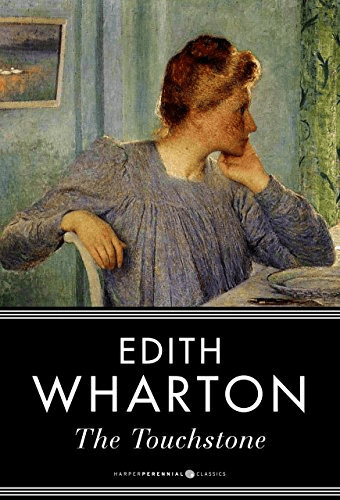
The Touchstone (1900), Edith Wharton

The Touchstone sets up a moral dilemma for Stephen Glennard, whose career is floundering making it impossible to marry the woman he loves. He is resentful of his contemporaries who always find a place at someone’s dinner table or invitation to the opera, while he has to calculate cab fares, clothing and food to make ends meet sacrificing the important contacts that could improve his life.

But one evening when at his club his eyes light on a name in a headline. Someone is soliciting information on Margaret Aubyn, a woman he had a relationship with. It ended when she left for England, though she continued to write to him for many years. The article states specifically, “She had so few intimate friends…that letters will be of special value.” Glennard has hundreds.

A friend helps him find a publisher for the letters, he being the go-between that keeps Glennard’s name out of any correspondence or notoriety. Based on the projected windfall, he marries Alexa Trent. They move to suburban New York City and for a year all is calm. When the letters are published Glennard is shocked to learn of the sympathy most readers, and his social circle, feel toward Margaret Aubyn. Slowly his conscience begins a slow downward spiral of guilt and for a time is haunted by her presence. He fears exposure and the reaction of his wife, who seems to have taken on a kind of protective stance against the exploitation of this woman.

The story had me glued to the narrative until the very last sentence, because the outcome was never assured. Wharton does not give the reader a firm conclusion to either Glennard’s guilt or Alexa’s acceptance. This is not a spoiler, this is pure Wharton!

My Antonia (1918), Willa Cather

More than any other person we remembered, this girl seemed to mean to us the country, the conditions, the whole adventure of our childhood. To speak her name was to call up pictures of people and places, to set a quiet drama going in one’s brain. 

Willa Cather is an incredible nature writer. She loses me to my imagination as she describes winter, the spring, summer and autumn through the hardships and triumphs of the old and new Scandinavians and Bohemians (Czechoslovakia) who have settled in the Nebraska prairie. Hoping to escape the poverty of the old country, some make a good go of it as they get to know the personality of this new land. But some refuse to adapt from the old ways and wallow endlessly in debt, depression and disease. The first generation tries to help the newcomers and there is some success, but there are always holdouts, too stubborn to take risks, try new methods or respect the different personality the seasons have here.

This book is so much about the land. The land as a wild mystery to the new immigrant farmers, but also as beauty and familiarity to the generation that settled before. This generational divide is a marked characteristic of this book.

Told as a reminiscence about his life on the prairie after he is orphaned, Jim Burden is sent from New York to live with his grandparents on their farm in Nebraska. He brings the struggles, the love and tragedies of the myriad characters to life, including his Ántonia, an independent Bohemian girl, who embodied the best and the worst of the old world and the new.

As we walked homeward across the fields, the sun dropped and lay like a great golden globe in the low west. While it hung there, the moon rose in the east, as big as a cart-wheel, pale silver and streaked with rose color, thin as a bubble or a ghost-moon. For five perhaps ten minutes, the two luminaries confronted each other across the level land, resting on opposite edges of the world. In that singular light every little tree and shock of wheat, every sunflower, stalk and clump of snow-on-the-mountain, drew itself up high and pointed, the very clods and furrows in the fields seemed to stand up sharply. I felt the old pull of the earth, the solemn magic that comes out of those fields at nightfall. 

Sometimes I went south to visit our German neighbors and to admire their catalpa grove, or to see the big elm tree that grew up out of a deep crack in the earth….Trees were so rare in that country, and they had to make such a hard fight to grow, that we used to feel anxious about them, and visit them as if they were persons. 

When Spring came, after that hard winter, one could not get enough of the nimble air. Every morning I wakened with a fresh consciousness that winter was over. There were none of the signs of spring for which I used to watch in Virginia, no budding woods or blooming gardens. There was only—spring itself; the throb of it, the light restlessness, the vital essence of it everywhere; in the sky, in the swift clouds, in the pale sunshine, and in the warm high wind—rising suddenly, sinking suddenly, impulsive and playful like a big puppy that pawed you and then lay down to be petted. If I had been tossed down blindfolded on that red prairie, I should have known that it was spring.

The Marne (1918), Edith Wharton

Whither thou goest will I go, thy people shall be my people…” Yes, France was the Naomi-country that had but to beckon, and her children rose and came.

Edith Wharton had been living in France for many years when WWI began. Like many in Europe, Wharton was frustrated and angry at America’s reluctance to enter the war and The Marne was written in response. The main character, Troy Belknap, is her voice against this hesitation, a call to save what she has come to love. This is a very emotional Wharton that I have not seen before. Through Troy, whose yearly visits to France with his parents, has  given him a love for the country, there is something very personal that Wharton brings to this story.

Troy is very young when he first summers in France. His parents arrange a tutor for him in all the subjects that interest him and every year he sees this same tutor, Paul Gantier. As he grows older, his friendships and enjoyment with his studies grow. It is an easy life of long motor drives, sightseeing, archaeological trips and the lovely sights to stoke a precocious imagination.

As the family travels each summer they often stay in the same hotels and inns and Troy has become very attached to one particular family and looks forward to seeing them every year. He has an insatiable urge for knowledge and getting the most out of his summers in France. He calls France, “his France.” His love for the country is deep in both the past and present, loving history as well as attentive to the people he meets wanting to know their story. He is devastated the summer the Germans begin their march toward Paris when his tutor has to leave him to fight. He is too young to go himself and is angry that the US has not stepped in.

His family, like many foreigners, are stranded once the fighting begins. Some are able to get to England, but find the same issue there. Wharton does not hold back her contempt at the utter narcissism that they feel their plight should be taken into consideration above all others-“…We’ve really spent enough money in Europe for some consideration to be shown us…” For the first time in their lives they are asked to think of others and rather than see where or how they could help the country they use for status and reputation at home, they are indignant they aren’t taken into consideration first. Troy is outraged at their egotism spends as little time as possible with them.

The misery of feeling himself a big boy, long-limbed, strong-limbed, old enough for evening clothes, champagne, the classics, biology, and views on international politics, and yet able to do nothing but hang about marble hotels and pore over newspapers, while rank on rank, and regiment on regiment, the youth of France and England, swung through the dazed streets and packed the endless trains—the misery of this was so great to Troy that he became, as the days dragged on, more than ever what his mother called callous, sullen, humiliated, resentful at being associated with all the rich Americans flying from France.

Once back in New York City a sort of ‘one-upmanship’ is occurring with these same people who complained that they were not given priority in leaving, but are now telling anyone who would listen about their privations and hardships.

“The tragedy of it—the tragedy—no one can tell who hasn’t seen it and been through it,” Mrs. Belknap would begin, looking down her long dinner table between the orchids and the candelabra; and the pretty women and prosperous men would interrupt their talk, and listen for a moment, half absently, with spurts of easy indignation that faded out again as they heard the story oftener. As more of the once stranded civilians return home they have fresh tales to tell and Mrs. Belknap finds herself out-storied, out-charitied, and out-adventured. She is pushed aside to make room for others, people want something newer….

As soon as he turns 18, Troy returns to France as an ambulance driver. And one day he is met on the road by a truck load of American soldiers. America has finally joined with France and England against Germany! “There they went, his friends and fellows, as he has so often dreamed of seeing them, racing in their hundreds of thousands to the rescue of France; and he was still too young to be among them, and could only yearn after them with all his aching heart!”

But at the last moment, one of the trucks stops and a young man calls out to him to hop in the truck, “come and help!” And just like that Troy, without a moment’s hesitation, leaves the ambulance and becomes a soldier. As the truck rolls on he is given some instruction, though he is also filled with guilt about leaving his position. At the first battle he is wounded and brought to a field hospital. Regaining consciousness it turns out that was the great Battle of the Marne. The Allies had pushed back the Germans and the advance on Paris has been checked! But the oddest thing happened. Troy’s wound was severe and in semi consciousness he saw Paul Gantier, the young man who had been his childhood tutor, lift him up until he felt himself floating. Regaining consciousness at the hospital, the medics told him that his rescue had been incredible, but that no one knew his rescuer, not his name or where he had gone to. And then he just disappeared. A stunned Troy held his tongue-his tutor had died near the beginning of the war….

Published in 1918 with battles still raging, this is more a book about the attitudes at the home front than the war itself. And with the war still on, this book is published as a type of propaganda, guilt propaganda if there is such a thing, I would call it. And perhaps not directed at middle America, but to those of the upper classes who can make a difference, the ones who call the shots and who supposedly love France. 

Wharton wrote another novel about the war and a few nonfiction. I will get to those at some point and will be interested to see if they are as passionate.

There had never been anything worthwhile in the world that had not had to be died for, and it was as clear as day that a world which no one would die for could never be a world worth being alive in.

Every stone that France had carved, every song she had sung, every new idea she had struck out, every beauty she had created in her thousand fruitful years, was a tie between them that all civilization was bound up in her, and that nothing that concerned her could concern her only.

For France was his holiday world, the world of his fancy and imagination, a great traceried window opening on the universe. And now, in the hour of her need, all he heard about him was the worried talk of people planning to desert her!

The Fruit of the Treed (1907), Edith Wharton

Human life is sacred,” he said sententiously.

“Ah, that must have been decreed by someone who had never suffered!” Justine exclaimed.

The Fruit of the Tree is a departure from most Edith Wharton novels that deal with the superficiality and hypocrisy of the lives of the upper class. While that plays a role here, the novel concentrates on the life of factory assistant manager, John Amherst, whose interest in bettering the conditions of the workers put him at odds with the wealthy owners. He is in a constant battle of explaining the evils of exploitation and the benefits of humane working conditions to the Westmore family who are not supportive

Now, young Richard Westmore, the owner of the mills, has died and his wife is named heir and overseer. When John Amherst and Bessy Westmore meet for the first time, he takes her on a tour of the factory and she meets some of the laborers. As they explain their jobs she sees through Amherst’s explanations that the dangers they are confronted with could be mediated by more updated equipment and a different philosophy of production. She is shocked by a recent accident on the factory line that left a young family man hospitalized, whose livelihood is now in jeopardy. John continues to speak of the morality of a working environment that is clean and safe, where the workers don’t have to come in sick because they have medical care or worry about their babies due to onsite child care and where adult education gives them opportunity for advancement. 

As John and Bessy fall in love it is more than an opportunist’s dream for John who is convinced he has turned Bessy from a disinterested carefree young woman to his partner in humanizing the lives of the people she has become responsible for. But the first blush of altruism for Bessy begins to fade when she realizes the time that must be spent “working” though she is still supportive of John’s aims and goals.

When Bessy’s childhood friend, the idealistic nurse Justine Brent, meets John at the bedside of an injured worker conflict arises between the three.

The marriage between John and Bessy is never peaceful. Bessy’s business advisors, friends of her deceased first husband, are always at odds with John’s plans for the factory and are constantly challenging her to stop him. They tell her that she should be concerned with the financial outlay and that John’s ideas do not guarantee a return on the money. When a horse riding accident puts her life in jeopardy any support for John and the factory wanes. John never loses his motivation for reform, though, and tries to press on. He has also lost the encouragement of Justine whose own life takes a turn when she makes a devastating decision prompting her to leave.

Thoughts

Wharton tackles many social and personal issues in this novel. One in particular reminds me of The House of Mirth. Without giving away an important plot twist, she has a character deal with the problem of chronic pain and the medical use of drugs. When Wharton was writing The House of Mirth she went to a chemist to understand sleeping draughts and their potency. She asked how a person would know to increase the dosage without killing themself. While the question in that novel considers a death by suicide or natural causes, the question in this novel is the morality euthanasia.

Wharton always draws her characters with such depth. It is easy to understand, though not always easy to agree on their motivations and here it is no different. John Amherst is committed to factory reform against all the odds thrown at him. Bessy grew up a typical materialistic girl, but has a big heart that has been opened to the inequities of real life. She struggles to do the right thing, but it is not easy for her, especially after she understands that John’s commitment to his beliefs infringe upon the luxuries she is accustomed to. Justine just wants everyone to be treated fairly, but comes up against the harsh lessons that being a woman of the working class entails. Suffice it to say, there is no happy ending for anyone in this novel, but perhaps with the passage time all the roughness with will smooth out….

But life is not a matter of abstract principles, but a succession of pitiful compromises with fate, of concessions to old traditions, old beliefs, old charities and frailties….And she had humbled herself to accept the lesson, seeing human relations at last as a tangled and deep-rooted growth, a dark forest through which the idealist cannot cut his straight path without hearing at each stroke the cry of the severed branch, “Why wounded thou me?”

Her world, in short, had been chiefly peopled by the dull or the crude, and, hemmed in between the two, she had created for herself an inner kingdom where the fastidiousness she had to set aside in her outward relations recovered its full sway. There must be actual beings worthy of admission to the secret precinct, but hither to they had not come her way; and the sense that they were somewhere just out of reach still gave an edge of youthful curiosity to each encounter with a new group of people. 

“I’ve no head for business—but I will try to.”

“It’s not business that I mean; it’s the personal relationship—just the thing the business point of view leaves out. Financially, I don’t suppose your mills could be better run; but there are over seven hundred women working in them, and there’s so much to be done, just for them and their children.”

“I have always understood that Mr. Truscomb did everything—“

“Do you leave it to your little girl’s nurses to do everything for her?”

Sister Carrie (1900), Theodore Dreiser

Nature is so grim. The city, which represents it so effectively, is also so grim. It does not care at all. It is not conscious. The passing of so small an organism as that of a man or woman is nothing to it. 

Carrie Meeber, or Sister Carrie as her family calls her, is a common type of her day—the small town girl, usually from the Midwest, who sets out to the big city to try her hand at independence before marriage, to send money home or to escape the strictures of domestic life altogether. Once in the city these young women are often rudely awakened and unprepared for the ruthlessness by which people exist, often falling into the temptation of making money at any cost. 

New industries springing up lure young and inexperienced women with promises of a steady paycheck, the thing they came to the city for in the first place. But once on the payroll they are exploited by long hours and tedious work with no real prospects of change. The thought of going back home is humiliating after being sent off by enthusiastic hopeful families. The only recourse besides marriage, if she can find a good man, is to harden herself to the exploitation and accept the challenges to her sexual and moral values.

Published in 1900 and one of the best books I’ve read this year, Sister Carrie tells the story of Carrie Meeber, who is fresh off the train from a small town in Wisconsin. She has come to Chicago to live with her sister’s family and to find work and a better life.

1893 Chicago World’s Columbian Exhibiton

She finds, however, that her enthusiasm and naivete for this new life has prevented her from realizing she has no skills, so she is only suited for the repetitive tedium and physical stress of factory work. A prolonged illness forces her to quit and her sister and brother-in-law threaten to send her home if she can’t financially contribute.

Life never really stabilizes for Carrie, even though she is rescued by a kindhearted salesman she meets on the train from Wisconsin, who sets her up in an apartment of her own. Though he is kind, it is assumed they will marry. But Carrie is swept off her feet by a wealthy sophisticated older, but married man, who promises her a secure loving future, although he keeps putting her off. In a moment of unpremeditated greed, he commits a crime and they escape from their obligations in Chicago.

Through several years on the run and with a deteriorating relationship and finances Carrie is fed up with being taken care of by others. Now in New York City, she tries her hand on the stage and in no time is the darling of the theater world with an income that gives her the material security she’s never known. Will she be happy and finally content?

Central Park

Dreiser writes a gripping and realistic narrative, peopled by those affected by the drudgery and monotony of factory life as well as those whose wealth is second nature.

The cities, too, of Chicago and New York are like secondary characters with mood swings of temperature and climate, of a humanity of impersonality and uncaring hearts. Both direct the course of daily life when thread bare clothes and holey shoes are no match for winter and a trek to a job is impossible; they kill, literally, when flop houses are booked for the night, bodies packed tightly in dirty beds or when a man is just pennies short of the fee and forced to spend the night in the elements. To survive seems like a combination of determined grittiness and just plain luck. A memorable, sad and poignant story.

Lower East Side

Dreiser’s Background

The inspiration for this novel comes from Dreiser’s own experience of coming to the city to make his fortune. Moving to New York to live with his sister, he experienced great difficulty in finding work. After a day of futility and disappointment—this was during the depression of 1893-94—he sat down on a park bench and found himself observing other men, the down and out, also looking for work. He had been introduced to the concept of social Darwinism and he began to imagine a society in which corporations and the control they had over workers, led to a City version of survival of the fittest. And Carrie Meeber was born.

“All men should be good, all women virtuous. Wherefore, villain, hast thou failed?”

“The long drizzle had begun. Pedestrians had turned up collars and trousers at the bottom. Hands were hidden in the pockets of the umbrella-less – umbrellas were up. The street looked like a sea of round, black-cloth roofs, twisting, bobbing, moving. Trucks and vans were rattling in a noisy line, and everywhere men were shielding themselves as best they could.”

“The nature of these vast retail combinations, should they ever permanently disappear, will form an interesting chapter in the commercial history of our nation.”

“She looked into her glass and saw a prettier Carrie than she had seen before; she looked into her mind, a mirror prepared of her own and the world’s opinions, and saw a worse. Between these two images she wavered, hesitating which to believe.”

Herland (1915,1979), Charlotte Perkins Gilman

There was no accepted standard of what was ‘manly and what was ‘womanly.’…When Jeff said to Celis, “Women should not carry anything…they are not built for heavy work. Celis looked out across the fields to where some women were working, building a new bit of wall out of large stones; looked back at the nearest town with its woman-built houses; down at the smooth, hard road they were walking on; and then at the little basket he had taken from her. “I don’t understand, are the women in your country so weak that they could not carry such a thing as that?[i]

I was so disappointed by Edward Bellamy’s depiction of women in his utopian novel, Looking Backward, that I found myself pining for a more positive view. I remembered I had Herland on my shelf and pulled it off only to find in the introduction the author was inspired by Bellamy! Charlotte Perkins Gilman was already known for her autobiographical,  The Yellow Wallpaper, which exposed the chilling and harrowing methods of the ‘rest cure’ forced on some women when depression and the inability to cope made living impossible. Surely, she had a more affirmative and supportive concept about women in her utopia?

Happily for me, Herland presents a stable and progressive environment, a well-planned framework for a new way of life. The novel, in a parallel to  Looking Backward, is based around conversations, in this case, between the three male explorers and their three female teachers.

The plot is simple enough. Three young men, Terry the rich boy, Van the sociologist and Jeff the doctor and friends since college have joined an expedition somewhere in Central or South America, the exact location is not made clear, where the native guides tell tales of a land of women high up in the mountains where there are no men or male children. One of the guides shows them a piece of cloth made with extraordinary skill that looks nothing like the work of local people. The three men vow to come back and find this land which they do a year later.

And the tales they heard are true. It IS a land of women, who have created a country of beauty, peace, culture and education without the aid of men. And poor Terry, who is certain the women have been waiting centuries for him ,spends the entire trip trying to prove it, but to no avail. Van and Jeff are eager to learn and understand the history and society of the country and it is through conversations with their three teachers, Zava, Moadine and Somel that we learn how the land came to be.

Two thousand years ago, after a series of wars, though they built fortresses and had skilled warriors, the men were unable to stave off attacks from other tribes and all were killed. This left women, young girls and old slave women as the only inhabitants when the final blow, a volcanic outburst, sealed off the pass below and penned them up against the mountains. There was no escape. After the initial despair where some women suggested suicide, the majority made the decision to live. The slave women taught them invaluable skills and they learned to work the tools and equipment of various trades. They had records and archives with their history, which they learned and added to as the centuries went by.

But the question had to be asked: if there were no men for two thousand years, how did they populate? For about 10 years after they were sealed in by the volcano, the remaining women plucked up the courage to plan a future as best they could. They cleaned up the land by working together and grew strong and wise and more and more mutually attached, until a miracle occurred: one young woman bore a girl child… a direct gift from the gods, they believed. She bore four more—all girls. The miracle continued as each woman, upon reaching the age of 25, bore her first child, until she, too, had five. But as the centuries passed and overpopulation threatened the land, the process settled on one child a piece.

“Babies are raised communally after a year spent with their mother, though even then, the mother is never far from her child. School and education is an environment calculated to allow the riches, freest growth….”[ii]

The children grow up in a system of education that draws out their talents and abilities to things they love and are good at so when they enter the work force work is a delight and a joyous contribution to the nation. This notion that education is for discovering what we’re good at and love is like Bellamy’s system, except that his excludes women, whose highest contribution to society is to procreate, with ‘careers’ only auxiliary, not part of the needs of the nation.

I should mention here that in Herland, motherhood, too, is lauded as the supreme achievement with babies loved and adored by the whole community. However, it is acknowledged that not every woman will have or want to have a child, a decision that is honored and respected. In Bellamy’s new world as in his real 19th century world, a woman who does not want to have children is looked on with derision, even suspicion.

It may be that Gilman’s perspective on motherhood is also a reflection of her ideas about women and work and the insistence that women have choices over their life. This may have also been a reaction against the criticism Gilman received when she gave up her daughter to be raised by her first husband so she could concentrate on her work. He remarried her best friend and the three were close, but the act of voluntarily giving up her child for such a “selfish” reason was looked upon as extremely “umotherly.”

Gilman also explores femininity in Herland. The women here are not ‘feminine’ in the way Terry, Van and Jeff are accustomed. It is confusing enough for them that society functions just fine in every area without men and Gilman uses this as a platform to explore this new womanhood. The three are educated about Herland for months together and individually by their three teachers, Zava, Moadine and Somel, whom they affectionately call “The Colonels.” The lack of sexual dynamics and their notions of femininity are confusing to the men. That the women of Herland created a land of peace and plenty, built streets and edifices, figured out food sources and methods of feeding 3 million people, developed laws and education without the guidance and organization skills of men, is an almost impossible concept for Terry, Van and Jeff.

Van: “Here you have human beings…but what we were slow in understanding was how these ultra-women, inheriting only from women, had eliminated not only certain masculine characteristics…but so much of what we had always thought essentially feminine….The tradition of men as guardians and protectors had quite died out. These stalwart virgins had no men to fear and therefore no need of protection.”

Terry, with sarcasm, “It’s likely women—just a pack of women—would have hung together like that! We all know women can’t organize—that they scrap like anything—are frightfully jealous.”

Jeff: “But these New Ladies didn’t have anyone to be jealous of, remember?”[iii]

What a blow to Terry who is observing a land where he is not needed and that frankly works better without men!

And in fact, Terry, the prized catch of manhood in his former life has the most difficult time. I think Gilman uses him to illustrate every sexist and chauvinistic word men ever said about women! Even after the men are accepted into society, learn the language and are educated on the history of the county, Terry refuses to accept that a country can actually exist without men and that in truth, the women MUST have been waiting just for him. As imagined, he causes the most problems, cannot accept what he sees and longs to get home to ‘real women.’ In a remarkable observation Van says, “those feminine charms we are so fond of are not feminine at all but mere reflected masculinity—developed to please us because they had to please us and in no way essential to the real fulfillment of their great process.”[iv]

Gilman explores many aspects of society, including religion

…they had a clear established connection between everything they did—and God. Their cleanliness, their health, their exquisite order, the rich peaceful beauty of the whole land, the happiness of the children, and above all the constant progress they made—all this was their religion….They applied their mind to the thought of God, and worked out the theory that such an inner power demanded outward expression. They lived as if God was real and at work within them.[v]

And relationships, because of course, there is romance! But between whom and whether they stay in Herland would be a spoiler, so you’ll have to read the book to find out. Hint: Poor Terry….

That this beautiful, stable, evolving world exists because women are cooperative with each other, that they are smart, are able to take their talents and abilities both physical and mental to their highest potential, have created culture and art is what Charlotte Perkins Gilman, writer and feminist, was working for in 19th/20th century America. It is hard to remember women once had to fight for the right to be smart and capable, to freely take their talents and abilities as far as they could, to create whatever kind of life they wanted.

It makes me laugh, knowing all I do now, to think of us three boys—nothing else, three audacious impertinent boys—butting into an unknown country without any sort of a guard or defense. We seemed to think that if there were men we could fight them, and if there were only women—why, they would be no obstacles at all.[vi]

Was Herland a reaction to Looking Backward? Or Gilman’s singular attempt to design a world where women were not only safe from the violence of men, they were also physically competent and smart and educated enough to build and care for their own society? Looking forward, taking the best from both, they have the potential to create a good decent society where each person is valued for their individuality, yet part of the whole.
The Bunner Sisters (1916), Edith Wharton

The Bunner sisters were proud of the neatness of their shop and content with its humble prosperity. It was not what they had once imagined it would be…and it was long since their hopes had soared higher.

Edith Wharton is known for her sharp observations about the excesses of the upper classes and expats of New York during the turn of the last century, but in the Bunner Sisters she turns her attention to working class shop owners and their day to day survival.

In novella form, this is a story about two sisters who are just scraping by with their small hat shop on a side street in a fading area of New York City. Ann Eliza, the oldest and Evelina the younger are loving and supportive of each other until Herman Ramy, who owns a clock repair shop, comes on the scene. As he gets to know the sisters he settles on Ann Eliza and proposes, but she tells him she has vowed never to marry. It is an easy switch for him to the younger sister, who does not know about the previous proposal.  They marry quickly and he spirits her off to St. Louis where he has been offered a job. 

Ann Eliza has given Evelina her share of the money they had saved up when her sister tells her how expensive St. Louis is and that Ramy will not get a raise until he’s been on the job for many months. Alone for the first time in her life Ann Eliza does the best she can, but without another person to run to other shops for supplies and food, it becomes challenging.

When her sister’s letters stop coming she fears the worst. Spending the little money she has she goes to St. Louis. Remembering the name of the shop in which Ramy was supposed to be working she finds he was fired for opium addiction and the owner has no idea where he is now. So Ramy wasn’t sick, which was one of the reasons the sisters felt sorry for him; he was addicted to opium even them. Ann Eliza returns to New York City fearing her sister is lost forever. When Evelina finally shows up alone, she has a harrowing story to tell.

Wharton packs such an emotional punch in her novellas that I always feel like I have been put through a ringer! This affected me similarly.

The Great Gatsby (1925), F Scott Fitzgerald

They were careless people…they smashed up things and creatures and then retreated back into their money or their vast carelessness, or whatever it was that kept them together, and let other people clean up the mess they had made…. 

If I didn’t feel obligated to read this book for Jazz Age June, I probably would have stopped reading it at some point–not because it was boring, badly written or uninteresting. It’s because it made me feel empty, just like the characters the book portrays. I am a visceral reader and an emotionally affected reader. I just didn’t want to feel so void of the life force as I turned page after page. But The Great Gatsby is so well-regarded as an anthem to the Jazz Age, the quintessential look at the Roaring Twenties, that I felt it right to finish. And I suppose, in the end, I am glad I did.

The book is narrated by Nick Carraway, who moves into the house next door to Jay Gatsby in West Egg, Long Island, New York. Gatsby is a mystery, both as to his present life and his past. Almost everything anyone knows of him can be contradicted by what the next person thinks he knows. Is he an Oxford man or not? Did he fight in the war or was he really a German spy? “He’s a murderer, you know.” “No, he could never have killed anyone.” His car is huge, his house is huge, his Saturday night parties fill his home to the brim with people he doesn’t know and he feeds them only the best food. But his business dealings are shady and probably illegal and no one really knows how he makes so much money.

Nick has a cousin, Daisy who lives with her husband Tom across the bay in East Egg. Tom is having an affair with Myrtle Wilson, whose husband owns the gas station in West Egg. Gatsby and Daisy were in love with each other five years ago, before he went off to war and so she married Tom, but both have carried a flame for each other ever since. Some of the more touching moments of the novel have to do with Gatsby’s nervousness in seeing Daisy for the first time in all these years, but their affair ends with a tragedy that almost feels like karma.

It’s funny how reading has gone for me this year. Several times I have read books back to back with main characters with the same first name, similar themes or similar odd word usage. This book and recently The Glimpses of the Moon have much in common theme-wise (and first name-wise) when it comes to relationships. I am not a prude and am all for finding true love, but in both these books the idea that marriage vows have meaning is certainly put to the adultery-test. And the bit of comical hypocrisy when Tom, who is having an affair with Myrtle, becomes incensed when he suspects Daisy is seeing Gatsby, is not lost on me.

There isn’t much narrative to the novel, except for the narrator, Carroway. He’s come to New York after college to start his accounting career and finds himself involved in the myriad dramas of the people around him. He is the moral one, the “good man,” the voice of the adult while the adolescents break the rules to their peril. They act like they’ve been shut up for years and finally found the way out of the chains of the straight and narrow prison that held their thoughts and feelings in check. Without restraints everything they do is in excess and through a restless lens. I couldn’t help but feel this emptiness in their motivations and that their hearts were devoid of the spark of life.

This novel supposedly illustrates the effect of the new found prosperity and personal freedom of post-war America in its loosening of boundaries between people in all aspects of life; the notion of the self-made and re-made “man” that is grander than anything before it. But with this freedom Fitzgerald shows that people can act with incredible selfishness and indecency leaving human wreckage in their wake.

I found this a profoundly depressing book. Even though Nick is the shining light in an otherwise morally bankrupt universe, I am still left with a void. I find it hard to believe this book is the ‘quintessential social commentary’ of America in the 1920s. If that were really true how did we survive the decade!

Glilmpses of the Moon (1922), Edith Wharton

He knew on how frail a thread the popularity of the penniless hangs, and how miserable a girl like Susy was the sport of other people’s moods and whims. It was a part of his difficulty and of hers that to get what they liked they so often had to do what they disliked.

Nick Lansing and Susy Branch of The Glimpses of the Moon are the answer key to Lawrence Selden and Lily Bart in The House of Mirth, whose motivations and actions often confused me. Where the problems exist in Edith Wharton’s, The House of Mirth, The Glimpses of the Moon is its “redo.”

Wharton, who was born in New York City to a wealthy and prominent family, writes realistically of upper class society in the early 20th century piercing its contradictions and exposing its hypocrisy. She is also masterful at portraying another part of this society: the dependents, the bright, pretty things of wit and intelligence hoping to break into the community of the wealthy and achieve some level of stability and status.

When Nick and Susy meet they recognize kindred spirits. Both are charming, beautiful and likeable; the kind the wealthy enjoy having around to enliven parties and animate conversations. They live off the good graces of their rich friends and all expenses are paid whether for a weekend in the country or a 3-month tour of Europe. They first see each other at their mutual friends, the Fulmer’s, where Susy is staying. Nick has come to visit and after several days of conversation they realize they are in the same position in society, but might do much better as a couple. “I don’t know how you feel; a man’s popularity is so much less precarious than a girl’s–but I know it would furbish me up tremendously to reappear as a married woman.” They both know the ropes, can spot opportunities and will be a novelty as a married couple. “We’re both rather unusually popular–why not be frank?–and it’s such a blessing for dinner-givers to be able to count on a couple of whom neither one is a blank.” So they make a bargain that they will marry with the understanding that if either finds a better situation the other will release them.

And it works. Due to Susy’s calculations she has figured out they could honeymoon for a year all over Europe on the invitations of friends for whom lending their homes to the newlyweds is a happy prospect. And so their life together begins with their first stay in a villa in Italy owned by a close friend of Susy’s, Charlie Strefford. They entertain the wealthy of their set who pop by in their boats or buggies to spend afternoons at home or evenings out.

Next, they move on to the home of Nelson and Ellie Vanderlyn where on the first night Susy finds an unexpected complication to their stay. Not expecting either to be home, she assumed their daughter would be with them. But in a letter left by Ellie to Susy she apologizes for leaving their 8 year-old daughter Clarissa and hopes Susy will be a good friend and care for her. Then Ellie asks for another favor. There are several letters to her husband she would like to have mailed, one each week. The post-mark is from the house, which Susy realizes means Ellie and Nelson are not together and Nelson thinks Ellie is home…Susy is sick with worry, disgust and fear all night going back and forth as to what to do. Should she participate in this deception against Nelson, should she aid in Ellie’s adultery, should she tell Nick even though Ellie begs her not to?

In the morning, she is resigned to play the game: in order for her and Nick to live this luxurious life as guests of other people they will always have to do something distasteful in return and this won’t be the last time. She and Nick, as a matter of course, will always have to do the dirty work of others.

However, this is a revelation to Nick who is stunned when by accident he finds out about Susy’s part in Ellie Vanderlyn’s affair.

Well–doesn’t our being together depend on what we can get out of people? And hasn’t there always got to be some give-and-take?…You’ve lived among these people as long as I have; I suppose it’s not the first time–”

By God, but it is….I have never in my life done people’s dirty work for them–least of all for favours in return. I suppose you guessed it, or you wouldn’t have hidden this beastly business from me.”

And Nick’s final blow against Susy:

“You knew I wouldn’t have stayed here another day if I’d known.”

“Yes: and then where in the world should we have gone?”

“You mean that–in one way or another–what you call give-and-take is the price of our remaining together?

As if Nick had forgotten their bargain and the compromises and concessions they’d have to make, he tells her they must part.

The two separate and continue to live at their various friends’ homes continuing to miss each other yet too proud to confess. It is many months since they have seen each other and Nick has taken a position as a secretary to their mutual friends, the Hicks’ aboard their yacht and cruises the Mediterranean. It is assumed he will marry their daughter, Coral.  Susy finds herself receiving attention from her old friend Strefford whose wealthy relatives have died leaving him a wealthier man than when she stayed at his villa. It is assumed she will marry him.

The manner in which the newly married, now separated Lansings are treated among their friends is almost matter of fact. At this period, divorce is not the stain on a woman’s reputation as it was only a decade or so earlier. Both are free to marry when the divorce is final. Some of the characters, though, are very puzzled by the decision to divorce, and in a not so very subtle way tell Susy she can stay married and find love elsewhere.

Because everyone is doing it….having affairs, that is. For their upper class friends cheating on your spouse is practically an obligation or at least usual. Nelson Vanderlyn eventually finds out about Ellie and though devastated, it is short-lasting. At one point, Susy hears that Nelson, Ellie and her new man are all dining “cheerfully together.” In this world of wealth, position and family ties marriage is to secure riches and status, not because of love. And to be married for many decades to someone you may not particularly like is a tedious prospect. So spouses cheat, and if discovered let it go, because they are doing it themselves.

When Nick and Susy reunite, it is not to live as their friends do. The parting has forced them to give up their pride and say they love each other. They will not cheat as their friends do to keep the family fortune, as they know they will have no fortune. The difference between Nick and Susy and their friends is that they married for love. If only Lawrence and Lily could have said it….

O Pioneers! (1913), Willa Cather

The land belongs to the future….We come and go, but the land is always here. And the people who love it and understand it are the people who own it⁠—for a little while.

O Pioneers! tells the story of the Scandinavian, Bohemian and French immigrants who settled in the Nebraska prairies during the turn of the 20th century to farm, raise families and have the success impossible in the old country. But the land is harsh and uncooperative, the crops often fail and livestock die. Some families sell out and move to the city and some stay and try to tame the land. The Bergsons, who left Sweden 10 years prior, are one such family. As father Bergson is dying he gathers his children around him pleading with them to stay with the land; to follow the lead of their sister, Alexandra, to whom he leaves the farm and to make a go of it no matter what it takes.

But the difficulties aren’t only with the land. Alexandra is constantly fighting her brothers, Oscar and Lou, who see their neighbors leaving their farms and moving to the cities to work in factories. Alexandra will not give up on her promise to her father even when it looks grim. Drought and an unforgiving climate are not the only reason neighboring farms are failing; the tried and true methods of farming that worked in the old country are not relevant here. When Alexandra hears the communities “down river” are thriving she takes a trip to find out why. Upon her return she tells her brothers they have to sell their cattle and corn and buy up more land and they have to be open to innovation.

The rigidity in refusing to learn new farming methods as well as choosing different crops has raised another issue: gossip⁠—no one wants to make any innovation that their neighbor isn’t making. This fear of what others think affects many of the farmers including Oscar and Lou and they bring this up with regularity. But after her trip they see it is pointless to fight her; she has worked out all the financials and the new methods of tending the crops they will have to employ. Begrudgingly, Oscar and Lou accept Alexandra’s terms and after several years the farm is a great success

Parallel to the growth and success of the land the people also flourish. The courtings, marriages and children populate the land along with the crops. Alexandra herself is like the generative force of nature, a divine spirit who resolves conflicts not only about the land, but with her neighbors. She sacrifices personal love and family for the greater love of honor to her father and for the greater good of the community.

Under Alexandra’s counsel the land and the people flourish. She doesn’t try to fight the land or to force certain crops, she tries to understand its needs. To see the land as it is and to not be afraid to go against the traditions of the past makes her land bloom. And this is how she is with her neighbors, a Mother Earth figure resolving arguments with compassion and understanding. Under her benevolent, but firm hand, the land and the people prosper.

Her face was so radiant…For the first time, perhaps, since that land emerged from the waters of geologic ages, a human face was set toward it with love and yearning. It seemed beautiful to her, rich and strong and glorious. Her eyes drank in the breadth of it, until her tears blinded her. The Genius of the Divide, the great, free spirit which breathes across it, must have bent lower than it ever bent to a human will before. The history of every country begins in the heart of a man or a woman.

One of the engaging aspects of this novel is in the crafting of the characters⁠—the Bergson family and their friends and neighbors. They have an archetypal feel that gives this novel depth and a larger purpose.

  • Ivar the Fool, the solitary old man of odd habits and perhaps a little “touched in the head,” but whose knowledge of animal welfare is unsurpassed; his connection and ability to heal them is at once a boon to his neighbors as well as the source of their suspicion of him
  • Emil (Alexandra’s youngest brother) and Marie-the requisite Doomed Lovers
  • Oscar and Lou Bergson-the Evil Brothers, the naysayers, who want to undermine Alexandra’s success
  • Carl Linstrum-the childhood best friend who becomes the Delayed Love Interest
  • Alexandra-Demeter, the Great Goddess of the Harvest who brings fertility to the Earth
  • The Land-the Life Force, a sentient being that begs to be understood

The novel ends on a triumphal note, but not before a great tragedy occurs. Love and death are central themes in O Pioneers!

My Thoughts

The narrative describes many of the great themes in the settling of the US; immigration, taming the land, individual freedom and independence as well as the importance of community, love of tradition as well as innovation. Through the Bergsons and their neighbors the failures and successes of the immigrant families who made America, especially in this area of the country, are illustrated with a detailed and perceptive hand.

I found this book to be quite profound. The writing is spare, with a matter-of-fact style that is deep and poetic, but without sentimentality. For example, when Ivar discovers the bodies of Emil and Marie, above them

…two white butterflies from Frank’s alfalfa-field were fluttering in and out among the interlacing shadow; diving and soaring, now close together, now far apart; and in the long grass by the fence the last wild roses of the year opened their pink hearts to die. 

And the ending thus

Fortunate country, that is one day to receive hearts like Alexandra’s into its bosom, to give them out again in the yellow wheat, in the rustling corn, in the shining eyes of youth!

I remember when I reviewed Rebecca, by Daphne du Maurier and some of the commenters said they wished they hadn’t read the book, so they could read it again for the first time. I feel this way about O Pioneers! This is a multi-layered book with insights that continue long after reading. And for me a prose that sings to the love of Nature and the land that sustains us. This is reading as pleasurable as it can be.