It was our purpose…to give up whatever we had heretofore attained, for the sake of showing mankind the example of a life governed by other than the false and cruel principles on which human society has all along been based.
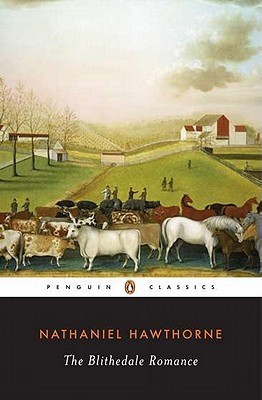
The Blithedale Romance is Nathaniel Hawthorne’s not so thinly based autobiographical account of his 8 months at Brook Farm, a socialist utopian community outside of Boston. The narrator is Miles Coverdale, a writer, who approaches this experiment with the expectation that the natural country air and physical labor of farm work will aid the writing projects he expects to do at night. And while we certainly get an idea of the workings of a utopian community, Hawthorne chooses to tell this story with that on the periphery.
Instead, The Blithedale Romance turns out to be more of a mystery novel centering on three characters Coverdale meets at the farm. The philanthropy-obsessed Hollingsworth who envisions building an institution for the reform of criminals on the Blithedale property; strong maternal Zenobia, whose early groundedness belies a future of intrigue and tragedy; and the wraith-like Priscilla who might not be of this world. Her entrance one night, unannounced, with the only goal that she is to serve Zenobia stymies everyone. Zenobia, is startled, but accepts this action as another sign underscoring the mystery of the romance of Blithedale.
Three quarters of the novel is about these three and their cryptic connections to each other that manifest as they busily pursue their utopian dreams. Their secret pasts and surprising familial connections are uncovered, one sinks further into insanity and sadly another commits suicide; strangers slink around the woods to ask questions first about Zenobia, then about Priscilla only to disappear; Zenobia tells the spell-binding story of the mysterious Veiled Lady, Coverdale almost dies of the flu and the city-slicker-turned-farmers almost ruin the community’s first seed-planting. So much for the peaceful pastoral life of a utopian society.
In fact, I was disappointed that Hawthorne told of his adventures in this way. I was hoping for more daily life, success and failures, the philosophical dream versus the reality of life, in utopia. I am with Henry James who although praised the novel also commented, “[I would] have liked to see the story concern itself more with the little community.”
While the stories of Zenobia, Hollingsworth and Priscilla are gripping at times and filled with pathos at others, they could have existed in myriad other settings removed from Blithedale farm. If Coverdale is a thinly disguised Hawthorne, am I to believe these characters and their trials and tribulations were HIS main focus? Ah well, I don’t like reviews that bemoan a book for not being about something else, so I will look for other sources about Brook Farm and its community.
On the positive side, Hawthorne IS a master at drawing fully formed characters, so in that regard, this novel does not disappoint. With all the shady folks moving in and out, the tale of the Veiled Lady, suspicious motivations and coincidental happenings, The Blithedale Romance would be a perfect read during the scary month of October!
 Classic Laurie