
Johnny: Anybody can ride in one of those hansom cabs, provided they got the money. So you can see what a free country we got here…In the old countries, certain people aren’t free to ride in them, even if they have the money.
Francie: Wouldn’t it be more of a free country if we could ride in them for free?
Johnny: No, because that would be Socialism and we don’t want that here.
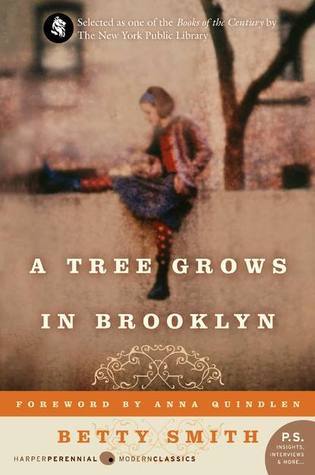
About a year and a half ago I heard a program on NPR about the publishing industry and World War II; that publishers put out specially formatted books with thin paper and in a particular size to fit easily into the pocket of a soldier’s uniform. They published classics as well as light reading and were passed from soldier to soldier throughout the fields of battle. A Tree Grows in Brooklyn was one of the most requested titles, because it reminded the soldiers of the values they were fighting for.
It is a Saturday during the summer of 1912 when we meet 11 year-old Francie Nolan. She lives with her brother Neeley and her parents, Katie and Johnny, both born in the United States, from Austrian and Irish backgrounds respectively. They live in a third-story walk up on a street with other immigrant Irish. Johnny is a singing waiter beloved by his friends and family, but alcohol has taken over him so his work is sporadic. Katie has become the breadwinner of the family and works as a ‘janitress’ cleaning homes and offices.
Francie and Neeley are always hungry, their clothes are not thick enough to protect them from the biting cold of winter and their home is not always heated. But they themselves are breadwinners as collectors of bits and bobs that they sell to the junkmen for pennies which will buy stale bread. Saturday afternoon being the most important day of the week, the kids scheme against each other for the best deals at the storefronts where they trade their stashes of rags and bits of metal and anything they can find to sell. With that money they buy food for the family, saving a penny for a sweet or two.
The book is told through budding writer Francie as she watches and observes the people and conditions around her. The narrative is a simple one as Francie grows from an 11 year-old to 17: her father dies of alcoholism, her mother takes on more work, she reads voraciously and realizes there is more to the world than Williamsburg, Brooklyn, New York; she falls in love, is jilted, she fears her brother, who likes to sing, will end up like her father; she must give up her education so her work can support her mother and brother, but the desire for education burns so hard she takes college classes at night and during the summer and is able to skip high school altogether and is accepted to a college in Michigan. Her mother remarries and the family moves out of poverty.
Through Francie, Smith writes with such detail about early 20th century Williamsburg and the crushing and demeaning poverty of its inhabitants. She writes with a meticulous hand the strategies the children employ that will get them the most for the items they have collected throughout the week: which stores will pay them the most, whether this shop owner likes girls better than their brothers or that shop owner will give more to the boys, and the pride the children feel contributing to the family bank (a can nailed to the closet floor). When Katie asks Francie to shop for food she is given instructions on what to say and how to approach the butcher, the breadmaker and so on, in order to get the best deal.
My Thoughts
Yet, the story is not just the narrative, but the characters that people Francie’s life: the teacher who at first encouraged her writing until she started writing the truth about her hard life, who then told her writing is supposed to be full of beauty; her aunt Sissy, the ‘floozie’ who married three times, had 10 children that died at birth, yet is the family member everyone turns to in times of crisis; the Jewish and German shop keepers with whom Francie deals, who can be gruff and mean to the poor children one minute only to give them something extra the next; her father Johnny who she is so close to, yet for all his patriotism about freedom, is never able free himself from his addiction; Katie, who wanted to make a different world for her children, took her mother’s advice to read from the Bible and Shakespeare,
“…every day you must read a page of each to your child—even though you yourself do not understand what is written down and cannot sound the words properly. You must do this that the child will grow up knowing of what is great—knowing that these tenements of Williamsburg are not the whole world.
And the titular tree that grows tall throughout Williamsburg like an umbrella, because “it likes poor people” has the tenacity to succeed like the human inhabitants because when it is cut down, will find a break in the cement, push through it and grow again.
The book was published in 1943 when, although the soldiers didn’t know it, was right in the middle of the war. They were not that far removed from their own immigrant past, the tales of the ‘old country’ that were still real for their parents and grandparents. So, it is fair to say that this novel is really a story of immigrant America, how each generation built it up from the succeeding one.
And which may be why the book was so heavily traded among soldiers who saw in the pages their own mother and sister who kept the family together, whose fathers worked any job they could get, a little brother they missed; the same immigrant neighbors, who regardless of their poverty, knew America could give their children freedom, the ability to determine their own destiny which set America a part from the enemies they were fighting.
 Classic Laurie