
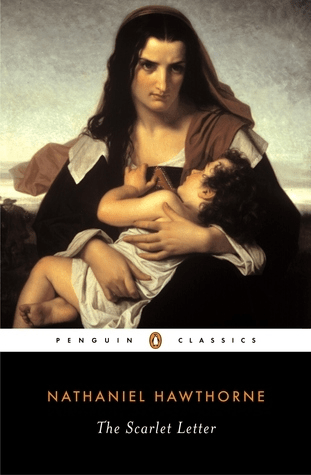
On the breast of her gown, in fine red cloth, surrounded with an elaborate embroidery and fantastic flourishes of gold thread, appeared the letter A. It was so artistically done, and with so much fertility and gorgeous luxuriance of fancy, that it had all the effect of a last and fitting decoration to the apparel which she wore; and which was of a splendor in accordance with the taste of the age, but greatly beyond what was allowed by the sumptuary regulations of the colony.
Technically this is a reread. However, all these many years since high school have dimmed my memories of the details. The first being the Introduction to the book or autobiographical essay that Hawthorne uses to show that the story he tells is true; that one day during his job as the Surveyor in the Custom House in the city of Salem, Massachusetts he explores the old building and discovers a room filled with old documents belonging to his predecessors. Upon opening a package wrapped with red tape, he finds a tattered piece of material with a faded letter “A” embroidered on it. Also enclosed are documents containing interviews with townspeople enabling him to piece together the story of Hester Prynne the adulteress, who bore a child, refused to name the father and lived life as a recluse.
The story takes place during the mid 17th century in the first few years of the Puritan city’s founding. Hester Prynne has been convicted of adultery and must live for the rest of her life with the shame branded on her in the form of an elaborately embroidered scarlet letter ‘A’ sewn into the bodice of her dress. She lives her life on the outskirts of town, raising her daughter and eking out an existence by sewing and embroidery. The man complicit in the liaison is identified to the reader as the Reverend Dimmesdale, though he does not acknowledge any involvement in Hester’s plight or responsibility for Pearl.
We learn Hester comes to Salem from England awaiting her husband who has not yet arrived and is feared to have died at sea. However, on the day Hester is released from prison and paraded through the crowd of townspeople to the platform from where she will be displayed for the day, he appears though he makes no move to rescue Hester, to forgive her or reveal their relationship to the authorities. He disguises himself as an itinerant doctor and changes his name to Chillingworth.
As the pious and well-loved minister of the town, Dimmesdale’s conscience gets the better of him and as the years go by his guilt begins to literally eat away at him. Dr. Chillingworth moves into his home presumably to care for him, but he knows Didmmesdale’s connection to Hester and it is not clear how honest he is with his advice.
Dimmesdale dies after a brilliant last sermon and soon after so does Chillingworth, himself a victim of guilt-related wasting disease. Hester and Pearl leave for several years and when Hester returns to Salem she is alone living once more on the edge of town bearing her sentence with quiet humility until she dies.
Some Things that Strike Me: The Supernatural, Corporate Sin
Hawthorne is at his best when he blends the normal with the supernatural as he does in The House of the Seven Gables and The Blithedale Romance and which he does here. In fact, there is a constant sense of evil and malevolent forces at work throughout; of the men in Hester’s life who act in fiendish ways, including her husband whose guilt has ‘transformed him into a devil;” a meteor that lights up the night sky and is observed as a foreboding sign; the rumored dance of witches with the Black Man [Satan] of the forest; little Pearl “born of sin” whose soul seems to fight the forces of good and evil. And finally, the scarlet letter which has a life of its own.
In the Introduction, as Hawthorne sifts through the documents pertaining to Hester Prynne, the remnant of the scarlet letter falls on his chest.
It seemed to me,—the reader may smile, but must not doubt my word,—it seemed to me, then, that I experienced a sensation not altogether physical, yet almost so, of a burning heat; and as if the letter were not of red cloth, but red-hot iron. I shuddered and involuntarily let it fall upon the floor.
The scarlet letter is also of curious interest to the infant Pearl who notices the glimmering gold embroidery “with a decided gleam that gave her face the look of a much older child,” causing Hester to never feel safe. This look is described as elfish, almost fiendish, an evil-spirit possession of the child mocking her mother.
When Dimmesdale dies it is in the presence of his congregation at the conclusion of what turns out to be his last sermon. Hester is near and comforts him. He confesses his guilt to her and hopes his suffering in life is sufficient penance to reach Heaven. Many of the spectators testify to seeing a scarlet letter A visible on his chest. Some say it was put there as the penance he took on when Hester first appeared to the public to show his flock we are all sinners. Others believe it was placed there through the work of Chillingworth, by necromancy and magic.
I find Pearl to be a striking character who is thought of as both the sin of her parents as well as a magical creature, full of airy light who is a wild woodland elf. The stain of her mother precludes the town’s children from associating with her so her playmates are the trees, brooks and animals of the forest and her fantasy life. But she scares Hester almost from the beginning.
The child’s own nature had something wrong in it, which continually betokened that she had been born amiss, –the effluence of her mother’s lawless passion, — had often impelled Hester to ask, in bitterness of heart, whether it were for ill or good that the poor little creature had been born at all.
Pearl refuses to obey rules and is described as a disordered and peculiar child whose character, Hester believes, was formed while she was giving in to her illicit passion which was transmitted into her child. As Pearl was “imbibing her soul from the spiritual world…the warfare of Hester’s spirit was perpetuated in Pearl.”
How unfair for a child to be so burdened by society’s strictures and grievous religious dogma through no fault of its own and without ever having recourse.
I also found it unusual that Hester’s accuser is not her husband, but the townspeople, the governors and magistrates, the clergy. At that time, religion and its enforced morality had a hold on one’s personal life and was policed by neighbors. Transgressions were brought to the clergy and punishment was strong to set an example.
It occurs to me how different a scenario is the accusation of adultery during the colonial times compared to our own. We leave adultery to the couple involved to sort it out as they will and while one or the other might make accusations against each other it is not a criminal offense affecting the entire town. It reminds me of the witch trials of Salem, this belief that what you do as an individual your community has something to say about it and everyone must toe the same line.
As the years pass though Hester continues to wear the scarlet letter, many in the town have either forgiven her or are unsure of her past. She becomes known for her good deeds to the poor and sick and comforting and consoling to any young women thought wronged in some accusation or another. In fact, many choose to see in her exemplary life the letter representing not her shame, but her penance. “They said that it meant Able.
And how does this all end for Hester Prynne and her little woodland elf of a daughter? Quite nicely as it turns out. The old devil Chillingworth died a rich man and bequeathed his fortune to Pearl who became the richest heiress of her day. Mother and daughter leave the country for many years until one day Hester arrives back at her simple cottage and attaches to her dress the scarlet letter continuing the punishment of her own free will. It is speculated that Pearl, being of marriageable age, has found a husband across the sea and would not be joining her mother.
To the townspeople who observe packages and letters coming into Hester’s home bearing seals of unknown English heraldry, they know someone from afar, is it Pearl?, is caring for her. This is confirmed the day Hester is seen embroidering a baby garment….
Such an intense tale of passion and mystery! Made up or based on reality? Whether the Introduction is true about the package with the faded fabric or not, a story of great magnitude is the result.
 Classic Laurie