
There was an odour….
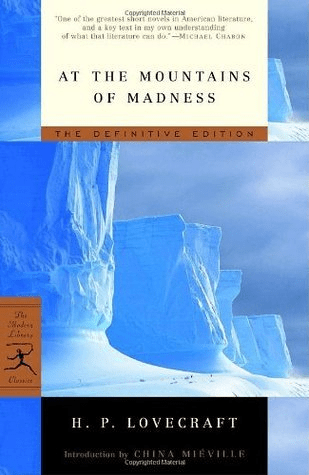
William Dyer is a university professor at Miskatonic University and this is his report of the expedition he lead to the Antarctic and the unexpected discoveries his team uncovered. His first communications to the outside world are full of exciting finds and praise for his men and their dedication. As the expedition continues, however, there are horrific accidents, missing team members and puzzling evidence of a past civilization that doesn’t make sense on the timeline of evolution. So traumatized are he and his men over the events they witnessed, he would have preferred to forget all that took place, but when he finds out another expedition is forming he hopes a more detailed description will discourage them.
His report begins soon after the company arrives in Antarctica. Once the team settles into base camp an advanced party, lead by Professor Lake, sets out in a transport plane bringing equipment that will allow the team to take core samples in the heretofore unexplored wilderness of Antarctica. Sled dogs are also brought for transportation over the icy surface as are all kinds of tools for scientific and geologic sampling. With each sighting of mountains or other geologic formation Lake relays back to Dr. Dyer who then communicates the findings to the University.
In the first communications are descriptions of a mountain range higher by tens of thousands of feet in elevation than any known in other parts of the world with a geological formation that looks as if it was carved by human hands. When organic life forms are found and taken out of the layers of ice, Lake decides to dissect them. With each new discovery pulled from their icy resting place, the dogs became more and more agitated until a special compound has to be built for them away from camp.
There is no consensus between Lake and Dyer if the forms are vegetable or animal in origin, but as Lake continues his dissection he discovers more and more of a complex internal design exciting both men. Suddenly, however, all communication from Lake ceases. After several hours pass in silence Dyer mounts a search party.
Anyone who knows the tropes of science fiction novels, short stories or the set-in-the-Antarctic B movies of the 1950s and 60s knows what is going to be found at the camp of the missing party, because nothing good ever comes of an expedition to the Antarctic! Monsters? Aliens? Organic life deformed by a nuclear chemical accident? A small party goes out to explore and they all go missing? Dogs trying to give warning that something is off kilter, but are ignored, or worse, put outside?
When Lake signs off for the night covering up the “creatures” after hours of dissection the suspense has been building up to this moment. He’s already described how the warmth of the air compared to the temperature underground has made the specimens more pliable. He describes a smell generated by the specimens and the annoyance of the barking dogs. Spoilers of all kinds swirl around through each passing page. You know what is going to happen. So what keeps you reading?
The story telling. The dangling-the-carrot of possibilities of horror that are obvious and in plain sight. But it is in the details of the almost breathless manner in the way he writes Dyer’s communication of his findings that Lovecraft excels. It is his incredible imagination coupled with a solid understanding of science, anthropology, geology and a flair for conveying the fantastic that brings Dyer’s discoveries of this ancient civilization to compelling life once he finds the murals and sculptures that tell the story of the Old Ones who populated the land long before the known historical record. And by bringing in what IS known of the historical, the geological and the geographical record Lovecraft creates both a realistic understanding of the “authorized” version of evolved life and the challenge to that with these new discoveries. There is enough interest and great story telling not to deter the reader from continuing on this journey even though experience in the genre and pure common sense has you shouting, “don’t split up” or “the dogs are trying to tell you something” or “put those life forms back where you found them and bury them deep!”
Research
The paintings of Nicholas Roerich were an influence on Lovecraft’s descriptions of the mountains Lake discovers.
I discovered Lovecraft had a life-long interest in the Antarctic and even as a child wrote stories based on books he’d read about the region. He followed the Byrd expedition which occurred just before he wrote the novel and he may have been influenced by the partial Antarctic setting of Poe’s novel, The Narrative of Arthur Gordon Pym of Nantucket. Having done his own research of the continent and knowing how little was explored, gave Lovecraft license to use his already active imagination to create a sophisticated singular epic tale of the already mysterious and inscrutable Antarctic.
The ceaseless five-pointedness of the surrounding architecture and of the few distinguishable mural arabesques had a dimly sinister suggestiveness we could not escape.
The tremendous significance lies in what we dared not tell–what I would not tell now but for the need of warning others off from nameless terrors.
The beings seem to have had no trouble in adapting themselves to part-time residence under water; since they had never allowed their gill systems to atrophy.
These were the Great Old Ones that had filtered down from the stars when earth was young-the beings whose substance an alien evolution had shaped, and whose powers were such as this planet had never bred.
 Classic Laurie