
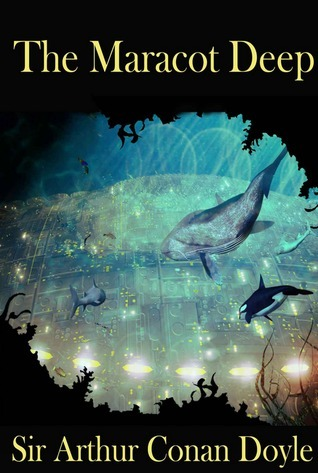
This is a surprising novel by an author I never realized had Jules Verne aspirations.
The Maracot Deep by Sir Arthur Conan Doyle is a fateful ocean adventure of the discovery of the lost civilization of Atlantis by three modern men whose research vessel has detached from their ship. The story is mostly told in epistolary style literally through a message in a bottle with Professor Maracot and his two companions finding themselves and their submersible falling into what they hope is not an abyss. Not to fear, they are rescued. Atlanteans live! When a mountain burst up through the water it submerged the large continent, but a portion of the population survived at the bottom of a deep part of the Atlantic Ocean.
They developed a vitreous material and a kind of battery pack that allows them to breathe in the water and a part of a complex of buildings that survived the catastrophe is airtight, to allow for the continuation of their civilization. The visitors discover the Atlanteans have a remarkable tool that allows for communication without language: They can project what’s in their mind on a screen so the men can see their thoughts in motion when rudimentary language fails.
They have a thriving arts and culture scene, and a somewhat developed social leadership organization, though Conan Doyle also describes a remnant Greek slave class and a race hierarchy that’s rather shocking.
Did the three men just happen to randomly fall into this experience or was it fate? A surprising revelation!
Doyle tells a good story here, but frankly I was rather disappointed at his lack of imagination especially through the first half. His descriptions of “old” Atlantis as passed down through the generations consisted of what we would find in the old manors and villas of England and Greece with a little Egyptian architecture thrown in for flavor. Nothing in the technology of this generation of Atlanteans was innovative or creative either.
However, my interest piqued in the second half, especially concerning the spirituality of the old gods and the one great God that still has control over the psyche of present day Atlanteans. That Maracot channeled a solution to His age-old grip on the Atlantean past astonished me and frankly, made me laugh a bit as I envisioned a mad scientist turned psychic medium. But discussions of other kinds of spirituality and a stronger narrative structure in this section redeemed the book for me.
With thanks to Simon and Karen for hosting these twice yearly clubs that always bring a fascinating new title into my life.
 Classic Laurie