
“Remembering Hilda as she used to be, was doubtless more satisfactory than seeing her as she must be now—and, after all, Alexander asked himself, what was it but his own young years that he was remembering?”
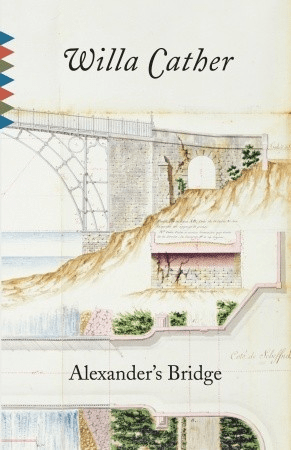
Willa Cather’s first novel is a sobering view on the inability to let go of the old and live in the present.
Bartley (called by his last name throughout the book) is having a midlife crisis that is threatening his profession, his marriage and his sanity. The success he is enjoying as chief engineer of designing and constructing bridges has not fulfilled him in the way he thought when he was an idealistic youth. He feels empty and as he projects the years to come he is completely overwhelmed. He loves Winifred his wife and the life they have built together, but it is not enough to satisfy this longing for joy and purpose.
It does not help that he has renewed an acquaintance with his first love, Hilda, who fills his mind with memories of their carefree life. Studying in Paris, being in love, feeling the world was his when it feels so hollow now has possessed him and he is about to ruin everything he has literally and figuratively built.
It turns out Alexander was one of those students who proved to be very good in school, but without a consciousness of what he wanted to be. He was mentored and guided into a profession that others thought he would be good in and he was stellar. The successes led him to accept this path and the years passed on. But as the present begins to feel uncomfortable he starts to idolize the past. The disappointments he is feeling take him back to the time of youth when he was full with the promise and optimism of the future.
Cather leads the reader through Alexander’s emotional turmoil as he pushes back and forth over the moral dilemmas he is experiencing. His relationship with Hilda is based on old times, not the present and at first she understands that. And then she gives in. But does she really bring him solace or just more confusion?
At the same time Alexander is on edge as a bridge he has engineered in Canada is on the brink of collapse, although at first he sees it only as a mild irritation and not the disaster it is ripe to become.
This book really had an effect on me and it made me reflect and ponder some of my own youthful goals and plans that never quite panned out. Unlike Bartley, however, I was able to overcome the wistfulness of that time, realizing my future turned out better because I could not see how I would change and grow when I was young.
Thoughts
This is Willa Cather’s first novel and it may have been based on the collapse of the Quebec Bridge on August 29,1907 claiming the lives of nearly 80 workers, including the chief engineer, made a significant impact on Cather. The narrative style and the book’s novella length might suggest an amateurish venture, which I’ve read is a common criticism.
But though the treatment of the various characters’ depth was uneven, I thought the point of the story to be profound and that came across. Yes, everything about the book could be fleshed out and more thoughtfully developed, but this is a critique that feels more like “Monday morning quarter backing.” Cather gets across Bartley’s universal pain and confusion that might give any reader of a certain age, pause. And as it did me, I would call this book a success.
 Classic Laurie