
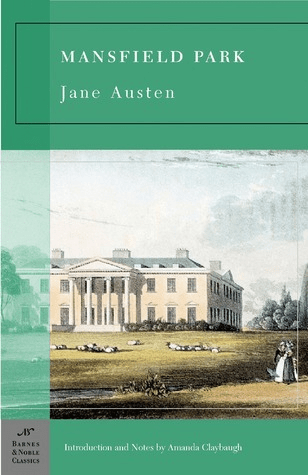
This reread was a challenge to myself to see if my initial reading of the character Fanny Price in Jane Austen’s, Mansfield Park, would change. In that first reading I found her moralizing tone and timidity quite tedious. Although I have softened that assessment—she remains one of my least liked of Jane Austen’s main characters.
In my initial reading I did not appreciate the liminal state in which Fanny Price enters Mansfield Park, a sort of “no-woman’s” status that gives her confusing messages. She comes to Mansfield Park as the 10 year-old daughter of Lady Bertram’s sister, Mrs. Price, whose large family is in difficult financial circumstances. As a niece, and cousin to the Bertram’s four children Fanny really isn’t “upstairs” or “downstairs” and thanks to her Aunt Norris, who is Lady Bertram’s other sister and lives in the parsonage, she won’t ever be able to forget it.
Fanny grows up as an afterthought, invisible until it is remembered that she might like similar things to her female cousins. Edmund remembers her most as does Sir Bertram when he is home, but she is easily forgotten when other more pressing issues impose. In social situations that call away her cousins she often stays behind to attend to Lady Bertram for whom she has become the de facto companion to whom “I can’t do without.” In this awkward, rankless state she finishes her childhood and grows into adolescence and beyond.
It is this awkward state in the family that I think shaped Fanny’s personality from her early days. She can’t speak up for herself without receiving a verbal wallop from Aunt Norris who constantly reminds her to be grateful of the tiniest scraps of attention and to remember her place. Yet, there are times she is treated like any member of the family, for example when she is given a horse to ride daily for her health or a fire in her room each day. It is a hard society to live in when you are never sure what you deserve. It is easier to try and stay invisible and out of the way, and not be put in a position that would call you out.
In this regard there is another aspect to Fanny Price I did not see in my first reading that is apparent now. From the very beginning of her life at Mansfield Park while she was often present in the action, she was put or placed herself in the background, in the corner, by the curtains or at the end of the couch. By staying out of the way, she became a witness to all of the dynamics of the household. She became an astute observer to the looks, the tiny actions and tones of voice that may have said one thing, but meant another.
This makes Fanny wiser than most of her contemporaries, because as an observer who is on the outside, she must also keep so much to herself. Except when she goes running to Edmund to reveal all these observations and conversations that ruined it for me in my first reading, when I initially described her as being a moralizing tattle-tale, and very irritatingly so.
I should have read more carefully, as it is obvious that she goes to Edmund because he is one of the few people who actually listens to her, and who regards her feelings as honest and important. Those many ‘asides’ to Edmund, do get on my nerves, especially against Mary Crawford, but of course, it is because she likes him and she feels he is being led astray.
I realize now it isn’t because Fanny is prudish when she tries to point out when Mary’s remarks are questionable, it is because she sincerely cares about Edmund’s reputation and does not want him to be brought down. And as we see at the end, this insight Providentially pays off.
And then we come to the end of the book and Edmund and Fanny are neatly wrapped up in a fine and beautiful bow. In my initial reading, while I assumed they’d be together, the swiftness and tidiness of their lives coming together was rather hard to believe, especially against all of the chaos that precedes it. And isn’t this often the case when characters lives change in seconds and the reader is left puzzled with brows furrowed? But Austen is a sly one and beats the critics to their objections with this lovely gem:
I purposely abstain from dates on this occasion, that every one may be at liberty to fix their own, aware that the cure of the unconquerable passions, and the transfer of unchanging attachments, must vary much as to time in different people. I only entreat everybody to believe that exactly at the time when it was quite natural that it should be so, and not a week earlier, Edmund did cease to care about Miss Crawford, and became as anxious to marry Fanny as Fanny herself could desire.
And everyone (mostly) lives happily ever after. Just as they should!
Finally
I read Mansfield Park with a particular purpose in mind and I did find insights that deepened my understanding of Fanny Price, but not enough to change my overall perception. However, in reading slowly and thoughtfully the reading experience was itself a great pleasure. I often read quickly and then go on to the next book forgetting that wonderful experience of being completely immersed in a book, taking my time to understand the large cast of characters and their stories. And then letting it all sit with me for a bit before. Much to my surprise “round two” of Mansfield Park, was quite satisfying and caused a shift in the way I read now.
 Classic Laurie