
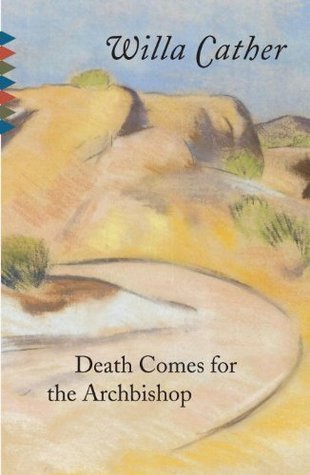
A Catholic bishop and his priest companion, who have known each other since seminary in France, walk into the desert of the great American Southwest. Charged with reforming the wayward parish priests who have taken advantage of frontier life and distance from the heads of their diocese to gain personal wealth, power and to break the vows that define their position, Bishop Latour and Father Vaillant have their hands full. Not only have the priests failed to live up to the standards of their role in the church, the two find parishes full of uncatechized, unbaptized congregants.
However, it is refreshing to find Cather’s story an exception from others of this kind of missionizing, because though both men have been sent to maintain the rules and regulations of the Church, it is mostly to reform the outlaw priests who have lead their congregations astray, not to exchange their power for the priest’s over the people.
Though Bishop Latour and Father Vaillant have a sacred belief in their calling, are obedient to the superiors who sent them here and accept that the work they must do is God’s will the emphasis of the story isn’t on conversion of the “heathen.” But a showing of love and compassion for the poverty of the indigenous and Mexican people. Slowly, after years of discipline or attrition the corrupt priests are replaced and the area flourishes.
Cather brings a great deal of realism and sensitivity to the novel in her description of the desert landscape and the difficult life of the people. Based on the true story of Jean-Baptiste Lamy, the first Bishop of New Mexico, other historical figures make appearances, including Kit Carson. Through his story line we learn of the personal toll the complexity of first Spanish, then Mexican, then American occupation takes on the various groups that populate this vast area of the “New World.”
Throughout the novel Cather’s talent as a nature writer is expressed through beautiful descriptions of the desert landscape and she often pauses the narrative to flesh out a character’s life or tell a legend or myth from the area painting a rich picture of this historical period.
Though Cather’s nature writing is beautiful, I did not find the overall writing in this novel as lyrical as O Pioneers!, and that bothered me at first. I wondered if this was perhaps an earlier novel, but came to find it was written later. After some thought, I decided her writing mirrored the bareness and simplicity of the desert and that this kind of spare writing actually worked. Death comes for the Archbishop has become one of my favorite novels.
 Classic Laurie