The Magician’s Nephew (1955), CS Lewis

“Narnia, Narnia, Narnia, awake. Love. Think. Speak. Be walking trees. Be talking beasts. Be divine waters.” Aslan

And the longer and more beautiful the Lion sang, the harder Uncle Andrew tried to make himself believe that he could hear nothing but roaring….And when the Lion spoke and said, “Narnia awake,” he didn’t hear any words: he heard only a snarl. And when the Beasts spoke in answer, he heard only barkings, growlings, bayings, and howlings.

This is my second read through and I still found the first part dull, the magic not particularly, well, magical. I remember thinking the first time around I would stick with it, because I wanted to read the series. Similarly, this time I felt the same dull disinterest. 

And then suddenly, Aslan appears and the book takes a most promising turn!

The Story

Digory and Polly, neighbor children who are thrust into the void by the power of the magic rings invented by Digory’s Uncle Andrew land in a world made up of innumerable ponds and woods. It is a new world without flora or fauna, but that changes as a magnificent and glorious sound pierces the air and the children realize Creation is being sung into being before their very eyes!

There were no words. There was hardly even a tune….It was so beautiful he [Digory] could hardly bear it…Then two wonders happened at the same moment. One was that the voice was suddenly joined by other voices; more voices than you could possibly count….The second wonder was that the blackness overhead all at once, was blazing with stars….a thousand points of light leaped out—single stars, constellations, and planets, brighter and bigger than any in our world….If you had seen and heard it, you would have felt quite certain that it was the stars themselves which were singing, and that it was the First Voice, the deep one, which had made them appear and made them sing….The Voice rose and rose till all the air was shaking with it; the sun rose. You could imagine that it laughed for joy as it came up….the earth was of many colors; they were fresh, hot and vivid. They made you feel excited until you saw the Singer himself, and then you forgot everything else. It was a Lion and stood facing the risen sun. Its mouth was wide open in song….

Creation being formed out of Song and love and beauty by a Lion who is at once Creator and Sacrifice (LWW). Because, yes, one cannot but help to see that connection. Aslan is birthing the world through the sound of his Voice, bringing forth the first plants, the new starry heavens, the sun and wind and all the animals, birds and beings that will populate this new world.

Out of the trees wild people stepped forth, gods and goddesses of the wood; with them came Fauns and Satyrs and Dwarfs. Out of the river rose the river god with his Naiad daughters. And all these and all the beasts and birds in their different voices, low or high or thick or clear, replied. “Hail, Aslan. We hear and obey. We are awake. We love. We think. We speak. We know.

Aslan tells the animals and other sacred beings to guard and protect the land because evil has been let loose. The Witch followed Digory and Polly into Narnia, but for now she is headed for lands far away and won’t trouble Narnia for hundreds of years. In the meantime Narnia must be made strong. Aslan sends the children on a journey to find the fruit of a special apple tree that once planted in Narnia will reign over it against all evil. When they return Aslan tells Digory to throw the apple a certain distance and it settles into the soft mud. In the morning the tree is big and filled with fruit. Digory is certain an apple from this tree will help his mother’s cancer and Aslan gives him one to take home.

When Digory and Polly return to London, Digory’s mother eats the apple and is cured. Digory plants the core and a tree grows again overnight. As the years pass and the children grow up so does the tree which has a symbiotic relationship with the one of its origin: it wiggles a bit on days when it is windy in Narnia, even when there is no wind in London. But its shaking has weakened its roots, and one wind-filled day in London the tree topples over. Now middle aged and with unfaded memories of Aslan and Narnia and all he saw there, Digory cannot just chop up the tree for fire wood. So he takes part of the tree and builds a wardrobe which he puts in his house in the country….

The Controversy: Chronological Order or Published Order

In my Harper Trophy editions, The Magician’s Nephew (MN) is the first in the series with The Lion the Witch and the Wardrobe (LWW) second. I didn’t know any better and read this first. I had struck up a conversation with a woman in a bookstore who is an avid Narnia fan. She told me that after Lewis published the LWW a friend asked him about the lamppost that appeared out of nowhere and in order to clear that up he wrote The Magician’s Nephew. In that moment it made sense to me to stick with the order in my series. But what did Lewis himself say?

In 1957, an 11-year-old boy named Lawrence Krieg was preparing to read the Narnia books for a second time. Lawrence wondered if he should re-read them chronologically, but his mother felt he should stick with the original published order. So, Lawrence wrote a letter to the author and received this response:

“I think I agree with your order for reading the books more than with your mother’s. The series was not planned beforehand as she thinks. When I wrote The Lion I did not know I was going to write any more. Then I wrote P. Caspian as a sequel and still didn’t think there would be any more, and when I had done The Voyage I felt quite sure it would be the last. But I found as I was wrong. So perhaps it does not matter very much in which order anyone read them.”

C. S. Lewis, letter dated, 4/23/57

Douglas Gresham, stepson of C.S. Lewis

“[HarperCollins] asked, ‘What order do you think we ought to do them in?’  And I said, ‘Well … I actually asked Jack himself what order he preferred and thought they should be read in.  And he said he thought they should be read in the order of Narnian chronology.’  So I said, ‘Why don’t you go with what Jack himself wanted?’

Lewis scholars almost universally agree that the original published order is superior. They suggest that The Lion, the Witch and the Wardrobe is more initially captivating than The Magician’s Nephew, that certain lines in Lion do not make sense when the book is not read first,and that Nephew has greater mythic power when read as a prequel.

I think I agree with the assessment that LWW is best to read first, if only because the first half of MN is not so interesting. It would be a shame to turn off a young reader of this marvelous series, because the first one they read doesn’t capture their imagination. Though I didn’t know better and read MN first, I do wish I’d saved it and read the books in published order. I got so much more out of it this time around; the story’s magical qualities come to the fore with the writing, which for me is ‘pure magic.’ I imagine though reading order will be an argument that will last until the end of time!
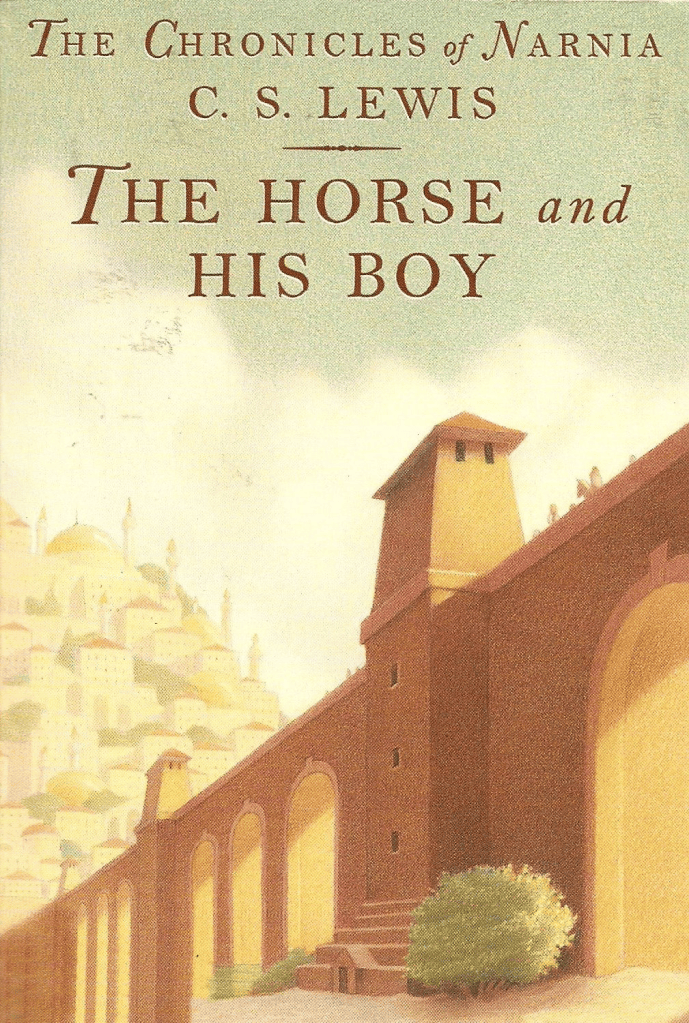
The Horse and his Boy (1954), CS Lewis

I’m a free Narnian.”

We’re free Narnians.

He was a free Narnian horse.

“I have been longing to go to the North all my life.” “Of course you have. That’s because of the blood that’s in you. I’m sure you’re true Northern stock.”

For a series of books written for children CS Lewis sure doesn’t sugar-coat childhood. He tackles bullying, the separation of families by war, the betrayal of siblings against each other and in this one child slavery, physical abuse and forced marriage, just to name a few. In The Horse and His Boy, there is less magic and playfulness and more realism. Lewis is telling a different kind of story here, where Aslan is mostly absent and Shasta and Aravis, the main characters, are on their own. In previous stories, the children knew they were on a mission for Aslan. This time, however, both have never even heard of Aslan and only find out later he has been guiding them from the beginning. But in the moment, their desire to escape, their plans and strategies have been due to their own will and wits.

Lewis also uses a different storytelling technique in this novel than he does in the others. In all the other books he is the creator of all the fantastic beasts, the flora and fauna and other beings. In this novel, he borrows the Calormen from a known culture, who are based on a middle eastern country, or tribe, or people, and sadly, are full of all the stereotypes one could imagine. At present, he has been rightly criticized and perhaps should have rethought this, however, I believe the story is still a good one and should be taken in the context of the time he was writing during which Asia and the Middle East were rather mysterious to the West.

When the story begins we meet Shasta, who as a young child was found drifting in a boat and is now the property of Arsheesh, a poor fisherman. Shasta is beaten regularly at Arsheesh’s whim. There are days when Shasta wants to escape and feels a pull to the North. Arsheesh is only too happy to turn him over to a Calormen nobleman who wants to buy him and while awaiting his fate in a stable Shasta finds that one of the horses can talk. Bree is a Narnian Horse belonging to this man, although he has kept his identity secret, and is treated cruelly, which both realize will be the same fate for Shasta. The two contrive a plan to escape to Narnia. On the road they meet another escapee from these lands, Aravis who is fleeing an arranged marriage. She is riding her horse, Hwin, who also happens to be a Talking Horse from Narnia.

The four team up, but it is a perilous journey and the children are challenged by the desert, ghoulish imaginings in the night, stalking, by what seem to be many lions, in which Aravis is wounded and an army trying to stop them that also wants to capture Narnia.

While this is very much an escape story, it is also a story about freedom and identity and about discovering who you really are and in remembering who you are. “I am a free Narnian,” says Bree repeatedly. Though long captured he hasn’t forgotten he is a noble war horse from Narnia and he is a free horse, belonging to no human.

Excuse me, Tarkheena [Aravis]…We’re free Narnians, Hwin and I, and I suppose, if you’re running away to Narnia, you want to be one too. In that case Hwin isn’t your horse any longer. One might just as well say you’re her human.

Shasta has always been attracted to the North (where Narnia is located), not the South even though southern travelers often come to sell fish and have great stories to tell. He knew who he was, before he was aware of it. And in a fairly obvious twist of fate it turns out Shasta’s identity is more than that of a common Narnian citizen.

And what to make of this Aslan? Though largely absent throughout the book when he appears he is often distant, distracted and removed. In a very different relationship with the main characters in this book than in previous novels, he is allowing them their journey without micromanaging the details. I believe this is a conscious shift in the message Aslan brings up to this time between what it means to be a child with all the hands-on guidance those ages entail to the next stage when you go out in the world and experience it through what you have been taught so far, including the making of mistakes. And with this new stage is the responsibility you accept for these mistakes, as Aravis learned when she experiences the consequences of a selfish act made against someone more vulnerable and much less socially powerful.

“It was I who wounded you,” said Aslan. Do you know why I tore you?”….The scratches on your back, tear for tear, throb for throb, blood for blood, were equal to the stripes laid on the back of your stepmother’s slave because of the drugged sleep you cast upon her. You needed to know what it felt like.” 

That is harsh. But a very good example of a true understanding of an “eye for an eye,” which is not the same punishment, but a fitting punishment. 

And then there is this passage that seems very odd, but I connect it to the idea of identity. This is Aslan’s response to Shasta when he meets him for the first time and asks who he is.

“Myself,” said the Voice, very deep and low so that the earth shook: and again “Myself,” loud and clear and gay: and then the third time “Myself,” whispered so softly you could hardly hear it, and yet it seemed to come from all round you as if the leaves rustled with it. 

It sounds like Aslan is trying to justify himself to more than Shasta. I would like to know what anyone else makes of this?

Suffice to say that I have no idea how I would have responded to this book as a child, but as an adult I feel like I am on a journey with these books as a whole. Almost like exoterica and esoterica, that is, you can read them as delightful adventure stories, but there is the deeper, hidden messages that take time to decipher. In fact, I had a thought as I was finishing this up that this whole story is reminiscent of the Old Testament and the Israelite’s journey out of slavery in Egypt to the freedom of the Promised Land-Shasta was found floating in a boat like Moses in his basket, Shasta is more than even he thinks he is again like Moses, Aslan is a fearful and often cold entity, the Calormen lands are in the desert. To plumb for another time?!! 

“I was the lion who forced you to join with Aravis. I was the cat who comforted you among the houses of the dead. I was the lion who drove the jackals from you while you slept. I was the lion who gave the Horses the new strength of fear of the last mile so that you should reach King Lune in time. And I was the lion you do not remember who pushed the boat in which you lay, a child near death, so that it came to shore where a man sat, wakeful at midnight, to receive you.” 

“By the Mane.” “Thanks be to the Lion.” “By the Lion’s Mane.” “By Aslan.”

Bree and Hwin lived happily to a great age in Narnia and both got married but not to one another. And there weren’t many months in which one or both of them didn’t come trotting over the pass to visit their friends at Anvard.

Prince Caspian (1951), CS Lewis

Listen, all you have heard about Old Narnia is true. It is not the land of Men. It is the country of Aslan, the country of the Waking Trees and Visible Naiads, of Fauns and Satyrs, of Dwarfs and Giants, of the gods and the Centaurs, of Talking Beasts. It was against these that the first Caspian fought. It is you Telmarines who silenced the beasts and the trees and the fountains, and who killed and drove away the Dwarfs and Fauns, and are now trying to cover up even the memory of them. The King does not allow them to be spoken of. 

This is a very indulgent, full-of-spoilers post, so be forewarned! I am participating in a readalong of the Chronicles of Narnia hosted by Chris of Calmgrove (one book per month and you can join in at any time) and Prince Caspian, our second book, took me by surprise. This is a reread for me; the first read through a couple of years ago found me rather off it, because it is basically about a war and I skipped through many pages. But this time though, I stuck to the script and was totally captivated by Lewis’s writing, which I obviously missed with all that skipping. I can honestly say I enjoyed this book more than The Lion, the Witch and the Wardrobe. Shocking.

What struck me in the writing was the magic. First a short recap:

The Pevensie children are called back to Narnia a year after their first visit through the wardrobe. This time they are at a train station on their way to boarding school when suddenly they feel a familiar physical pull and find themselves on a deserted island they soon realize is Cair Paravel where they ruled Narnia as kings and queens. They have been summoned to help Prince Caspian regain his rightful place as King of Narnia after his devious uncle has stolen the throne. Caspian is of the Telmar race who invaded Narnia over a thousand years ago conquering the land and sending the magic into dormancy. Old Narnia has been kept alive through whispered stories as any mention of talking animals, animated trees, naiads and the like is dealt with harshly. Caspian’s nurse kept Narnia alive for him through these stories and as rightful King he is determined to restore it to its former glory. There is a lot of magic in this one and some beautiful passages that describe the reawakening of the land and animals of Old Narnia who were silenced when Prince Caspian’s ancestors, the Telmars, conquered the land.

In general, one can see all kinds of symbolism in these books from the Christian, to the medieval, to basic fantasy and modern metaphor and probably others I am not aware of. I do tend toward the Christian in general, because it is just so easy to see Aslan as a Christ figure, yet in Prince Caspian I found so much more of the magical whether pagan or metaphysical. While it would take a book to muse and ponder through all this, I am content with treating this post as a sort of commonplace book, that is, just sharing what struck me in my reading. Talking badgers, good dwarfs and bad, an astronomical system specific to Narnia, changes in the Pevensie children that only happen in Narnia and the great Lion, Aslan, the magical quality of this book struck me more than in The Lion, the Witch and the Wardrobe. I think Lewis is at his creative and imaginative best here and writes with a child’s heart, that affects me as an adult, in so many of these passages. It was such a surprising and satisfying read. Which just goes to show me, “Stop skipping pages, Laurie!”

Some favorite passages.

Lucy senses Aslan’s presence.

Lucy feels the magic before her siblings and never wavers in what she sees and feels even against their push back. She senses the magic in the trees, knows Aslan is calling her before she can see him, while Peter and Susan use reason only to guide them when they first land in Narnia. Does this reason-over-magic which drives the two older children foreshadow their “aging out” of Narnia as Aslan tells them in the end? Have they lost the Soul of Narnia, which is still very present in Lucy?

A great longing for the old days when the trees could talk in Narnia came over her. She knew exactly how each of these trees would talk if only she could wake them, and what sort of human form it would put on. She looked at a silver birch: it would have a soft, showery voice and would look like a slender girl, with hair blown all about her face, and fond of dancing. She looked at the oak: he would be a wizened, but hearty old man with frizzled beard and warts on his face and hands, and hair growing out of the warts. She looked at the beech under which is was standing. Ah!—she would be the best of all. She would be a gracious goddess, smooth and stately, the lady of the wood. “Oh Trees, Trees, Trees, wake, wake, wake. Don’t you remember it? Don’t you remember me? Dryads and Hamadryads, come out, come to me.” Though there was not a breath of wind they all stirred about her. The rustling noise of the leaves was almost like words. The nightingale stopped singing as if to listen to it. Lucy felt that at any moment she would begin to understand what the trees were trying to say.

This same night Lucy looks up. This passage affected me personally as a night-sky lover as I have begun tracking the constellations through the year. When the Pleiades, Orion and Sirius become visible, I, too have a thrill of recognition as Lucy does when she awakens in the middle of the night back in Narnia.

…with the thrill of memory, she saw again, after all those years, the bright Narnian stars. She had once known them better than the stars of our own world, because as Queen in Narnia she had gone to bed much later than as a child in England. And there they were—at least, three of the summer constellations could be seen from where she lay: the Ship, the Hammer, and the Leopard. “Dear old Leopard,” she murmured. 

And there is the breathing, Aslan’s breathing. What to make of this? I cannot see it as other than the breath of life God breathes to animate Adam. Aslan breathes on the children and they see differently, they themselves are different. Edmund, “For Aslan had breathed on him at their meeting and a kind of greatness hung about him.” Susan, who wouldn’t follow Lucy’s direction given by Aslan, because she thought she knew better is breathed upon by Aslan and admonished, “You have listened to fears, child. Come, let me breathe on you. Forget them. Are you brave again?” 

Aslan breathes on the first Telmarine who volunteers to go into the new land, “As soon as the Lion’s breath came about him, a new look came in to the man’s eyes—startled, but not unhappy—as if he were trying to remember something.”

Mighty little Reepicheep and the restored tail.

And then there are the miracles. There is Aslan’s healing and restoration of Reepicheep’s tail and the healing of Caspian’s old nurse who is on her death bed and is cured just by Aslan’s presence at her bedside, “Oh Aslan I knew it was true I’ve been waiting for this all my life.” And then heck, he turns the water in the well into wine and with a sip she jumps out of bed! I mean really, water into wine? What to make of that?!! Or and I making too much of that?

And finally, Narnia is restored. Peter, Susan, Edmund and Lucy, Caspian, the animals and magical creatures follow Aslan into the peopled parts of the land where he is more visible to humans in ways he was not in the former novel, appearing as a sort of Pied Piper or Jesus character collecting followers as he and the Narnians walk through towns. Those who follow him have a kind of inner knowing that they are supposed to drop everything and leave with him.

They come to a school where a “tired-looking girl was teaching arithmetic….She looked out of the window and saw the divine revelers singing up the street and a stab of joy went through her heart. Aslan stopped right under the window and looked up at her…Said Aslan, “Now Dear Heart,” she jumped down and joined them.

Whatever the explanation, there is something about this book that is different from The Lion, the Witch and the Wardrobe that is definitely more Christian, Spiritual, magical, metaphorical—however you frame it. Aslan, is different, too. His presence in Narnia has been kept alive by faith, by stories and belief even by those who have never seen him. He also acts differently with the four Pevensie children by expecting them to act more on their own with only general direction from him, as if he is testing their faith in him and their purpose in Narnia.

The enduring love for the Narnia universe is evident in the popularity of the books by young and old alike, by the religious, the spiritual, the literary critic, the agnostic and in all the ways one can interpret these books. This interest/obsession/admiration isn’t waning. It is like Old Narnia continuing to live in our memories, though not through whispers and the pain of death, but out in the open and in living color!

But all night Aslan and the Moon gazed upon each other with joyful and unblinking eyes.

A Stitch in Time (1976), Penelope Lively

Eleven year-old Maria Foster talks to inanimate objects. She has conversations with cats and trees, too. It is clear she is curious and smart and the conversations she begins with her parents, based on what she has observed in the world or something she read leave them bewildered, as if they just don’t know what to do with a girl so serious and deep. So only-child Maria has created a world where objects listen and engage, give her advice and solace in ways her family cannot.

We meet the Foster family on their summer holiday to Lyme Regis. They are staying in an old Victorian house for a month. It has a resident cat, furniture that has seen decades of wear and an old tree in the backyard perfect for Maria to sit in and ponder. Next door is a small hotel where families of holiday makers are spending the summer and from her perch she notices one particular family with one particular boy. Once they meet Maria and Martin, after some initial hesitation, find in each other kindred spirits interested in the larger questions of life. They roam the hills and beaches picking up fossils, observing the varied geology of the land, which leads to a discussion of evolution when they visit a nearby museum.

Lyme Regis fossils.

In a complementary story line, Maria has become obsessed with a girl her age named Harriet who lived in the house Maria’s family is renting a hundred years ago. A photograph of a piece of Harriet’s embroidery with an ominous signature has captured Maria’s imagination. She is convinced Harriet died young and is determined to find out her story. She keeps most of her thoughts to herself until she makes a small attempt to share them with Martin. Mostly, though, she is content to have found an exploring buddy who shares her new found interests in the fossils and geology of the hills and cliffs they wander.

There are wonderful supernatural elements in the story that affect only Maria besides the cat, the petrol pump and the tree that she has conversations with: there is an insistent sound of a barking dog and the creaking noise of a swing in motion. Maria scours the neighborhood for physical evidence of these to no avail and as this part of the story unfolds they play an important part in the mystery of Harriet.

As Maria explores both her inner and outer worlds she grows in confidence and acceptance of herself and can acknowledge that what she thinks about and what interests her are genuine and noble. She has become communicative and expressive with her mother who is finally able to see and understand this daughter who had always seemed so shut up within herself.

A really wonderful book about a smart, serious, curious kind of girl that should be celebrated!

And thanks to Simon and Karen for creating these various clubs that have helped me find books and authors I may not have discovered otherwise.

The cat sat down beside her, disposed, it seemed, for a chat.

“No,” said Maria, “I don’t think I’m going to let you talk any more. Sometimes you say uncomfortable things. Though actually I think I am getting a bit better at not being made uncomfortable.” 

“P’raps” said Maria, “they turn into the kind of people they are because the things that happen to them make them like that.” Like I’m shy and I talk to myself because of the sort of family I live with and Martin’s like he is because he’s got a different kind of family.

“You are a bit peculiar sometimes,” [Martin] added, “You were talking to that tree yesterday. I heard. You were sitting in it and you suddenly said, ‘Oh, Quercus ilex…’”

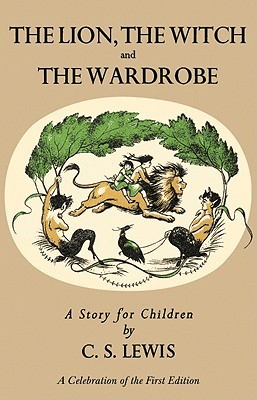
The Lion, the Witch and the Wardrobe (1950), CS Lewis

None of the children knew who Aslan was. At [his name] each one of the children felt something jump in its inside. Edmund felt a sensation of mysterious horror. Peter felt suddenly brave and adventurous. Susan felt as if some delicious smell or some delightful strain of music had just floated by her. And Lucy got the feeling you have when you wake up in the morning and realise that it is the beginning of the holidays or the beginning of summer.

One of my commitments this year is to read the complete Narnia series. I started with The Magician’s Nephew (some would argue that is actually the 6th book). But this one gets into the heart of the matter—the struggle between good and evil in the Land of Narnia and the ethics of choosing sides. I love the layers with which you can understand this book; how you can see a Christian allegory or “just” a magical adventure. Like many fantasies Narnia is a land where animals talk, Witches are cruel, quests are taken and bravery against evil is the key to survival.

Peter, Susan, Edmund and Lucy Pevensies are siblings who have been sent out of London for the duration of the war to the country home of an old professor. During one rainy day Lucy discovers that the back of the big wardrobe in a mostly empty room is actually a gateway to a magical land called Narnia. After her first adventure she returns home to tell her brothers and sister, but they do not believe her, especially after investigating the wardrobe themselves and finding nothing but old coats.

Lucy is distraught that her sanity has been called into question, even after Edmund finds his way into the Land. Finally, in one last effort to quell Lucy’s insistence her siblings try again and successfully find themselves in the cold snowy winter of Narnia. They soon realize they are caught in a battle for rulership of Narnia between the wicked White Witch who wants to subjugate the population and Aslan the Lion who wants all beings to be free. The children learn they are part of the prophecy of Narnia, which they hear from the first friends they meet, Mr. and Mrs. Beaver:

…down at Cair Paravel there are four thrones and it’s a saying in Narnia time out of mind that when two Sons of Adam and two Daughters of Eve sit in those four thrones, then it will be the end not only of the White Witch’s reign but of her life, and that is why we had to be so cautious as we came along, for if she knew about you four, your lives wouldn’t be worth a shake of my whiskers.

The children readily give themselves up to the cause and the tasks Aslan asks them to complete. The ultimate cruelty for the Witch in order to gain Narnia for herself is to kill Aslan, who willingly sacrifices himself for the greater good. His resurrection, though, is not part of her plan.

As an adult, I found some of the writing simplistic compared to the writing in The Magician’s Nephew, which was written years later. Especially at the beginning I felt like my hand was being held throughout the action. Once all of the children get into Narnia, however, the book reads like any adventure story with complex characterizations and the challenge of making moral choices. When Aslan makes his moral choice Lewis is at his writerly best when after the shock of Aslan’s murder by the Witch and her minions, he explains to the children why he cannot really die:

…that though the Witch knew the Deep Magic, there is a magic deeper still which she did not know. Her knowledge goes back only to the dawn of time. But if she could have looked a little further back into the stillness and the darkness before Time dawned, she would have read there a different incantation. She would have known that when a willing victim who had committed no treachery was killed in a traitor’s stead, the Table would crack and Death itself would start working backward.

Aslan and the children and the rest of the animals in Aslan’s service go to the Witch’s castle in the last battle for Narnia. Her courtyard is full of statues, her enemies she turned to stone and as Aslan breathes on each one animating them back to life they join his cause. She is killed and Peter, Susan, Edmund and Lucy sit on their thrones, taking their rightful place as the Kings and Queens of Narnia.

But they are not meant to stay and in the course of trying to capture the White Stag, come upon the lamppost that got them to and from Narnia. Leaving their friends, they scramble back through the wardrobe, where they decide they need to tell the Professor everything. A wise man who had an adventure himself, he assures the children they will return to Narnia but not by the wardrobe. How will they know when it’s time? “Keep your eyes open.”

I am not sure what to expect next if Narnia has been saved and Aslan triumphs. Mr. Beaver tells the children about Aslan, “He’ll be coming and going….One day you’ll see him and another you won’t. He doesn’t like being tied down—and of course he has other countries to attend to. He’ll often drop in. Only you mustn’t press him. He’s wild, you know. Not like a tame lion.” Will I see these “other countries” and Aslan again? Will these children return to Narnia or go elsewhere? Will other children take their place in the stories to come?

I guess I’ll find out! And no spoilers, please 🙂

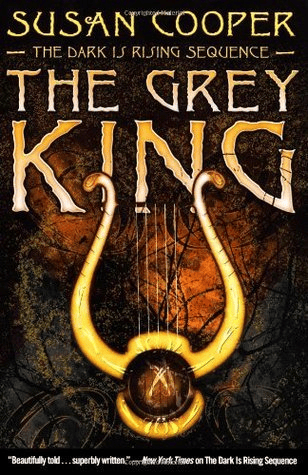
The Grey King (1975), Susan Cooper

“It is because you are not properly human, but one of the Old Ones of the Light put here to hold back the terrible power of the Dark. You are the last of that circle to be born on earth. And I have been waiting for you.”
 

Though this book is number four in a series I have not read, this did not seem to affect my reading experience: I read it in two sittings wholly drawn in by the storytelling. And though I may have missed some elements by not having read the previous books, especially regarding the eleven year-old protagonist Will Stanton and how he realized he was an Old One on his first full quest to overcome the rising Dark, the book worked fine as a stand alone title for me. For a full summary of the book, I recommend the Kirkus Review.

I choose this book for two reasons: one, the Wales setting, of course; and two, I wanted something fantasy-related as I thought I needed a little “light” reading at the moment. Ha! Let’s just say quests to overcome the Dark are far from light and I should have known!

Will Stanton comes to his relatives in Wales to convalesce after a bout with hepatitis. During his illness he was plagued by a delirium that filled his head with words and images he didn’t understand and now that he is well, can’t let go of them or a feeling of foreboding and something he is supposed to do about it. Once in Wales he awakens to the meaning of these signs and realizes he is on a mission, the details of which are not always obvious until he is in danger.

What makes the novel compelling is how gradually it is revealed to Will that many of those in the family he is staying with and their friends also have a part to play against this rising Dark. Yet, they as well do not know the extent of their role until called upon. So, the reader is carried along with the story, not knowing who is who until the final pages.

The book is based on Welsh legends that the people of the village have grown up with and talked about all of their lives. From the hills and mountains to the lakes, rock outcroppings, to magical beasts and fabled people the story is steeped in the mythology of this distinct place. And as Will goes about gaining strength it is obvious that his presence with these particular relatives is no coincidence; that he had to be here, in this place, at this time.

Will’s memory is gradually activated to specific tasks, to words of ancient spells in the Old Language and to the people around him and to what they mean for the quest. He senses the power of the Grey King, the rising Dark and how to fight it, the identity of the three-robed Old Ones, to the evil neighbor Caradog Prichard, the kindness of John Rowland and his deep knowledge of all the legends and tales of the land and to the final revelation of his friend and ally, Bran, and his true identity.

And as far as this final revelation of the whole quest and success of it, I have only three words: What. An. Ending….

A spoiler, of course, so I won’t say. But as I sat reading the last pages surprised and shocked, I thought, “Of COURSE, King Arthur would have a place in this story…of course!

A final note on Susan Cooper’s writing—which at times is wonderfully poetic and lyrical—the narrative is so beautifully constructed due to her superb knowledge of the old legends and stories that make even the setting itself feel alive with its magic.

I am not sure if I will read the other books in this series, because I can’t imagine I would enjoy them as much as this one. But who knows, I may have to find out….

____________

Dogsbody (1975) Diana Wynne Jones

Do listen to this, Leo! It’s about the Dog Star.

Sirius, Alpha Canis Major, often called the Dog Star, is only some eight and a half light-years distant from our Solar System…its brightness and characteristic green color make it a notable object in our winter sky…It’s exactly right for you! Oh–and you’ve got a Companion that’s a white dwarf, about half the size of our sun.

Sirius is angry. In fact, he is so angry he is lit up green. He has been accused of murder and the mishandling of the Zoi, which was seen falling to Earth and he cannot convince the other luminaries of his innocence. However, they have suspended his sentence with the proviso that he be banished to Earth to find and return the Zoi. He will be put in the body of a native creature, in this case a dog, without the knowledge of his mission. If he succeeds, he will be reinstated to all his spheric dignities. If he fails he will die in a manner natural to the dog. His green eyes are the only indication he is different from other dogs.

He begins his life on Earth in a litter of unwanted puppies, who are taken to the river to be drowned. Two die, but 4 are rescued by people who find them barely clinging to life, including young Kathleen, who is Irish and living with her English relatives while her father serves out his jail sentence back in Ireland. Already begrudged by Mrs. Duffield, who hates the Irish and is not happy that her husband took her in, the dog just makes things worse: Kathleen has to promise to do all the cooking and cleaning in order for Leo, the name she gives the dog, not to be put down.

Mrs. Duffield and her two young boys, Basil and Robin, make life difficult for Leo by their aggressive behavior towards him. Mrs. Duffield is a potter with a shop inside the house which makes the ever growing Leo a hazard. So he is banished to the backyard every morning to be tied up until Kathleen comes home from school and can take him out. It is on a walk to the field where she picked him up that he begins to awaken to his mission, that he is something else besides a dog, that he was wrongly accused of murder, that someone let him down and while he understands that his goal on Earth is to find a Zoi and bring it back, at this point he does not know what it is.

As the days go by and Leo remembers more he develops the ability to understand human language, which Kathleen notices. A book lover, she reads to him at night and though these scenes are touching, they give Leo some of the most important information he needs for his quest. He also communicates with the 3 Duffield cats, who have come to trust him after he saves one of them, Tibbles, from a severe beating by Mrs. Duffield. Tibbles teaches him how to unlock the gate, which he does each day to go and search for the Zoi. He feels an even more immediate need to find it after he realizes Basil is a collector of rocks and fossils and fears he may come across the Zoi first.

As the rush to find the Zoi and clear his name heats up, Leo encounters help and hindrance from all kinds of magical, earthly and celestial beings: Sol and Moon, who communicate via sun and moon beams and Earth whose clues come from its body, the Companion sphere of Sirius and the New-Sirius who want to kill Leo so he can’t come back and kindly old Miss Smith who takes in Kathleen and Leo when life at the Duffield’s becomes too dangerous for both.

The ending is bittersweet. There is victory, there is letting go, there is grief. But ultimately for us, the stars are in alignment, our Earth is stabilized and Kathleen is safe.

While this is a wonderful children’s tale (although the treatment of Leo by the Duffields is hard to watch even for adults), Diana Wynne Jones fills this story with astronomical legends and mythical symbolism to keep adults satisfied. As the great orbs of our galaxy fight and war with each other, they are reminiscent of the stories of Greek and Roman gods and goddesses and the feuds between them that threaten all of humanity and the one brave warrior tasked to save us all.

And what of the Zoi? Is it life itself? Is this a spiritual quest Leo travels toward as much as it is material? After all he is trying to save his life, or is he trying to save the life of all humanity? Frankly, I didn’t realize the depth of questions I would have before I started this book.

On a Personal Note

About three years ago I wanted to identify some of the constellations in the night sky and to learn their legends and history. Since Orion is so obvious and full of and close to major stars and other constellations I started there. Each late fall and through the winter months as it make its way across the sky I think of what I have learned. Orion is the Hunter, who is in the lead, while Sirius the loyal Dog, follows. In reading Dogsbody now, both Orion and Canis Major are visible and I have loved adding this story to what I know already about these constellations.

This is my first Diana Wynne Jones and I am grateful to Lory at Emerald City Book Review where I discovered March Magics and to Kristen at We Be Reading for having created it, giving readers a chance to discuss or discover a new author.

Fever 1793 (2000), Laurie Halse Anderson

I didn’t run from the redcoats, and I won’t run from a dockside miasma. What is wrong with people…We suffered all kinds of disease in our youth, but folks were sensible. They didn’t squall like children and hide in the woods. Captain William Farnsworth Cook, Pennsylvania Fifth Regiment.

Fever 1793, is a compelling historical novel based on the yellow fever epidemic that ravaged Philadelphia during the stifling hot summer of 1793. The story centers on 13-year old Mattie Cook, who watches helplessly as her beloved city grapples with the fear and devastation the epidemic wreaks.

Mattie’s parents own Cook’s Coffeehouse, a hub for politicians and merchants located two blocks from President Washington’s house. Philadelphia is the nation’s first capital city and Mattie is proud to live here. Since her father died, she helps her mother run the business along with Polly, the serving girl and her childhood friend, and Eliza, a free black who has been cooking up the special fare Cook’s is known for since it opened. As the city has prospered, so has Cook’s.

But August has brought fever—just a few cases to start, but enough to worry Mattie’s mother, Lucille, who forbids her daughter from doing any errands or getting provisions down at the docks. Some people are certain the refugees from Barbados have brought the illness and want them quarantined. Though others remind them there is always a sickness during the height of summer heat. Still, there are more cases as August progresses and there have been deaths. Lucille puts more restrictions on Mattie, who is frustrated at being so confined. When Polly does not come to work one day and it is learned she died of the fever, Lucille is adamant that Mattie be sent out of the city to friends out of town.

When it is declared the illness is in fact yellow fever, Philadelphia quickly empties as the wealthy leave for their homes in the country and others write to friends and family outside the city hoping they will take them in. Ships stop docking making food and other supplies scarce forcing businesses to close. Many who can’t get out hoard as much food as they can and close up their homes hunkering down inside for the duration. Amidst protest, Mattie is sent away with her grandfather.

And so begins Mattie’s harrowing journey to the family she never gets to, to the fever that almost kills her and the hospital stay where she recovers. Though weak and with Philadelphia still in the grip of the fever, her age precludes her being released with no place to go. There is no word of her mother’s fate and her aged grandfather cannot take full responsibility for her. Her only option is an orphan house for children who lost their parents and who have no other family to care for them.

But Mattie refuses. She wants to find her mother and go back home. Her determination cannot be matched, so she and her grandfather return to the coffeehouse only to find it has been plundered. After a few days of cleaning up, the coffeehouse is again broken into and her grandfather is killed. Mattie is now afraid to stay by herself.

Wives were deserted by husbands, and children by parents. The chambers of diseases were deserted, and the sick left to die of negligence. None could be found to remove the lifeless bodies. Their remains, suffered to decay by piecemeal, filled the air with deadly exhalations, and added tenfold to the devastation. Charles Brockden Brown (Memoirs of the Year 1793)

One of the very engaging aspects of the book are the historical quotes that begin each chapter adding to the reality of this frightening time. The real epidemic killed an astonishingly 5,000 people during the summer and early fall of 1793 until the first frost in October brought it to an end.

Anderson incorporates into the novel several contentious issues the epidemic sparked, including the controversial use of bloodletting to “release the poisons” from the blood; the argument between doctors who believed the fever spread through a “miasma” in the air, therefore confining patients to rooms with no access to fresh air versus those doctors who believed fresh air was healthy and part of the cure; the overwhelming number of children orphaned by the epidemic who needed to be housed; how the fever transformed some relationships between blacks and whites who worked together to help the city; and how this catastrophe brought out the best and worst in people as they fought for their lives.

There is great distress in the city for want of cash. Friendship is nearly entirely banished from our city. Dr. Benjamin Rush (1793)

Not for the The Free African Society, however. Founded in 1787 to aid widows, the infirm and out of work Africans, during the epidemic it offered to help all citizens of Philadelphia. Richard Allen and Absalom Jones co-founders of the Society put advertisements in the papers: “We set out to see where we could be useful—the black people were looked to. We then offered our services in the public papers, by advertising that we would remove the dead and procure nurses.”

And in fact, this is how Mattie found Eliza. After her grandfather was killed, Mattie knew she couldn’t stay in the coffeehouse and set out looking for news of her mother. She stumbled upon Eliza in the streets and found she was caring for and feeding the sick wherever she was needed. Eliza was able to fill Mattie in on all that had transpired since she was sent away. Mattie learned that her mother had gone to the family she was sent to, so what could she think when she found that Mattie had never arrived? But for the moment it was decided that without her grandfather and with the business too dangerous to stay in alone, Mattie would stay with Eliza’s family and would go out with her and nurse the sick.

Blessed be God for the change in the weather. The disease visibly and universally declines. Dr. Benjamin Rush (1793)

For weeks the city was caught in the grip of fever, death carts piled high as they rumbled down the streets. Finally, one blessed night a frost sets in and in a little more than a day or two the epidemic is over. Almost immediately the ships begin to dock bringing food and supplies to the beleaguered city and those who went to the country come back. George Washington makes his way back to Philadelphia and the whole city comes alive.

But Mattie has an uncertain future ahead of her. It is suggested she go into an orphan house until she reaches maturity. If she sells the coffeehouse, she can use the money for a dowry. Maturity? Hasn’t she seen and done enough in the last few months as any adult? No, she thinks. The coffeehouse is hers and it is a good respectful business. She will reopen it. But she knows she can’t do it alone and there is only one person she can trust who also has the experience to make the coffeehouse successful again. Though it is unconventional, she asks Eliza to go into partnership. She does not have to be asked twice.

A very satisfying book in which I learned about an event in American history I did not know before.

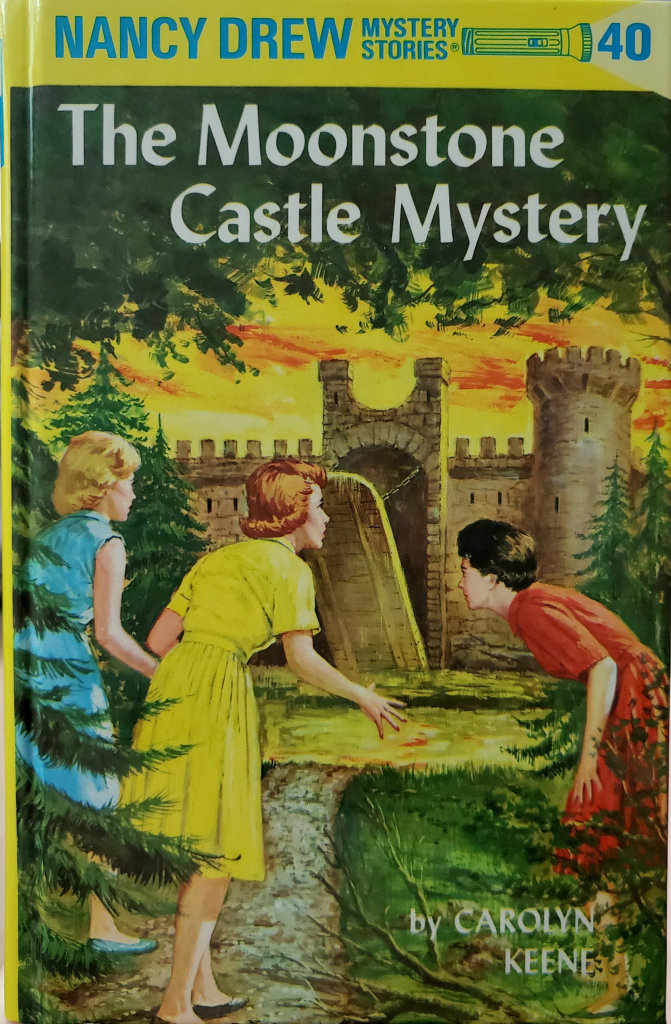
The Moonstone Castle Mystery (1963), Carolyn Keene

Bess and George were always interested in observing Nancy’s sleuthing procedures. They often wondered whether it was her charm, her straightforward manner, or her businesslike approach that unfailingly gained her entrance to offices and officials. Now, with little explanation on her part, the girls were ushered into the president’s office.

I am house sitting for my sister while she and my brother in law are in Massachusetts welcoming a new grandchild, who is now overdue, refusing to vacate the premises voluntarily. So, I am in San Diego a lot longer than I thought I would be!

While going through my sister’s bookshelves I found she has many of our old Nancy Drew books and since one of the book challenges I signed up for this year calls for a building in the title, I decided to give The Moonstone Castle Mystery a try. Like many girls of a certain age (ahem), Nancy Drew “girl detective” was a popular series along with Cherry Ames “nurse detective” and the Little House books.

As I began to read, I wondered how dated this would feel and if it had any relevance to me, now, or for today’s young readers.

Nancy lives with her lawyer father and housekeeper, Hannah Gruen (her mother died when she was a baby) and often helps her father with his cases. This is book number 40, so Nancy is a young woman at this point, with many cases under her belt. She is a skilled, confident and bold investigator and easily puts together answers from the clues she and her trusty girlfriends, Bess and George, find.

In this particular case, her father has asked her to go to the town of Deep River to find the whereabouts of a missing child as he suspects the heiress of a fortune is actually a fraud and the missing child in Deep River the real heir. With Bess and George, Nancy drives her beloved convertible to Deep River.

As in many mystery stories that start out with a simple question, Nancy and friends are soon caught up in something much bigger than a missing child. Someone is on to her and does not want her to discover the truth.

In the course of the trip she is followed by an unknown man, her car is stolen, while boating a crazed man rams her boat, she is briefly kidnapped, spied upon, chased and then is the chaser, figures out how to keep the drawbridge at the castle from rising, she interviews creepy people and decodes their answers and discusses the next move with Bess and George.

In short, nothing daunts Nancy Drew. She is not shy or hesitant. She does not question herself and willingly goes into the unknown. With Bess and George, who have accompanied her on many cases, these young women have honed their investigative skills and are game for any challenge. When more than one lead has to be tracked down at once, the young women divide up the duties, meeting later to discuss what they found.

So it was a real shock when Nancy invited their boyfriends, who happened to be counselors at a camp nearby, up for the weekend to help with this case. From the moment Ned, Dave and Burt arrive, Nancy defers to Ned with questions she had already gone over with Bess and George, letting Ned take the lead when she is perfectly capable of figuring out things herself.

Thankfully, the young men are only there for the weekend, because they all get into more scrapes and dangerous situations while the men take charge! In fact, Ned is the reason Nancy is kidnapped while they are checking out the castle. His, “wait here while I go down to the cellar, because it is too dangerous,” left Nancy alone where she is drugged and pulled into a closet. Nancy would never have balked about going down to the cellar herself.

When I asked myself if the original Nancy Drew is still relevant, despite the obvious awkwardness above, I found the actual mystery held my attention. Though some of the language and concepts are dated and obsolete (think doing detective work without computers or cell phones, getting a busy signal at the hospital because ‘the wires are crossed’ and referring to someone as queer, but not in reference to their sexuality), it is a good story with complex and layered clues leading to even more complicated situations.

These books have gone through many reprints and some modern updating since they were first published in the 1930s, but their portrayal of young women who are smart, confident, think for themselves, work together and trust each other is timeless and universal and certainly relevant in the 21st century.

Have you read any of the Nancy Drew mysteries as an adult?

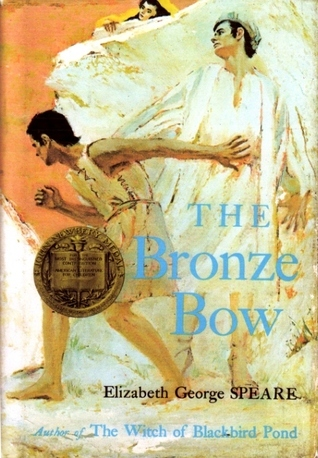
The Bronze Bow (1961), Elizabeth George Speare

“—He trains my hands for war,

so that my arms can bend a bow of bronze.”

When I read The Witch of Blackbird Pond last year, Elizabeth George Speare drew me into 17th century colonial Connecticut by her attention to historical detail and engaging writing style. I would say Speare surpassed herself in The Bronze Bow set during the time of Jesus in 1st century Palestine. This is the story of tormented Daniel bar Jamin, a young renegade blacksmith whose hatred for the Roman occupation of his ancestral land fuels his every waking moment. Sold to an abusive blacksmith at age 13 when there wasn’t enough food for the family, he fled to the mountains above his town 5 years later and joined a group of like-minded warriors. He is now 18 and he and the other young men are restless to fight, but the leader of the group, Rosh, keeps putting them off sending them out only to raid the fields of their Jewish neighbors telling the young fighters they need to gather more men before they can take action against the Romans.

When word comes to Daniel that his grandmother is dying leaving his sister alone, he puts his warrior plans on hold and moves back into the city to take care of Leah. It has been five years since Daniel saw his sister and grandmother. When he knocks on the door Leah is cowering in a corner and he realizes at 15, she is still traumatized over the unbearable experience of watching their father die by crucifixion at the hands of the Romans. Daniel’s mother stayed with him on the hill and later died of exposure. Five-year old Leah escaped from a neighbor’s house and was found at the crosses for an undetermined length of time. But it was long enough to give her nightmares and a fear of all people.

The town’s blacksmith Simon, called the Zealot, tells Daniel he wants to leave his business and follow a new preacher named Jesus. He is not sure how long he will be gone, but tells Daniel he can use his shop, the tools and materials as his own and move into the house connected to it. After much persuasion and the kindness of neighbors who build her a litter, Leah is carried like a queen to her new home. Daniel attracts a wide clientele with the skills he perfected on the mountain and is able to provide good food and clothing for Leah for the first time in her life. He also begins recruiting a band of youth who are itching to fight the Romans who he hopes will strengthen Rosh’s group.

Meanwhile, Daniel has renewed a friendship with a boy he knew from school. When Joel and his sister Malthace hear about the warrior group they, too, want to fight. Boy, girl it doesn’t matter, they all want the Romans out! However, their family is moving to Capernaum and Joel is supposed to go away for rabbinical studies.

It is against this backdrop of violence and hatred that Daniel first hears Jesus speak. He is confused when Jesus addresses the crowd and talks about building the Kingdom of God, which is what he wants, but Jesus’ kingdom doesn’t seem to come with a war, so how would it get built? And Joel is confused because Jesus says things that don’t sound like a rabbi, “He practically said it was alright to eat without washing our hands. Perhaps it’s dangerous to even listen to him. And yet—.”

And yet, against everything Daniel and Joel have lived for, the righteous actions against the oppressor and the righteousness of the Law, they are at once drawn then repelled over and over by what Jesus says. The first crack in Daniel’s emotional armor comes when his friend Simon the Zealot, the former fighter for Israel has decided to give up his shop and everything else about his past life and follow Jesus. He tries to explain to Daniel what has changed, but Daniel is incensed.

“Supposed they put chains on all of you and drag you off to prison.”

“He [Jesus] says that the only chains that matter are fear and hate, because they chain our souls. If we do not hate anyone and do not fear anyone, then we are free.”

In the end, Daniel’s hate could not be sustained…

This novel is so rich in the details of 1st century daily life and Jewish ritual during the time of the Temple. Food, clothing, commerce and the different ways in which people react to the Roman occupation make this novel very realistic. Speare treats the complexity of feelings that Jesus’ words bring to the various characters with depth and honesty as they struggle to make sense of their long-held beliefs.

Speare won the 1962 Newbery Medal for The Bronze Bow, a young adult novel suitable for adults 🙂