A Walk With Jane Austen (2007), Lori Smith

I hope that somehow this proximity to Jane’s life will help me understand my own.

This was the perfect book to cap my first Austen in August experience.  A work of nonfiction, A Walk with Jane Austen: A Journey into Adventure, Love & Faith helped with much of the back story to Jane Austen’s life and times that I mentioned in my Mansfield Park post and filled in some of the etiquette and culture gaps that perplexed me.

The Premise

Lori Smith is at a painful and difficult time in her life. Thirty-three years old she is unfulfilled in her job, frustrated that she is still single and though she does not doubt her Christian faith, she is struggling to make sense with all that is not working in her life. But the most difficult impediment is the profound fatigue and debilitating symptoms of an illness doctors cannot diagnose.

She learns to cope with the on again off again pattern of the illness and makes the decision to quit her job to become a full time writer. Long an admirer of Jane Austen, when a medication for an imbalanced thyroid gives her a reprieve from her symptoms, she books a trip to England with the goal of healing and reinventing herself through the life and works of Austen.

Everything in my life was dark, stifling. I needed light and air….In some ways, those of us who love Austen look to her to escape into another world. When our own is complicated and stressful, hers is tea and careful conversations and lovely dresses and healthy country air.

A Travel Guide

Starting with a course at Oxford and by reading through all of Austen’s novels, Smith is armed with maps and tips for visiting cities and landmarks that figure in Austen’s life as well as in her novels: Steventon, Chawton, Lyme Regis, Winchester, Bath, Box Hill and more. She quotes passages and ponders their connections to her own life.

Though I still have two more books of Austen to read (Pride and Prejudice and Emma) it was easy to follow the parallels of Austen’s life with her novels that Smith points out (for example, at Steventon, she sees the barn where Austen “threw rousing family theatricals with her brothers,” and I just read Mansfield Park!)

Some of the Austen family material Smith shares was helpful to me, too, in knowing two of her brothers were in the Navy (William in Mansfield Park, Colonel Brandon in Sense and Sensibility and Captain Wentworth and others in Persuasion), that one of her brothers was adopted into another family (Fanny in Mansfield Park), that James second wife was mean and jealous (Mrs. Norris in Mansfield Park) and Chawton Great House as the model for the Tilney home in Northanger Abbey.

This is a book for those new to Jane Austen and for the confirmed Janeite. For anyone planning a trip to England and their own walk with Jane Austen, consider this a comprehensive model.

Romance?

Finally, does Smith find romance? Of course, she does! Youth, England, summer, a course at Oxford. On her first day at the University she meets an American man studying for the summer who is kind, Christian and seems friendly. She falls head over heels, obsesses appropriately, has her future with him all planned out, but sadly, the feelings are not reciprocated. Although there are few resolutions for the issues Smith begins her trip

My days are still small. But the light is beginning to return. Just a couple of weeks ago I started being able to laugh at the world again, and that felt very good–soul healing laughter. I want more of it, to enjoy life, to love the people around me…I hope I will be healthy again.

And in health and all aspects of her life, I wish her well.

Lori Smith has written several books including, Jane Austen’s Guide to Life: Thoughtful Lessons for the Modern Woman.
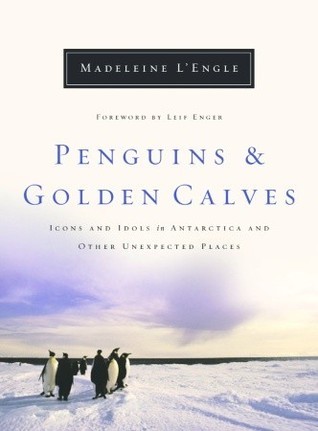
Penguins and Golden Calves: Icons and Idols in Antarctica and Other Unexpected Places (1996), Madeleine L’Engle

An icon should give us glimpses of our God who is both immanent and transcendent, knowable and unknowable. If an icon becomes more important to us than what it reveals of God, then it becomes a golden calf….

Penguins and Golden Calves: Icons and Idols in Antarctica and Other Unexpected Places describes L’Engle’s trip to Antarctica when she was 74 years old and the encounters she had with the small, crested Rock Hopper Penguins. She uses the image of the golden calf and her experience with the penguins to illustrate the difference between idols and icons. Like the Israelites, who turned the golden calf into idol worship instead of the worship of God, the penguins became to her an icon that opened her up to experience of God; an icon is the window to that connection.

Madeleine L’Engle, who died in 2007, was a well-known believer in Christ, who often ran afoul of ‘establishment’ Christianity by continuing to question and to seek that which made her uncomfortable in her faith. But her nonfiction has always struck a chord in me, as I am attracted to believers of all kinds who struggle to make sense of their tradition and especially, like L’Engle, see a bigger picture. Books like this mirror my own questions and struggles with spirituality, religion and belief.

It is not flippant for me to say that a penguin is an icon for me, because the penguin invited me to look through its odd little self and on to a God who demands of us that we be vulnerable…Whatever is an open door to God is, for me, an icon.

Because L’Engle uses penguins (penguins?!) as an icon to God, I was intrigued from the beginning and it articulated for me why I find it so easy to connect to God in nature and not in a building. I am never so connected to the experience, love and beauty of the Creator than when I am walking the bluffs overlooking the ocean, hiking the trails of the nearby mountains or when watching a lizard slither across a huge rock in the desert.

There are parts of liturgical services that in the words and rituals, I do see beauty and sincerity. I love getting caught up in words, in turns of phrase, of ideas written just so. And in a moment of public prayer or thanksgiving, I am often caught up in a sea of emotions. But once I leave the building, they are gone. And once I glimpse a hummingbird flitting over a flower or a flock of birds in v-formation it is only then that I can sincerely praise God.

I think we have totally complicated God and what it means to worship. The first thing God did, according to the Bible, was to create the world. Pagans stopped there, while the rest went on to create golden calves, complicated and alienating ways of worship, erecting walls of concrete to hold services, and sadly, making theologies with a total disregard for the Creator’s creation. How ironic!

So, even if we understand that praying through icons is not idolatry, why do we mortals need icons? Icons are not adequate, nor are sunset and moonrise and star-filled skies, though they are icons of God’s creation. Perhaps we need icons because of the very inadequacy of our ability to understand God….

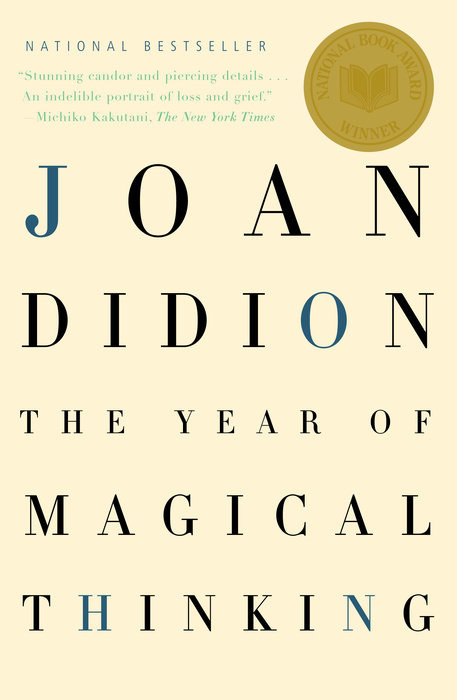
The Year of Magical Thinking (2006), Joan Didion

I like Joan Didion’s work, but when this was originally released my best friend was dying and I just couldn’t touch it. Even though the book wasn’t about cancer, I didn’t want to read about death, as if doing so would be a jinx. And ha! now I understand that was MY bit of magical thinking.

“You sit down to dinner and life as you know it ends.”

On December 30, 2003, as John Dunne was drinking Scotch and talking to his wife as she made them dinner, he had a massive heart attack.

Didion kept notes as a way to chronicle the many stages of grief she experienced during that first year after her husband’s death. I want to say right away this is not a depressing book. There are many moments of humor as is common even in the most grievous of situations. Instead, she chronicles the large and small thoughts and experiences as she tries to come to terms with his death.

The crazy thoughts that run through her mind ask—“could I have prevented his death in some way? Or could he? Were there clues to this impending tragedy that we both missed?”

~When John asked that they move back to New York City, she put him off, but if she hadn’t would that have affected his heart?

~If she alerted him to studies about the efficacy of low dose aspirin would that have saved him (even though she knew he was on the more powerful anticoagulant Coumadin)?

~In that last conversation before dinner he asked if the drink she made him was with single malt Scotch or the other Scotch, “because I don’t think you should mix them.” Did she miss the meaning there?

~Was he trying to tell her something a few years ago when he wondered if they were frittering away their lives and not really living?

“As I recall this I realize how open we are to the persistent messages that we can avert death.”

In the end, her grief turns to mourning as this first year passes into the second. Already some aspects of her husband are fading and she thinks of this as a betrayal. But she has to go on. She is still here.

Remembering bits of a conversation when they were swimming to a cave where the tide had to be just right to swim in, John said, “You have to feel the swell change. You have to go with the change.”