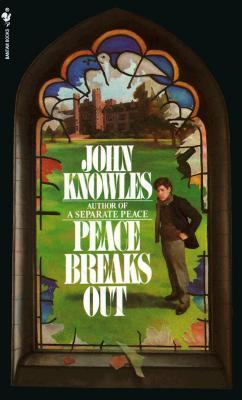
Peace Breaks Out (1981), John Knowles

But no men got killed by the enemy, not one, on United States soil…They never got here. Do you realize what that saved the American psyche from? Think how we would have felt if we’d seen Germans parading down Fifth Avenue in New York, locking up President Roosevelt, pasting up orders on buildings telling what time we had to be home, what we couldn’t read, how much we’d be allowed to eat, if anything…What if you’d seen your house blow up, with your mother inside, and your baby sister, and your little dog.

This is a sequel to the young adult classic, A Separate Peace published in 1959, although it is a stand-alone book and does not require any knowledge of the first book.

The story takes place at Devon School, a prep school for boys in New Hampshire, just after WWII. The war factors into both books with profound effects on the character and aspirations of the boys. In A Separate Peace military service was inevitable due to the draft and affected how the boys interacted with each other and themselves, as well as their plans for the future. In Peace Breaks Out, the graduating class is the first in many years where the young men can look forward to a ’normal’ future. But they feel cheated that they aren’t going to be able to ‘do their part’ in fighting the bad guys ‘over there,’ so instead, they fight them at school.

The school becomes a microcosm of the fear the larger world feels in the aftermath of the war over Russian domination and Nazi sympathy. A cabal develops among the boys led by the editor of the school newspaper, Wexford, who plot against German apologist Hochschwender with disastrous results.

Pete Hallam, war hero and recent alum, who has come back to Devon school to teach history and physical education sees what is happening and tries to intervene. But suspicions on both sides are impossible to break through. When a stained glass window honoring the students who fought and died in the war is broken, the damage Wexford has done to Hochschwender’s character has dire consequences.

Knowles has a gift for enfolding the reader into the life of the school through seasonal changes which dictate the rhythm and activities of the boys. I found this to be true in the first book as well. Winter especially, when it is brutally cold gives the boys little time for physical activities, but a lot of time for scheming and plotting. And like the boys in this boarding school who are only able to leave with permission, we also are forced to stay and grapple with their fear, anger and suspicion of each other.

While there are some weak plot lines, Knowles has a gift for creating memorable characters and as in the first book, that aspect is strong in the second.

A Separate Peace (1959), John Knowles

Finney never left anything alone, not when it was well enough, not when it was perfect. “Let’s go jump in the river,” he said under his breath as we went out of the sunporch. He forced compliance by leaning against me as we walked along, changing my direction; like a police car squeezing me to the side of the road, he directed me unwillingly toward the gym and the river.[i]

 My Thoughts

This was my first reading of a book many read as teenagers. The novel is told as a flashback when Gene Forrester comes back to his prep school alma mater, the Devon School in New Hampshire 15 years after he graduated. He has come back to make peace with the disastrous events that occurred in his last year of school. As he walks through the campus he feels the same sense of fear as he did when he entered as a boy and frankly, this feeling of something bad or ominous in the making lurked through each page I turned.

…. like stale air in an unopened room, was the well known fear which had surrounded and filled those days, so much of it that I hadn’t even known it was there. Because, unfamiliar with the absence of fear and what that was like, I had not been able to identify its presence.[ii]

 The story begins during the summer of 1942 and continues through the academic year of 1942/43, a time of world war that factored into the minds and hearts of the boys who knew their immediate future after graduation would include military service. For Gene and his best friend Phineas (Finney), this is a tragic year.

“I don’t really believe we bombed Central Europe, do you,” said Finney thoughtfully.

 …Bombs in Central Europe were completely unreal to us here, not because we couldn’t imagine it—a thousand newspaper photographs and newsreels had given us a pretty accurate idea of such a sight—but because our place here was too fair for us to accept something like that. We spent that summer in complete selfishness, I’m happy to say. The people in the world who could be selfish in the summer of 1942 were a small band, and I’m glad we took advantage of it.[iii]

Against the backdrop of WWII, Knowles effectively creates an insular sense of boarding-school life; that even though the world was deep into the war the boys’ world was concerned with their athletic prowess and academic victories, their complicated and confusing relationships with each other, secret societies, and the rule-breaking of boys living so intimately with each other.

As someone who attended a large public college, I have always been fascinated by small eastern schools. I fantasize about the ideal setting, atmosphere, students and course work. But I have never come up with such a notion as the Super Suicide Society of the Summer Session, where Gene was forced by Finney to start each meeting by jumping off a tree branch into a river.

In fact, while I was drawn into the story by Knowles’ well-defined setting and characters, the main characters I found hard to like. Finney’s manipulation of the boys, especially Gene and Gene’s inability to stand up for himself against Finney was hard to take. The pall of danger cast over the novel from the beginning made me fear a catastrophe akin to Lord of the Flies might break out any minute.

And when it happened, when a death came, it was almost a relief! I don’t know what this says about me as a person, but I was glad for this break-through in the atmosphere of doom. And as the novel came to a close, I found I liked Finney and Gene better once I understood their story.

I think the dynamics between the students, their idiosyncrasies, their individual perspectives on the world that were so well-defined still makes this a relevant choice for today’s teenage and adult audiences.

Phineas, [said Gene], “you wouldn’t be any good in the war….”

 “They’d get you some place at the front and there’d be a lull in the fighting, and the next thing anyone knew you’d be over with the Germans or the Japs asking if they’d like to field a baseball team against our side. You’d be sitting in one of their command posts, teaching them English. Yes, you’d get confused and borrow one of their uniforms, and you’d lend them one of yours. Sure, that’s just what would happen. You’d get things so scrambled up nobody would know who to fight any more. You’d make mess, a terrible mess, Finny, out of the war.”[iv]