The Magician’s Nephew (1955), CS Lewis

“Narnia, Narnia, Narnia, awake. Love. Think. Speak. Be walking trees. Be talking beasts. Be divine waters.” Aslan

And the longer and more beautiful the Lion sang, the harder Uncle Andrew tried to make himself believe that he could hear nothing but roaring….And when the Lion spoke and said, “Narnia awake,” he didn’t hear any words: he heard only a snarl. And when the Beasts spoke in answer, he heard only barkings, growlings, bayings, and howlings.

This is my second read through and I still found the first part dull, the magic not particularly, well, magical. I remember thinking the first time around I would stick with it, because I wanted to read the series. Similarly, this time I felt the same dull disinterest. 

And then suddenly, Aslan appears and the book takes a most promising turn!

The Story

Digory and Polly, neighbor children who are thrust into the void by the power of the magic rings invented by Digory’s Uncle Andrew land in a world made up of innumerable ponds and woods. It is a new world without flora or fauna, but that changes as a magnificent and glorious sound pierces the air and the children realize Creation is being sung into being before their very eyes!

There were no words. There was hardly even a tune….It was so beautiful he [Digory] could hardly bear it…Then two wonders happened at the same moment. One was that the voice was suddenly joined by other voices; more voices than you could possibly count….The second wonder was that the blackness overhead all at once, was blazing with stars….a thousand points of light leaped out—single stars, constellations, and planets, brighter and bigger than any in our world….If you had seen and heard it, you would have felt quite certain that it was the stars themselves which were singing, and that it was the First Voice, the deep one, which had made them appear and made them sing….The Voice rose and rose till all the air was shaking with it; the sun rose. You could imagine that it laughed for joy as it came up….the earth was of many colors; they were fresh, hot and vivid. They made you feel excited until you saw the Singer himself, and then you forgot everything else. It was a Lion and stood facing the risen sun. Its mouth was wide open in song….

Creation being formed out of Song and love and beauty by a Lion who is at once Creator and Sacrifice (LWW). Because, yes, one cannot but help to see that connection. Aslan is birthing the world through the sound of his Voice, bringing forth the first plants, the new starry heavens, the sun and wind and all the animals, birds and beings that will populate this new world.

Out of the trees wild people stepped forth, gods and goddesses of the wood; with them came Fauns and Satyrs and Dwarfs. Out of the river rose the river god with his Naiad daughters. And all these and all the beasts and birds in their different voices, low or high or thick or clear, replied. “Hail, Aslan. We hear and obey. We are awake. We love. We think. We speak. We know.

Aslan tells the animals and other sacred beings to guard and protect the land because evil has been let loose. The Witch followed Digory and Polly into Narnia, but for now she is headed for lands far away and won’t trouble Narnia for hundreds of years. In the meantime Narnia must be made strong. Aslan sends the children on a journey to find the fruit of a special apple tree that once planted in Narnia will reign over it against all evil. When they return Aslan tells Digory to throw the apple a certain distance and it settles into the soft mud. In the morning the tree is big and filled with fruit. Digory is certain an apple from this tree will help his mother’s cancer and Aslan gives him one to take home.

When Digory and Polly return to London, Digory’s mother eats the apple and is cured. Digory plants the core and a tree grows again overnight. As the years pass and the children grow up so does the tree which has a symbiotic relationship with the one of its origin: it wiggles a bit on days when it is windy in Narnia, even when there is no wind in London. But its shaking has weakened its roots, and one wind-filled day in London the tree topples over. Now middle aged and with unfaded memories of Aslan and Narnia and all he saw there, Digory cannot just chop up the tree for fire wood. So he takes part of the tree and builds a wardrobe which he puts in his house in the country….

The Controversy: Chronological Order or Published Order

In my Harper Trophy editions, The Magician’s Nephew (MN) is the first in the series with The Lion the Witch and the Wardrobe (LWW) second. I didn’t know any better and read this first. I had struck up a conversation with a woman in a bookstore who is an avid Narnia fan. She told me that after Lewis published the LWW a friend asked him about the lamppost that appeared out of nowhere and in order to clear that up he wrote The Magician’s Nephew. In that moment it made sense to me to stick with the order in my series. But what did Lewis himself say?

In 1957, an 11-year-old boy named Lawrence Krieg was preparing to read the Narnia books for a second time. Lawrence wondered if he should re-read them chronologically, but his mother felt he should stick with the original published order. So, Lawrence wrote a letter to the author and received this response:

“I think I agree with your order for reading the books more than with your mother’s. The series was not planned beforehand as she thinks. When I wrote The Lion I did not know I was going to write any more. Then I wrote P. Caspian as a sequel and still didn’t think there would be any more, and when I had done The Voyage I felt quite sure it would be the last. But I found as I was wrong. So perhaps it does not matter very much in which order anyone read them.”

C. S. Lewis, letter dated, 4/23/57

Douglas Gresham, stepson of C.S. Lewis

“[HarperCollins] asked, ‘What order do you think we ought to do them in?’  And I said, ‘Well … I actually asked Jack himself what order he preferred and thought they should be read in.  And he said he thought they should be read in the order of Narnian chronology.’  So I said, ‘Why don’t you go with what Jack himself wanted?’

Lewis scholars almost universally agree that the original published order is superior. They suggest that The Lion, the Witch and the Wardrobe is more initially captivating than The Magician’s Nephew, that certain lines in Lion do not make sense when the book is not read first,and that Nephew has greater mythic power when read as a prequel.

I think I agree with the assessment that LWW is best to read first, if only because the first half of MN is not so interesting. It would be a shame to turn off a young reader of this marvelous series, because the first one they read doesn’t capture their imagination. Though I didn’t know better and read MN first, I do wish I’d saved it and read the books in published order. I got so much more out of it this time around; the story’s magical qualities come to the fore with the writing, which for me is ‘pure magic.’ I imagine though reading order will be an argument that will last until the end of time!
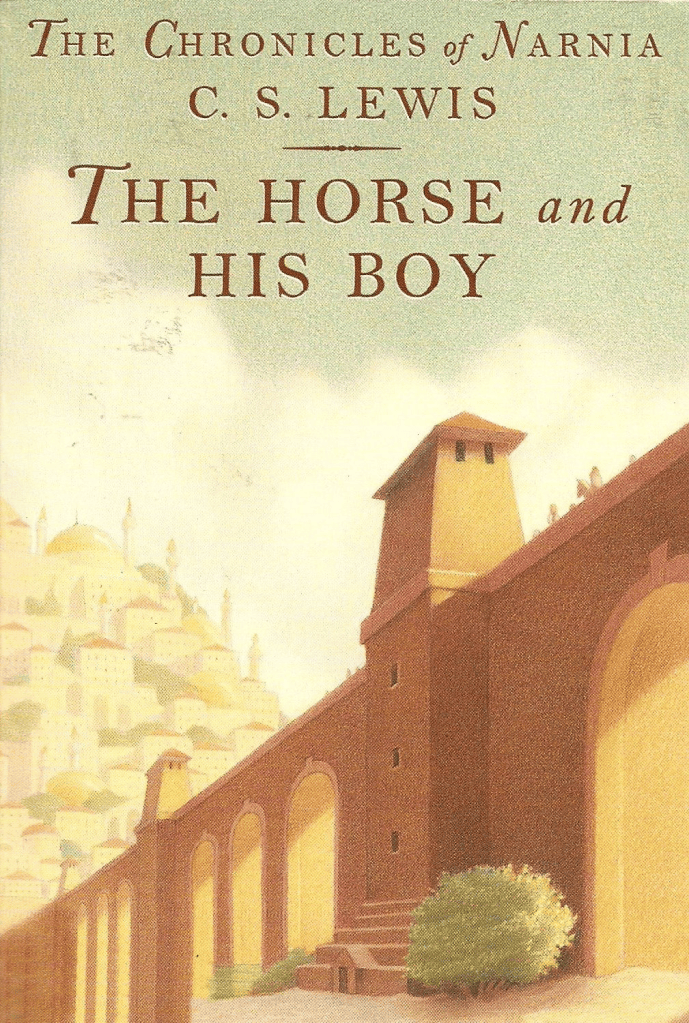
The Horse and his Boy (1954), CS Lewis

I’m a free Narnian.”

We’re free Narnians.

He was a free Narnian horse.

“I have been longing to go to the North all my life.” “Of course you have. That’s because of the blood that’s in you. I’m sure you’re true Northern stock.”

For a series of books written for children CS Lewis sure doesn’t sugar-coat childhood. He tackles bullying, the separation of families by war, the betrayal of siblings against each other and in this one child slavery, physical abuse and forced marriage, just to name a few. In The Horse and His Boy, there is less magic and playfulness and more realism. Lewis is telling a different kind of story here, where Aslan is mostly absent and Shasta and Aravis, the main characters, are on their own. In previous stories, the children knew they were on a mission for Aslan. This time, however, both have never even heard of Aslan and only find out later he has been guiding them from the beginning. But in the moment, their desire to escape, their plans and strategies have been due to their own will and wits.

Lewis also uses a different storytelling technique in this novel than he does in the others. In all the other books he is the creator of all the fantastic beasts, the flora and fauna and other beings. In this novel, he borrows the Calormen from a known culture, who are based on a middle eastern country, or tribe, or people, and sadly, are full of all the stereotypes one could imagine. At present, he has been rightly criticized and perhaps should have rethought this, however, I believe the story is still a good one and should be taken in the context of the time he was writing during which Asia and the Middle East were rather mysterious to the West.

When the story begins we meet Shasta, who as a young child was found drifting in a boat and is now the property of Arsheesh, a poor fisherman. Shasta is beaten regularly at Arsheesh’s whim. There are days when Shasta wants to escape and feels a pull to the North. Arsheesh is only too happy to turn him over to a Calormen nobleman who wants to buy him and while awaiting his fate in a stable Shasta finds that one of the horses can talk. Bree is a Narnian Horse belonging to this man, although he has kept his identity secret, and is treated cruelly, which both realize will be the same fate for Shasta. The two contrive a plan to escape to Narnia. On the road they meet another escapee from these lands, Aravis who is fleeing an arranged marriage. She is riding her horse, Hwin, who also happens to be a Talking Horse from Narnia.

The four team up, but it is a perilous journey and the children are challenged by the desert, ghoulish imaginings in the night, stalking, by what seem to be many lions, in which Aravis is wounded and an army trying to stop them that also wants to capture Narnia.

While this is very much an escape story, it is also a story about freedom and identity and about discovering who you really are and in remembering who you are. “I am a free Narnian,” says Bree repeatedly. Though long captured he hasn’t forgotten he is a noble war horse from Narnia and he is a free horse, belonging to no human.

Excuse me, Tarkheena [Aravis]…We’re free Narnians, Hwin and I, and I suppose, if you’re running away to Narnia, you want to be one too. In that case Hwin isn’t your horse any longer. One might just as well say you’re her human.

Shasta has always been attracted to the North (where Narnia is located), not the South even though southern travelers often come to sell fish and have great stories to tell. He knew who he was, before he was aware of it. And in a fairly obvious twist of fate it turns out Shasta’s identity is more than that of a common Narnian citizen.

And what to make of this Aslan? Though largely absent throughout the book when he appears he is often distant, distracted and removed. In a very different relationship with the main characters in this book than in previous novels, he is allowing them their journey without micromanaging the details. I believe this is a conscious shift in the message Aslan brings up to this time between what it means to be a child with all the hands-on guidance those ages entail to the next stage when you go out in the world and experience it through what you have been taught so far, including the making of mistakes. And with this new stage is the responsibility you accept for these mistakes, as Aravis learned when she experiences the consequences of a selfish act made against someone more vulnerable and much less socially powerful.

“It was I who wounded you,” said Aslan. Do you know why I tore you?”….The scratches on your back, tear for tear, throb for throb, blood for blood, were equal to the stripes laid on the back of your stepmother’s slave because of the drugged sleep you cast upon her. You needed to know what it felt like.” 

That is harsh. But a very good example of a true understanding of an “eye for an eye,” which is not the same punishment, but a fitting punishment. 

And then there is this passage that seems very odd, but I connect it to the idea of identity. This is Aslan’s response to Shasta when he meets him for the first time and asks who he is.

“Myself,” said the Voice, very deep and low so that the earth shook: and again “Myself,” loud and clear and gay: and then the third time “Myself,” whispered so softly you could hardly hear it, and yet it seemed to come from all round you as if the leaves rustled with it. 

It sounds like Aslan is trying to justify himself to more than Shasta. I would like to know what anyone else makes of this?

Suffice to say that I have no idea how I would have responded to this book as a child, but as an adult I feel like I am on a journey with these books as a whole. Almost like exoterica and esoterica, that is, you can read them as delightful adventure stories, but there is the deeper, hidden messages that take time to decipher. In fact, I had a thought as I was finishing this up that this whole story is reminiscent of the Old Testament and the Israelite’s journey out of slavery in Egypt to the freedom of the Promised Land-Shasta was found floating in a boat like Moses in his basket, Shasta is more than even he thinks he is again like Moses, Aslan is a fearful and often cold entity, the Calormen lands are in the desert. To plumb for another time?!! 

“I was the lion who forced you to join with Aravis. I was the cat who comforted you among the houses of the dead. I was the lion who drove the jackals from you while you slept. I was the lion who gave the Horses the new strength of fear of the last mile so that you should reach King Lune in time. And I was the lion you do not remember who pushed the boat in which you lay, a child near death, so that it came to shore where a man sat, wakeful at midnight, to receive you.” 

“By the Mane.” “Thanks be to the Lion.” “By the Lion’s Mane.” “By Aslan.”

Bree and Hwin lived happily to a great age in Narnia and both got married but not to one another. And there weren’t many months in which one or both of them didn’t come trotting over the pass to visit their friends at Anvard.

Prince Caspian (1951), CS Lewis

Listen, all you have heard about Old Narnia is true. It is not the land of Men. It is the country of Aslan, the country of the Waking Trees and Visible Naiads, of Fauns and Satyrs, of Dwarfs and Giants, of the gods and the Centaurs, of Talking Beasts. It was against these that the first Caspian fought. It is you Telmarines who silenced the beasts and the trees and the fountains, and who killed and drove away the Dwarfs and Fauns, and are now trying to cover up even the memory of them. The King does not allow them to be spoken of. 

This is a very indulgent, full-of-spoilers post, so be forewarned! I am participating in a readalong of the Chronicles of Narnia hosted by Chris of Calmgrove (one book per month and you can join in at any time) and Prince Caspian, our second book, took me by surprise. This is a reread for me; the first read through a couple of years ago found me rather off it, because it is basically about a war and I skipped through many pages. But this time though, I stuck to the script and was totally captivated by Lewis’s writing, which I obviously missed with all that skipping. I can honestly say I enjoyed this book more than The Lion, the Witch and the Wardrobe. Shocking.

What struck me in the writing was the magic. First a short recap:

The Pevensie children are called back to Narnia a year after their first visit through the wardrobe. This time they are at a train station on their way to boarding school when suddenly they feel a familiar physical pull and find themselves on a deserted island they soon realize is Cair Paravel where they ruled Narnia as kings and queens. They have been summoned to help Prince Caspian regain his rightful place as King of Narnia after his devious uncle has stolen the throne. Caspian is of the Telmar race who invaded Narnia over a thousand years ago conquering the land and sending the magic into dormancy. Old Narnia has been kept alive through whispered stories as any mention of talking animals, animated trees, naiads and the like is dealt with harshly. Caspian’s nurse kept Narnia alive for him through these stories and as rightful King he is determined to restore it to its former glory. There is a lot of magic in this one and some beautiful passages that describe the reawakening of the land and animals of Old Narnia who were silenced when Prince Caspian’s ancestors, the Telmars, conquered the land.

In general, one can see all kinds of symbolism in these books from the Christian, to the medieval, to basic fantasy and modern metaphor and probably others I am not aware of. I do tend toward the Christian in general, because it is just so easy to see Aslan as a Christ figure, yet in Prince Caspian I found so much more of the magical whether pagan or metaphysical. While it would take a book to muse and ponder through all this, I am content with treating this post as a sort of commonplace book, that is, just sharing what struck me in my reading. Talking badgers, good dwarfs and bad, an astronomical system specific to Narnia, changes in the Pevensie children that only happen in Narnia and the great Lion, Aslan, the magical quality of this book struck me more than in The Lion, the Witch and the Wardrobe. I think Lewis is at his creative and imaginative best here and writes with a child’s heart, that affects me as an adult, in so many of these passages. It was such a surprising and satisfying read. Which just goes to show me, “Stop skipping pages, Laurie!”

Some favorite passages.

Lucy senses Aslan’s presence.

Lucy feels the magic before her siblings and never wavers in what she sees and feels even against their push back. She senses the magic in the trees, knows Aslan is calling her before she can see him, while Peter and Susan use reason only to guide them when they first land in Narnia. Does this reason-over-magic which drives the two older children foreshadow their “aging out” of Narnia as Aslan tells them in the end? Have they lost the Soul of Narnia, which is still very present in Lucy?

A great longing for the old days when the trees could talk in Narnia came over her. She knew exactly how each of these trees would talk if only she could wake them, and what sort of human form it would put on. She looked at a silver birch: it would have a soft, showery voice and would look like a slender girl, with hair blown all about her face, and fond of dancing. She looked at the oak: he would be a wizened, but hearty old man with frizzled beard and warts on his face and hands, and hair growing out of the warts. She looked at the beech under which is was standing. Ah!—she would be the best of all. She would be a gracious goddess, smooth and stately, the lady of the wood. “Oh Trees, Trees, Trees, wake, wake, wake. Don’t you remember it? Don’t you remember me? Dryads and Hamadryads, come out, come to me.” Though there was not a breath of wind they all stirred about her. The rustling noise of the leaves was almost like words. The nightingale stopped singing as if to listen to it. Lucy felt that at any moment she would begin to understand what the trees were trying to say.

This same night Lucy looks up. This passage affected me personally as a night-sky lover as I have begun tracking the constellations through the year. When the Pleiades, Orion and Sirius become visible, I, too have a thrill of recognition as Lucy does when she awakens in the middle of the night back in Narnia.

…with the thrill of memory, she saw again, after all those years, the bright Narnian stars. She had once known them better than the stars of our own world, because as Queen in Narnia she had gone to bed much later than as a child in England. And there they were—at least, three of the summer constellations could be seen from where she lay: the Ship, the Hammer, and the Leopard. “Dear old Leopard,” she murmured. 

And there is the breathing, Aslan’s breathing. What to make of this? I cannot see it as other than the breath of life God breathes to animate Adam. Aslan breathes on the children and they see differently, they themselves are different. Edmund, “For Aslan had breathed on him at their meeting and a kind of greatness hung about him.” Susan, who wouldn’t follow Lucy’s direction given by Aslan, because she thought she knew better is breathed upon by Aslan and admonished, “You have listened to fears, child. Come, let me breathe on you. Forget them. Are you brave again?” 

Aslan breathes on the first Telmarine who volunteers to go into the new land, “As soon as the Lion’s breath came about him, a new look came in to the man’s eyes—startled, but not unhappy—as if he were trying to remember something.”

Mighty little Reepicheep and the restored tail.

And then there are the miracles. There is Aslan’s healing and restoration of Reepicheep’s tail and the healing of Caspian’s old nurse who is on her death bed and is cured just by Aslan’s presence at her bedside, “Oh Aslan I knew it was true I’ve been waiting for this all my life.” And then heck, he turns the water in the well into wine and with a sip she jumps out of bed! I mean really, water into wine? What to make of that?!! Or and I making too much of that?

And finally, Narnia is restored. Peter, Susan, Edmund and Lucy, Caspian, the animals and magical creatures follow Aslan into the peopled parts of the land where he is more visible to humans in ways he was not in the former novel, appearing as a sort of Pied Piper or Jesus character collecting followers as he and the Narnians walk through towns. Those who follow him have a kind of inner knowing that they are supposed to drop everything and leave with him.

They come to a school where a “tired-looking girl was teaching arithmetic….She looked out of the window and saw the divine revelers singing up the street and a stab of joy went through her heart. Aslan stopped right under the window and looked up at her…Said Aslan, “Now Dear Heart,” she jumped down and joined them.

Whatever the explanation, there is something about this book that is different from The Lion, the Witch and the Wardrobe that is definitely more Christian, Spiritual, magical, metaphorical—however you frame it. Aslan, is different, too. His presence in Narnia has been kept alive by faith, by stories and belief even by those who have never seen him. He also acts differently with the four Pevensie children by expecting them to act more on their own with only general direction from him, as if he is testing their faith in him and their purpose in Narnia.

The enduring love for the Narnia universe is evident in the popularity of the books by young and old alike, by the religious, the spiritual, the literary critic, the agnostic and in all the ways one can interpret these books. This interest/obsession/admiration isn’t waning. It is like Old Narnia continuing to live in our memories, though not through whispers and the pain of death, but out in the open and in living color!

But all night Aslan and the Moon gazed upon each other with joyful and unblinking eyes.

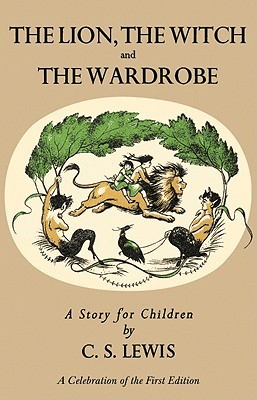
The Lion, the Witch and the Wardrobe (1950), CS Lewis

None of the children knew who Aslan was. At [his name] each one of the children felt something jump in its inside. Edmund felt a sensation of mysterious horror. Peter felt suddenly brave and adventurous. Susan felt as if some delicious smell or some delightful strain of music had just floated by her. And Lucy got the feeling you have when you wake up in the morning and realise that it is the beginning of the holidays or the beginning of summer.

One of my commitments this year is to read the complete Narnia series. I started with The Magician’s Nephew (some would argue that is actually the 6th book). But this one gets into the heart of the matter—the struggle between good and evil in the Land of Narnia and the ethics of choosing sides. I love the layers with which you can understand this book; how you can see a Christian allegory or “just” a magical adventure. Like many fantasies Narnia is a land where animals talk, Witches are cruel, quests are taken and bravery against evil is the key to survival.

Peter, Susan, Edmund and Lucy Pevensies are siblings who have been sent out of London for the duration of the war to the country home of an old professor. During one rainy day Lucy discovers that the back of the big wardrobe in a mostly empty room is actually a gateway to a magical land called Narnia. After her first adventure she returns home to tell her brothers and sister, but they do not believe her, especially after investigating the wardrobe themselves and finding nothing but old coats.

Lucy is distraught that her sanity has been called into question, even after Edmund finds his way into the Land. Finally, in one last effort to quell Lucy’s insistence her siblings try again and successfully find themselves in the cold snowy winter of Narnia. They soon realize they are caught in a battle for rulership of Narnia between the wicked White Witch who wants to subjugate the population and Aslan the Lion who wants all beings to be free. The children learn they are part of the prophecy of Narnia, which they hear from the first friends they meet, Mr. and Mrs. Beaver:

…down at Cair Paravel there are four thrones and it’s a saying in Narnia time out of mind that when two Sons of Adam and two Daughters of Eve sit in those four thrones, then it will be the end not only of the White Witch’s reign but of her life, and that is why we had to be so cautious as we came along, for if she knew about you four, your lives wouldn’t be worth a shake of my whiskers.

The children readily give themselves up to the cause and the tasks Aslan asks them to complete. The ultimate cruelty for the Witch in order to gain Narnia for herself is to kill Aslan, who willingly sacrifices himself for the greater good. His resurrection, though, is not part of her plan.

As an adult, I found some of the writing simplistic compared to the writing in The Magician’s Nephew, which was written years later. Especially at the beginning I felt like my hand was being held throughout the action. Once all of the children get into Narnia, however, the book reads like any adventure story with complex characterizations and the challenge of making moral choices. When Aslan makes his moral choice Lewis is at his writerly best when after the shock of Aslan’s murder by the Witch and her minions, he explains to the children why he cannot really die:

…that though the Witch knew the Deep Magic, there is a magic deeper still which she did not know. Her knowledge goes back only to the dawn of time. But if she could have looked a little further back into the stillness and the darkness before Time dawned, she would have read there a different incantation. She would have known that when a willing victim who had committed no treachery was killed in a traitor’s stead, the Table would crack and Death itself would start working backward.

Aslan and the children and the rest of the animals in Aslan’s service go to the Witch’s castle in the last battle for Narnia. Her courtyard is full of statues, her enemies she turned to stone and as Aslan breathes on each one animating them back to life they join his cause. She is killed and Peter, Susan, Edmund and Lucy sit on their thrones, taking their rightful place as the Kings and Queens of Narnia.

But they are not meant to stay and in the course of trying to capture the White Stag, come upon the lamppost that got them to and from Narnia. Leaving their friends, they scramble back through the wardrobe, where they decide they need to tell the Professor everything. A wise man who had an adventure himself, he assures the children they will return to Narnia but not by the wardrobe. How will they know when it’s time? “Keep your eyes open.”

I am not sure what to expect next if Narnia has been saved and Aslan triumphs. Mr. Beaver tells the children about Aslan, “He’ll be coming and going….One day you’ll see him and another you won’t. He doesn’t like being tied down—and of course he has other countries to attend to. He’ll often drop in. Only you mustn’t press him. He’s wild, you know. Not like a tame lion.” Will I see these “other countries” and Aslan again? Will these children return to Narnia or go elsewhere? Will other children take their place in the stories to come?

I guess I’ll find out! And no spoilers, please 🙂