The Touchstone (1900), Edith Wharton

The Touchstone sets up a moral dilemma for Stephen Glennard, whose career is floundering making it impossible to marry the woman he loves. He is resentful of his contemporaries who always find a place at someone’s dinner table or invitation to the opera, while he has to calculate cab fares, clothing and food to make ends meet sacrificing the important contacts that could improve his life.

But one evening when at his club his eyes light on a name in a headline. Someone is soliciting information on Margaret Aubyn, a woman he had a relationship with. It ended when she left for England, though she continued to write to him for many years. The article states specifically, “She had so few intimate friends…that letters will be of special value.” Glennard has hundreds.

A friend helps him find a publisher for the letters, he being the go-between that keeps Glennard’s name out of any correspondence or notoriety. Based on the projected windfall, he marries Alexa Trent. They move to suburban New York City and for a year all is calm. When the letters are published Glennard is shocked to learn of the sympathy most readers, and his social circle, feel toward Margaret Aubyn. Slowly his conscience begins a slow downward spiral of guilt and for a time is haunted by her presence. He fears exposure and the reaction of his wife, who seems to have taken on a kind of protective stance against the exploitation of this woman.

The story had me glued to the narrative until the very last sentence, because the outcome was never assured. Wharton does not give the reader a firm conclusion to either Glennard’s guilt or Alexa’s acceptance. This is not a spoiler, this is pure Wharton!

The Marne (1918), Edith Wharton

Whither thou goest will I go, thy people shall be my people…” Yes, France was the Naomi-country that had but to beckon, and her children rose and came.

Edith Wharton had been living in France for many years when WWI began. Like many in Europe, Wharton was frustrated and angry at America’s reluctance to enter the war and The Marne was written in response. The main character, Troy Belknap, is her voice against this hesitation, a call to save what she has come to love. This is a very emotional Wharton that I have not seen before. Through Troy, whose yearly visits to France with his parents, has  given him a love for the country, there is something very personal that Wharton brings to this story.

Troy is very young when he first summers in France. His parents arrange a tutor for him in all the subjects that interest him and every year he sees this same tutor, Paul Gantier. As he grows older, his friendships and enjoyment with his studies grow. It is an easy life of long motor drives, sightseeing, archaeological trips and the lovely sights to stoke a precocious imagination.

As the family travels each summer they often stay in the same hotels and inns and Troy has become very attached to one particular family and looks forward to seeing them every year. He has an insatiable urge for knowledge and getting the most out of his summers in France. He calls France, “his France.” His love for the country is deep in both the past and present, loving history as well as attentive to the people he meets wanting to know their story. He is devastated the summer the Germans begin their march toward Paris when his tutor has to leave him to fight. He is too young to go himself and is angry that the US has not stepped in.

His family, like many foreigners, are stranded once the fighting begins. Some are able to get to England, but find the same issue there. Wharton does not hold back her contempt at the utter narcissism that they feel their plight should be taken into consideration above all others-“…We’ve really spent enough money in Europe for some consideration to be shown us…” For the first time in their lives they are asked to think of others and rather than see where or how they could help the country they use for status and reputation at home, they are indignant they aren’t taken into consideration first. Troy is outraged at their egotism spends as little time as possible with them.

The misery of feeling himself a big boy, long-limbed, strong-limbed, old enough for evening clothes, champagne, the classics, biology, and views on international politics, and yet able to do nothing but hang about marble hotels and pore over newspapers, while rank on rank, and regiment on regiment, the youth of France and England, swung through the dazed streets and packed the endless trains—the misery of this was so great to Troy that he became, as the days dragged on, more than ever what his mother called callous, sullen, humiliated, resentful at being associated with all the rich Americans flying from France.

Once back in New York City a sort of ‘one-upmanship’ is occurring with these same people who complained that they were not given priority in leaving, but are now telling anyone who would listen about their privations and hardships.

“The tragedy of it—the tragedy—no one can tell who hasn’t seen it and been through it,” Mrs. Belknap would begin, looking down her long dinner table between the orchids and the candelabra; and the pretty women and prosperous men would interrupt their talk, and listen for a moment, half absently, with spurts of easy indignation that faded out again as they heard the story oftener. As more of the once stranded civilians return home they have fresh tales to tell and Mrs. Belknap finds herself out-storied, out-charitied, and out-adventured. She is pushed aside to make room for others, people want something newer….

As soon as he turns 18, Troy returns to France as an ambulance driver. And one day he is met on the road by a truck load of American soldiers. America has finally joined with France and England against Germany! “There they went, his friends and fellows, as he has so often dreamed of seeing them, racing in their hundreds of thousands to the rescue of France; and he was still too young to be among them, and could only yearn after them with all his aching heart!”

But at the last moment, one of the trucks stops and a young man calls out to him to hop in the truck, “come and help!” And just like that Troy, without a moment’s hesitation, leaves the ambulance and becomes a soldier. As the truck rolls on he is given some instruction, though he is also filled with guilt about leaving his position. At the first battle he is wounded and brought to a field hospital. Regaining consciousness it turns out that was the great Battle of the Marne. The Allies had pushed back the Germans and the advance on Paris has been checked! But the oddest thing happened. Troy’s wound was severe and in semi consciousness he saw Paul Gantier, the young man who had been his childhood tutor, lift him up until he felt himself floating. Regaining consciousness at the hospital, the medics told him that his rescue had been incredible, but that no one knew his rescuer, not his name or where he had gone to. And then he just disappeared. A stunned Troy held his tongue-his tutor had died near the beginning of the war….

Published in 1918 with battles still raging, this is more a book about the attitudes at the home front than the war itself. And with the war still on, this book is published as a type of propaganda, guilt propaganda if there is such a thing, I would call it. And perhaps not directed at middle America, but to those of the upper classes who can make a difference, the ones who call the shots and who supposedly love France. 

Wharton wrote another novel about the war and a few nonfiction. I will get to those at some point and will be interested to see if they are as passionate.

There had never been anything worthwhile in the world that had not had to be died for, and it was as clear as day that a world which no one would die for could never be a world worth being alive in.

Every stone that France had carved, every song she had sung, every new idea she had struck out, every beauty she had created in her thousand fruitful years, was a tie between them that all civilization was bound up in her, and that nothing that concerned her could concern her only.

For France was his holiday world, the world of his fancy and imagination, a great traceried window opening on the universe. And now, in the hour of her need, all he heard about him was the worried talk of people planning to desert her!

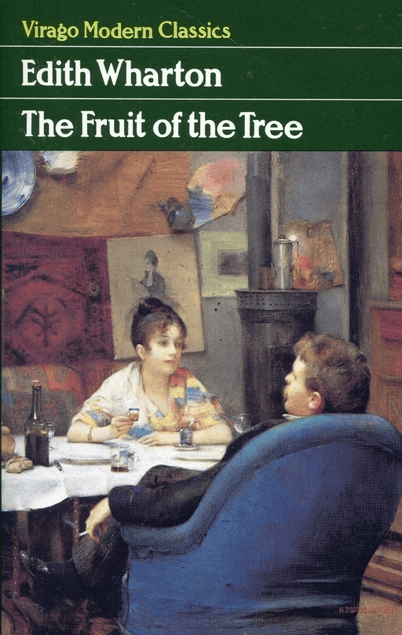
The Fruit of the Treed (1907), Edith Wharton

Human life is sacred,” he said sententiously.

“Ah, that must have been decreed by someone who had never suffered!” Justine exclaimed.

The Fruit of the Tree is a departure from most Edith Wharton novels that deal with the superficiality and hypocrisy of the lives of the upper class. While that plays a role here, the novel concentrates on the life of factory assistant manager, John Amherst, whose interest in bettering the conditions of the workers put him at odds with the wealthy owners. He is in a constant battle of explaining the evils of exploitation and the benefits of humane working conditions to the Westmore family who are not supportive

Now, young Richard Westmore, the owner of the mills, has died and his wife is named heir and overseer. When John Amherst and Bessy Westmore meet for the first time, he takes her on a tour of the factory and she meets some of the laborers. As they explain their jobs she sees through Amherst’s explanations that the dangers they are confronted with could be mediated by more updated equipment and a different philosophy of production. She is shocked by a recent accident on the factory line that left a young family man hospitalized, whose livelihood is now in jeopardy. John continues to speak of the morality of a working environment that is clean and safe, where the workers don’t have to come in sick because they have medical care or worry about their babies due to onsite child care and where adult education gives them opportunity for advancement. 

As John and Bessy fall in love it is more than an opportunist’s dream for John who is convinced he has turned Bessy from a disinterested carefree young woman to his partner in humanizing the lives of the people she has become responsible for. But the first blush of altruism for Bessy begins to fade when she realizes the time that must be spent “working” though she is still supportive of John’s aims and goals.

When Bessy’s childhood friend, the idealistic nurse Justine Brent, meets John at the bedside of an injured worker conflict arises between the three.

The marriage between John and Bessy is never peaceful. Bessy’s business advisors, friends of her deceased first husband, are always at odds with John’s plans for the factory and are constantly challenging her to stop him. They tell her that she should be concerned with the financial outlay and that John’s ideas do not guarantee a return on the money. When a horse riding accident puts her life in jeopardy any support for John and the factory wanes. John never loses his motivation for reform, though, and tries to press on. He has also lost the encouragement of Justine whose own life takes a turn when she makes a devastating decision prompting her to leave.

Thoughts

Wharton tackles many social and personal issues in this novel. One in particular reminds me of The House of Mirth. Without giving away an important plot twist, she has a character deal with the problem of chronic pain and the medical use of drugs. When Wharton was writing The House of Mirth she went to a chemist to understand sleeping draughts and their potency. She asked how a person would know to increase the dosage without killing themself. While the question in that novel considers a death by suicide or natural causes, the question in this novel is the morality euthanasia.

Wharton always draws her characters with such depth. It is easy to understand, though not always easy to agree on their motivations and here it is no different. John Amherst is committed to factory reform against all the odds thrown at him. Bessy grew up a typical materialistic girl, but has a big heart that has been opened to the inequities of real life. She struggles to do the right thing, but it is not easy for her, especially after she understands that John’s commitment to his beliefs infringe upon the luxuries she is accustomed to. Justine just wants everyone to be treated fairly, but comes up against the harsh lessons that being a woman of the working class entails. Suffice it to say, there is no happy ending for anyone in this novel, but perhaps with the passage time all the roughness with will smooth out….

But life is not a matter of abstract principles, but a succession of pitiful compromises with fate, of concessions to old traditions, old beliefs, old charities and frailties….And she had humbled herself to accept the lesson, seeing human relations at last as a tangled and deep-rooted growth, a dark forest through which the idealist cannot cut his straight path without hearing at each stroke the cry of the severed branch, “Why wounded thou me?”

Her world, in short, had been chiefly peopled by the dull or the crude, and, hemmed in between the two, she had created for herself an inner kingdom where the fastidiousness she had to set aside in her outward relations recovered its full sway. There must be actual beings worthy of admission to the secret precinct, but hither to they had not come her way; and the sense that they were somewhere just out of reach still gave an edge of youthful curiosity to each encounter with a new group of people. 

“I’ve no head for business—but I will try to.”

“It’s not business that I mean; it’s the personal relationship—just the thing the business point of view leaves out. Financially, I don’t suppose your mills could be better run; but there are over seven hundred women working in them, and there’s so much to be done, just for them and their children.”

“I have always understood that Mr. Truscomb did everything—“

“Do you leave it to your little girl’s nurses to do everything for her?”

The Bunner Sisters (1916), Edith Wharton

The Bunner sisters were proud of the neatness of their shop and content with its humble prosperity. It was not what they had once imagined it would be…and it was long since their hopes had soared higher.

Edith Wharton is known for her sharp observations about the excesses of the upper classes and expats of New York during the turn of the last century, but in the Bunner Sisters she turns her attention to working class shop owners and their day to day survival.

In novella form, this is a story about two sisters who are just scraping by with their small hat shop on a side street in a fading area of New York City. Ann Eliza, the oldest and Evelina the younger are loving and supportive of each other until Herman Ramy, who owns a clock repair shop, comes on the scene. As he gets to know the sisters he settles on Ann Eliza and proposes, but she tells him she has vowed never to marry. It is an easy switch for him to the younger sister, who does not know about the previous proposal.  They marry quickly and he spirits her off to St. Louis where he has been offered a job. 

Ann Eliza has given Evelina her share of the money they had saved up when her sister tells her how expensive St. Louis is and that Ramy will not get a raise until he’s been on the job for many months. Alone for the first time in her life Ann Eliza does the best she can, but without another person to run to other shops for supplies and food, it becomes challenging.

When her sister’s letters stop coming she fears the worst. Spending the little money she has she goes to St. Louis. Remembering the name of the shop in which Ramy was supposed to be working she finds he was fired for opium addiction and the owner has no idea where he is now. So Ramy wasn’t sick, which was one of the reasons the sisters felt sorry for him; he was addicted to opium even them. Ann Eliza returns to New York City fearing her sister is lost forever. When Evelina finally shows up alone, she has a harrowing story to tell.

Wharton packs such an emotional punch in her novellas that I always feel like I have been put through a ringer! This affected me similarly.

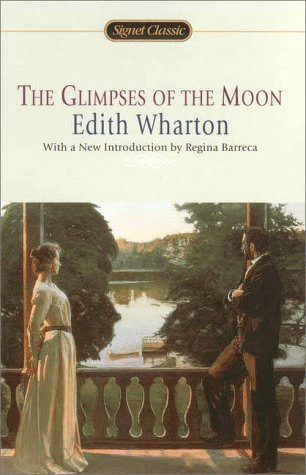
Glilmpses of the Moon (1922), Edith Wharton

He knew on how frail a thread the popularity of the penniless hangs, and how miserable a girl like Susy was the sport of other people’s moods and whims. It was a part of his difficulty and of hers that to get what they liked they so often had to do what they disliked.

Nick Lansing and Susy Branch of The Glimpses of the Moon are the answer key to Lawrence Selden and Lily Bart in The House of Mirth, whose motivations and actions often confused me. Where the problems exist in Edith Wharton’s, The House of Mirth, The Glimpses of the Moon is its “redo.”

Wharton, who was born in New York City to a wealthy and prominent family, writes realistically of upper class society in the early 20th century piercing its contradictions and exposing its hypocrisy. She is also masterful at portraying another part of this society: the dependents, the bright, pretty things of wit and intelligence hoping to break into the community of the wealthy and achieve some level of stability and status.

When Nick and Susy meet they recognize kindred spirits. Both are charming, beautiful and likeable; the kind the wealthy enjoy having around to enliven parties and animate conversations. They live off the good graces of their rich friends and all expenses are paid whether for a weekend in the country or a 3-month tour of Europe. They first see each other at their mutual friends, the Fulmer’s, where Susy is staying. Nick has come to visit and after several days of conversation they realize they are in the same position in society, but might do much better as a couple. “I don’t know how you feel; a man’s popularity is so much less precarious than a girl’s–but I know it would furbish me up tremendously to reappear as a married woman.” They both know the ropes, can spot opportunities and will be a novelty as a married couple. “We’re both rather unusually popular–why not be frank?–and it’s such a blessing for dinner-givers to be able to count on a couple of whom neither one is a blank.” So they make a bargain that they will marry with the understanding that if either finds a better situation the other will release them.

And it works. Due to Susy’s calculations she has figured out they could honeymoon for a year all over Europe on the invitations of friends for whom lending their homes to the newlyweds is a happy prospect. And so their life together begins with their first stay in a villa in Italy owned by a close friend of Susy’s, Charlie Strefford. They entertain the wealthy of their set who pop by in their boats or buggies to spend afternoons at home or evenings out.

Next, they move on to the home of Nelson and Ellie Vanderlyn where on the first night Susy finds an unexpected complication to their stay. Not expecting either to be home, she assumed their daughter would be with them. But in a letter left by Ellie to Susy she apologizes for leaving their 8 year-old daughter Clarissa and hopes Susy will be a good friend and care for her. Then Ellie asks for another favor. There are several letters to her husband she would like to have mailed, one each week. The post-mark is from the house, which Susy realizes means Ellie and Nelson are not together and Nelson thinks Ellie is home…Susy is sick with worry, disgust and fear all night going back and forth as to what to do. Should she participate in this deception against Nelson, should she aid in Ellie’s adultery, should she tell Nick even though Ellie begs her not to?

In the morning, she is resigned to play the game: in order for her and Nick to live this luxurious life as guests of other people they will always have to do something distasteful in return and this won’t be the last time. She and Nick, as a matter of course, will always have to do the dirty work of others.

However, this is a revelation to Nick who is stunned when by accident he finds out about Susy’s part in Ellie Vanderlyn’s affair.

Well–doesn’t our being together depend on what we can get out of people? And hasn’t there always got to be some give-and-take?…You’ve lived among these people as long as I have; I suppose it’s not the first time–”

By God, but it is….I have never in my life done people’s dirty work for them–least of all for favours in return. I suppose you guessed it, or you wouldn’t have hidden this beastly business from me.”

And Nick’s final blow against Susy:

“You knew I wouldn’t have stayed here another day if I’d known.”

“Yes: and then where in the world should we have gone?”

“You mean that–in one way or another–what you call give-and-take is the price of our remaining together?

As if Nick had forgotten their bargain and the compromises and concessions they’d have to make, he tells her they must part.

The two separate and continue to live at their various friends’ homes continuing to miss each other yet too proud to confess. It is many months since they have seen each other and Nick has taken a position as a secretary to their mutual friends, the Hicks’ aboard their yacht and cruises the Mediterranean. It is assumed he will marry their daughter, Coral.  Susy finds herself receiving attention from her old friend Strefford whose wealthy relatives have died leaving him a wealthier man than when she stayed at his villa. It is assumed she will marry him.

The manner in which the newly married, now separated Lansings are treated among their friends is almost matter of fact. At this period, divorce is not the stain on a woman’s reputation as it was only a decade or so earlier. Both are free to marry when the divorce is final. Some of the characters, though, are very puzzled by the decision to divorce, and in a not so very subtle way tell Susy she can stay married and find love elsewhere.

Because everyone is doing it….having affairs, that is. For their upper class friends cheating on your spouse is practically an obligation or at least usual. Nelson Vanderlyn eventually finds out about Ellie and though devastated, it is short-lasting. At one point, Susy hears that Nelson, Ellie and her new man are all dining “cheerfully together.” In this world of wealth, position and family ties marriage is to secure riches and status, not because of love. And to be married for many decades to someone you may not particularly like is a tedious prospect. So spouses cheat, and if discovered let it go, because they are doing it themselves.

When Nick and Susy reunite, it is not to live as their friends do. The parting has forced them to give up their pride and say they love each other. They will not cheat as their friends do to keep the family fortune, as they know they will have no fortune. The difference between Nick and Susy and their friends is that they married for love. If only Lawrence and Lily could have said it….

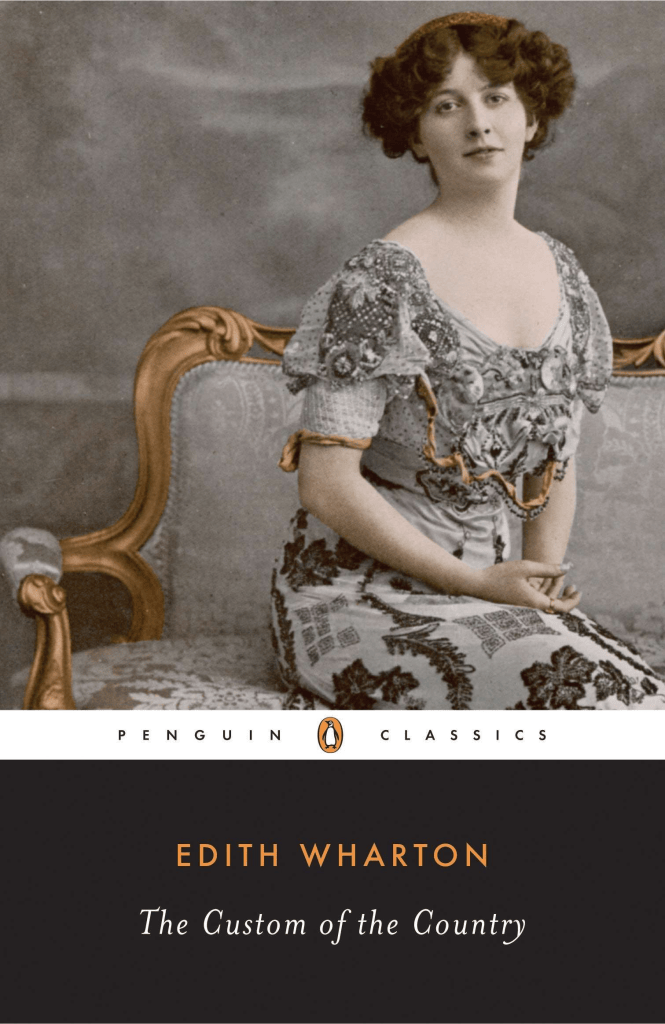
The Custom of the Country (1913), Edith Wharton

Ralph Marvell: You know nothing of this society you’re in; of its antecedents, its rules, its conventions; and it’s my affair to look after you, and warn you when you’re on the wrong track.

Undine: I don’t believe an American woman needs to know such a lot about their old rules. They can see I mean to follow my own, and if they don’t like it they needn’t go with me.

Undine Spragg, the main character in Edith Wharton’s, The Custom of the Country, must surely be ranked in the top ten of the most disliked protagonists of literary history. Narcissist, taker, Queen of the Most-Selfish do not describe fully the ruin she wreaks as she pursues life in high society.

I have now read most of Edith Wharton’s major novels and novellas as I continue this year of reading specific writers. Her main characters have this in common: they dream of a better life than the one they find themselves in, they make plans for it and plot through the roadblocks that may be in the way, the goal seems just within reach and then the outcome is thwarted in some way and they are stuck where they have always been. And in each of these stories I have cheered for the protagonist to reach that goal, to fulfill the dream he or she has worked so hard for. But in Undine Spragg I found the exception. Her shockingly malicious behavior had me wondering who or when her reign of ruin would be put to an end.

The Narrative

Set in early 20th century New York City, Paris and Italy, The Custom of the Country concerns Undine Spragg, a startling beauty with grand ambitions beyond her small midwestern town of Apex. After her father has some business success, she begs her parents to move to New York City where she hopes to establish herself in the higher echelons of society. Armed with Town Talk and Boudoir Chat she devours the articles describing the fashionable trends for women, the best places to be seen and the names of those she hopes to meet. After two years of many false and humiliated starts where the difference between old and new money is important, but never apparent to the newcomer, Undine marries Ralph Marvell, whom she believes is the answer to her dreams of upper class life.

But it becomes clear on their honeymoon to Italy that old-monied Ralph is not as rich as Undine had hoped. What also becomes apparent to the cultured, would-be novelist is his wife is not suited to his own visions of married life. The solitude of the remote places Ralph thought perfect for a honeymoon Undine finds boring and craves the excitement of people and parties. She has no desire for new experiences or to broaden her mind:

An imagination like his peopled with such varied images and associates…could hardly picture the bareness of the small half lit place in which his wife’s spirit fluttered. Her mind was as destitute of beauty and mystery as the prairie school-house in which she has been educated; and her ideals seemed to Ralph as pathetic as the ornaments made of corks and cigar-bands with which her infant hands had been taught to adorn it….

As they try to settle into life in his ancestral home in Washington Square, both become miserable. He, because he has to put his dreams as a writer on hold to work at a job he hates in order to pay for her enormous appetite for fashion and socializing and she, because once married she never expected to have to pay attention to how much things cost or to budget. When Undine becomes pregnant, which is a joyous occasion for Ralph he is shocked to see how devastated she is over what a pregnancy will do her physical beauty and mopes about until a son is born, whom she soon neglects.The recurring theme for Undine is outlined above and follows her through subsequent marriages and affairs. She believes her beauty should be showcased by the best fashions Paris has to offer and to be seen with the best people at the best places her duty; having a successful effect on those of society reflects on her family. And though custom forces husbands and fathers to provide for their wives and daughters, she refuses to be fitted with anything less than the finest whether there is enough money or not. And when there is not she manipulates, cajoles, pouts and generally makes it impossible for “the best” not to be delivered and laid out the next day.

Leaving her infant son with Ralph, Undine flees to her friends in Europe. The flirtation she’s had with wealthy Peter Van Degen, the husband of Ralph’s cousin Clare and his best friend, becomes a full-blown affair. Undine obtains a divorce giving her custody of Paul, but has made no contact with him since leaving. She is certain Peter will divorce his wife for her and continues to press him, because she knows without a marriage contract she is vulnerable. But when Peter cools to her, she is once more with little money and is unable to keep up with her friends.

Several years pass with a miserable Undine living with her parents. She convinces her father to send her to Europe where she hopes to once again climb the ladder of success. When the French count Raymond de Chelles falls in love with her and they plan to marry, she tells Ralph she wants Paul to join her in France, though her long-time absence is disturbing to both father and son. Distraught at the thought of losing his son Ralph makes a business deal with Elmer Moffatt, with whom he has done business in the past. Hoping to raise a hundred thousand dollars as a sort of buy off, he is confident that for Undine there is a price for everything, including her son. But the deal goes bad and what is worse, he discovers Moffatt and Undine were once married when they were teenagers, but her father forced an annulment. In shock at this, coupled with the loss of his son, he commits suicide. Undine is now free to marry the Count.

However, the Count’s family are traditionalists and though as lovers Undine and Raymond had a vibrant social life, as his wife there are different expectations. He wants no more of that life for her and sequesters her and Paul to an out of the way old family residence where she, of course, is not happy. This time it is she who cools to a relationship and divorces Raymond. When at a chance meeting with Elmer Moffatt she realizes how rich he is, she marries him and thinks the days of “how much does this cost” are over. Does she finally have everything she wants?

That can never be true for Undine Spragg. There is never enough and always some new bright and shiny object to chase.

Rich beyond imagination Moffatt is satisfied with his life, but he is not as ambitious as Undine would like. When giving a dinner party she hears about an Ambassadorship to England granted to an old nemesis from her small town in Apex and she is intrigued. She wants that for her husband, too.

She had a great vague vision of the splendors they were going to—all the banquets and ceremonies and precedences….Turning to her husband goading him for his lack of ambition saying he could have that easily, he delivers to her the most devastating piece of news she could hear: no amount of money, connections or titles could allow him such a position, because he is married to a divorced woman and “They won’t have divorced Ambassadresses.” This she could never get. And as she advanced to welcome her guests she said to herself that it was the one part she was really made for.

Conclusion

This novel is a challenging read; it is complex and rich in commentary on the American expat experience of which Wharton’s writing is superb.

Wharton is a bold critic on the type of wealthy semi-resident traveler who has come to be known as the ‘ugly American.’ Though Undine is a fictional character within a fictional landscape, she is nonetheless a symbol for this type of narcissistic, rich destroyer of tradition that Wharton, herself an expat American living on and off in Paris, rails against. Wharton has Raymond deliver a speech to Undine that brilliantly decries this kind of superficial American sensibility. They are at the end of their marriage when Raymond discovers Undine tried to sell his family’s centuries-old wall tapestries, because she wanted money.

That’s all you feel when you lay hands on things that are sacred to us! And you’re all alike, every one of you. You come among us from a country we don’t know, and can’t imagine, a country you care for so little that before you’ve been a day in ours you’ve forgotten the very house you were born in—if it wasn’t torn down before you knew it! You come among us speaking our language and not knowing what we mean; wanting the things we want, and not knowing why we want them; aping our weaknesses, exaggerating our follies, ignoring or ridiculing all we care about—you come from hotels as big as towns, and from towns as flimsy as paper, where the streets haven’t had time to be named, and the buildings are demolished before they’re dry, and the people are as proud of changing as we are of holding to what we have—and we’re fools enough to imagine that because you copy our ways and pickup up our slang you understand anything about the things that make life decent and honorable for us.

If this had any effect on Undine, one would never know it. Empathy, recognition of her faults, growth into adult behavior was not part of her make up. She threatened to leave Raymond for “speaking to me this way,” and soon she did.

I have to admit it: Although Edith Wharton has become one of my favorite writers it was a bit of a relief to turn the last page on this one!

Madame de Treymes (1907), Edith Wharton

And Madame de Treymes has left her husband?

Ah, no, poor creature: they don’t leave their husbands—they can’t.

Madame de Treymes, published in 1907, is Wharton’s first work after The House of Mirth. As one of the themes in most of her fiction, this novella is very much concerned with the male/female dynamic around marriage. In this short work Wharton’s prose weaves a consummate tale of cunning and deceit, good intentions, hope and promise and the final let down.

The story revolves around the American Fanny de Malrive (née Frisbee) and her wish to divorce her husband. At this time in France, the husband must initiate the proceedings and though he granted a separation six years ago, he has not allowed for this greater termination of their union. As John Durham has proposed the need for a divorce is pressing and they hope the influence of Christiane de Treymes, her husband’s sister, can convince him. One of the issues holding back her consent to marry Durham is the requirement in the separation that she remain in France where her husband’s family has full access to their young son, which she believes will also be part of any divorce settlement. It is this control she fears and something she knows Durham cannot understand:

The moment he passes out of my influence, he passes under that other—the influence I have been fighting against every hour since he was born!—There is nothing in your experience—in any American experience—to correspond with that far-reaching family organization, which is itself a part of the larger system, and which encloses a young man of my son’s position in a network of accepted prejudices and opinions. Everything is prepared in advance—his political and religious convictions, his judgments of people, his sense of honour, his ideas of women, his whole view of life…Already he is only half mine, because the Church has the other half.

Gallantly, John responds, “If you’ll marry me, I’ll agree to live out here as long as you want, and we’ll be two instead of one to keep hold of your half of him.” And so, they are resolved.

We are never certain about the crimes Fanny’s husband committed, be they against her and their marriage or something else, but his family willingly supported the separation. Divorce is another matter entirely, though. Christiane is the most important member of his family and she has always been sympathetic to Fanny, so it is to her she and John turn. However, when John asks for her support, she asks him for help with her own serious matter: she is in debt after having taken her husband’s and family’s money and now has no means to pay it back. The debtor turns out to be her lover and she wants John to bail him out. Blackmail? He hesitates with his answer as such a despicable request sinks in. She responds:

Do you mean to give me nothing—not even your sympathy—in return? Is it because you have heard horrors of me? When are they not said of a woman who is married unhappily? Perhaps not in your fortunate country, where she may seek liberation without dishonor., But here–! You who have seen the consequences of our disastrous marriages—you who may yet be the victim of our cruel and abominable system; have you no pity for one who has suffered  in the same way, and without the possibility of release?…I don’t pretend to deny that I know I am asking you a trifle. You Americans, when you want a thing always pay ten times what it is worth.

He won’t do it. He won’t help her in this way. But in the end, Christiane still presses her brother for a divorce.

Months pass as the proceedings and court papers are worked out and prepared. John has gone abroad with his mother and sisters to wait out the decision. Days before the divorce is finalized, John pays Christiane a visit. When Christiane tells him the particulars of the settlement, which Fanny does not know yet, he is shocked to realize Christiane’s “payback.” It slowly dawns on him this means Fanny may not be able to proceed with the divorce, which of course means their marriage is in jeopardy. The full weight of the deceit contained in the divorce decree will come after the marriage and the only moral thing to do is to tell Fanny the truth now.

Wharton’s long residence in France gives her intimate access to the contrasts between American and French culture and views of American individualism vs French ties to family, church and society, which are of major importance in this novella. The story and characters are just as vivid as if this was one of Wharton’s longer works. And the ending is just as shocking! (A major spoiler, but since this is a novella it won’t take you long to know)!

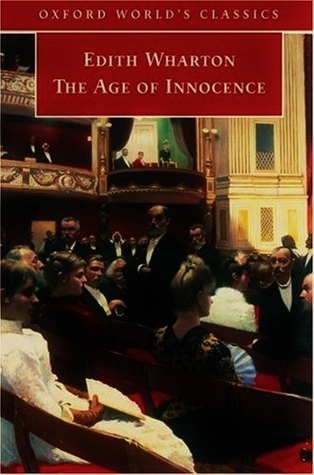
The Age of Innocence (1920), Edith Wharton

It was not the custom in New York drawing rooms for a lady to get up and walk away from one gentleman in order to seek the company of another. Etiquette required that she should wait, immovable as an idol, while the men who wished to converse with her succeeded each other at her side. But the Countess was apparently unaware of having broken any rule, she sat at perfect ease in a corner of the sofa beside Archer, and looked at him with the kindest eyes.

Wharton seems to be interested in the struggle between a person’s freedom versus society’s demands; between the ability to dream a new reality for yourself and what your class says you can and cannot do. Main characters are caught in what they want for their life and their inability to get it. There is always interference and it is then that their conscience kicks in or their chance to choose is lost. And then they resign themselves to their fate. This is my perspective, anyway.

The Age of Innocence tackles marriage and after only a few pages in it is obvious that this particular courtship is not going to go well.

It is an opera night in 1870s New York City and the well-known Swedish opera singer Christine Nilsson is performing. Newland Archer is scanning the audience and rests his eyes on the box across from him where May Welland, his soon to be announced fianceé is sitting with her mother and aunt. He has the vantage to observe her unnoticed.

His thoughts at first are to his love and what he will make of her and how she has been raised to be molded by her husband. “…he contemplated her absorbed young face with a thrill of possessorship in which pride in his own masculine initiation was mingled with a tender reverence for her abysmal purity.” He is interrupted when a friend points out a young woman who has just entered the Welland box and whose foreign dress is causing a stir. She is Madame Ellen Olenska, May’s cousin, who has come from Europe having run away from her husband and has come home to get a divorce.

At first, Ellen is shunned by many of her American relations who fear the disgrace divorce would cast on their reputation. When Newland’s law firm takes on the handling of the divorce, he is asked by the family to intercede with Ellen and encourage her not to file. Later he is asked to dam this breach between Ellen and the family due to his marriage to May, which leads to a disaster as the two fall in love.

As Newland navigates the thorny rules and rituals of courtship and marriage, he exposes the faults and farce of the new state he is entering into. He catches himself musing on what he expects his wife to be; while not quite equals, he wants something that is more free than what he sees in his circle. But the way women are raised, how can this be?

He reviewed his friends’ marriages—the supposed happy ones—and saw none that answered, even remotely, to the passionate and tender comradeship which he pictured as his permanent relation with May Welland. He perceived that such a picture presupposed, on her part, the experience, the versatility, the freedom of judgment, which she had been carefully trained not to possess; and with a shiver of foreboding he saw his marriage becoming what most of the other marriages about him were: a dull association of material and social interests held together by ignorance on the one side and hypocrisy on the other.

Would his marriage become like so many others where the husband “had formed a wife so completely to his own convenience that, in the most conspicuous moments of his frequent love-affairs with other men’s wives, she went about in smiling unconsciousness…”

Newland reasoned that the things he loved about May–her frankness, her grace and loyalty were an artificial construct.

He felt himself oppressed by this creation of factitious purity, so cunningly manufactured by a conspiracy of mothers and aunts and grandmothers and long dead ancestresses, because it was supposed to be what he wanted, what he had a right to, in order that he might exercise his lordly pleasure in smashing it like an image made of snow.

Wharton pulls no punches here.

Ellen, through her life experiences, possesses the sexual and intellectual freedom that Newland desires in a woman, a wife. And yet she is not free. Even if Newland wanted to leave May, the lack of a divorce would stand in the way of their marriage. Ellen sees the futility of living in limbo and announces she is going back to Paris, presumably to her husband. And what Newland and men like him don’t understand, is that women like May see through the bars of their gilded cage; they understand what marriage really is and only pretend to ‘smile in unconsciousness.’ Sick at Ellen’s departure, Newland tells May he wants to take a trip. Without missing a beat she tells him she is pregnant and that she told Ellen so a few weeks ago.

“You know I told you we had a long talk one afternoon—and how dear she was to me.”

“But that was a fortnight ago, wasn’t it? I thought you said you weren’t sure till today.”

“No; I wasn’t sure then—but I told her I was. And you see I was right! she exclaimed, her blue eyes wet with victory.

In the final chapter decades have passed. May has born three children and after 26 years of marriage has died. Newland thinks of his life with her as deep and real. Ellen, though, lives only in the past. And at the very end of the novel when circumstances take the turn that both had wished for long ago, Newland makes a remarkable decision.

It would be easy to dislike a character like Newland Archer, but Wharton makes it impossible. He is honestly trying to assess the promise of his life against the social conventions of his time; exposing the hypocrisy of  the status quo and the values they hold dear.

The House of Mirth (1905), Edith Wharton

You asked me just now for the truth—well, the truth about any girl is that once she’s talked about she’s done for; and the more she explains her case the worse it looks.  

Though Lily Bart didn’t grow up rich, she was born into a comfortable and respectable home with relatives high on the social scale. Like most girls in this class her only purpose in life is to find a wealthy, respected husband. Lily doesn’t just have hopes this will happen, she is very good at making it happen.

But it all comes crashing down when her father makes a series of bad business deals leaving her at the mercy of relatives and friends. Her luck holds out longer than many in this situation, because her beauty and charm is sought after and admired in her ‘set’ who continue to include her in their social gatherings, weekend outings and trips abroad.

Because her future is dependent on whom she marries Lily must calculate and weigh every conversation and action she makes. She becomes a keen observer of the most minute details of what is socially acceptable and there are so many! One wrong word or action, one misinterpreted conversation or negative comment or showing too much interest in a man or not enough, can have devastating consequences.

The Power of Gossip and Lies

When the gossip about Lily and the unfounded lies begin to run rampant, the same friends who welcomed her into their world at her father’s death, abandon her and are willing to watch her fall rather than come to her defense and risk damaging their own reputations. As Mr. Rosedale admits to her,

Mrs. Dorset…did you a beastly bad turn last spring. Everybody knows what Mrs. Dorset is, and her best friends wouldn’t believe her on oath where their own interests were concerned; but as long as they’re out of the row it’s much easier to follow her lead than to set themselves against it, and you’ve simply been sacrificed to their laziness and selfishness.

One misstep in judgment (going to the apartment of her close male friend alone) begins the downward spiral of gossip and innuendo Lily never recovers from. And her pride makes it impossible for her to fight back.

Not only has the gossip killed any prospect for marriage, the question of how can Lily then support herself must be considered. In this class system, women like Lily are born to be dependent. There is never a question about working or learning a trade. Though she tries her hand at various occupations, Wharton writes a remarkable passage of truth that Lily is conscious of:

She had learned by experience that she had neither the aptitude nor the moral constancy to remake her life on new lines to become a worker among workers, and let the world of luxury and pleasure seep by her unregarded…Inherited tendencies had combined with early training to make her the highly specialized product she was: She had been fashioned to adorn and delight; to what other end does nature round the rose-leaf and paint the hummingbirds’ breast?

 Wharton’s Unsentimental Pen

I have railed against Wharton for writing such depressing novels as Ethan Frome  and Summer. It isn’t that I expect a fantasy of happy endings, but Ethan Frome, Charity Royall and Lily Bart cannot catch a break from the rigid social norms they struggle against.

However, about half way through The House of Mirth I had a stop-me-in-my-tracks moment: Wharton doesn’t write depressing novels, she just writes with an unsentimental pen. She chooses to write stories about people’s fate or more precisely that they can’t escape it once an action or word sets them on that trajectory; that social norms are so rigid and a person’s duty to their class is so morally strong there is no wiggle room for escape or independence from it. For whatever reason, Wharton writes about the injustices of a system that kills passion, desire and freedom.

Women as Instigators

It is horribly sad that women in the novel are the instigators of the lies and stories that bring Lily down and that her own aunt with whom she is living believes the gossip about Lily accepting unwanted attention from married men. She not only believes it, but instead of asking Lily outright if what people are saying is true, she is incensed that Lily has allowed herself to be talked about in the first place,

It was horrible of a young girl to let herself be talked about; however unfounded the charges against her, she must be to blame for their having been made.

When your own family members turn against you, what recourse do you have? And when you know fighting back is useless, how do you cope?

Bullying in The House of Mirth

While The House of Mirth is rooted in its time period, something struck me as very contemporary. Lily’s death is suspicious in terms of it being an accident or self-inflicted. But the stage was set because of the devastating effects of the bullying and meanness she was subjected to. This is the same behavior and sometimes the result many teenagers of today are forced to endure.

Lily Bart shows us the tragic outcome when this behavior is allowed to grow and fester unchecked. I think this puts to rest those critics who wonder if  classic literature should still be taught in schools.

Ethan Frome (1911), Edith Wharton

This was a very depressing novel. Let’s just get that out of the way. Like another of Wharton’s New England novels Summer, which I read last year, she once again creates a character whose life has promise and potential, but bad choices made early on coupled with poverty and duty to family ruin any chance of freedom. Ethan Frome’s draining, joy-sucking life permeated every page.

Wharton creates a bit of mystery surrounding Ethan Frome in the opening pages. The unnamed narrator who arrives in town on business notes his somber countenance, “something bleak and unapproachable in his face, and he was so stiffened and grizzled that I took him for an old man,” yet he was only 52. The coach driver explained he has looked that way since ‘the smash-up.’ And with that, the strange, sad tale of Ethan Frome begins.

Frome is many years into a loveless marriage. He and his wife, Zeena, live in the Frome family home eking out a slim existence from soil that doesn’t yield much. He asked Zeena to marry him out of gratitude for helping him nurse his sick mother. Right after they marry her real or imagined ill health makes her unable to take care of the home, so she enlists the help of her young cousin, Mattie Silver, although it is soon clear she has no household skills.

Mattie’s youth and joy for life is Ethan’s one bright light and he begins to care for her deeply. When Zeena announces that her new doctor wants her to get a proper hired girl, because “I oughtn’t to have to do a single thing around the house,” Ethan is devastated. Mattie will have to leave because they can’t afford to pay for two girls, although she has no family to take her in. Ethan spends days frantically looking for a way to run off with Mattie, until he realizes its futility. The day he takes Mattie to the train station he stops to take her sledding. Both are distraught over their impending separation admitting they cannot live apart and make a pact to end their pain by sledding into a tree. They are severely injured, but both live. Ethan is left with a limp and a scarred forehead, but Mattie sustains a spinal injury that leaves her permanently disabled.

The action skips to the present when the narrator, who has only heard bits and pieces of this story is invited by Ethan to stay the night during a snow storm. When the front door is opened he hears more than one voice coming from the kitchen. He is shocked to walk in on both Zeena and Mattie sitting around the kitchen table.

When he goes back to his boarding house, run by a childhood friend of Ethan’s she explains that yes, after the accident, Zeena took Mattie back and nursed her as best she could and without any family to return to the three have lived together for 24 years. She tells him, “If she’d ha’ died, Ethan might ha’ lived; and the way they are now, I don’t see’s there’s much difference between the Fromes up at the farm and the Fromes down in the graveyard; ‘cept that down there they’re all quiet, and the women have got to hold their tongues.”

Though the story is terribly tragic I admire Wharton’s writing. She is not sentimental or overly emotional, but matter of fact. The event happens or the choice sets in motion tragic consequences, the character accepts his or her fate and makes new choices and with them we move on. As in real life we have to get on with whatever hand we are dealt and this is how Wharton writes.

Except that I found it hard to just let go of Ethan’s fate. Is it too much to ask to give him a little happiness after having to leave college to come back home to care for his father, then his mother, then his wife and finally both his wife and unrequited lover? Couldn’t Wharton give him a little better financial situation or let his wife die young or…something?

However, like Charity, the main character in Summer, who similarly had to pit personal fulfillment against duty, what the reader finds here is reality. Both Ethan and Charity made foolish choices the first time they fell in love, which left them with life-altering consequences they could never break away from. And maybe that is the moral or the cautionary tale here; what you do when young comes back to haunt you. The whole trajectory of your life can change in an instant, so make good choices!

Right.

Try telling that to any young person in love!