…he was never a fiend or even truly a madman, but only an eager, studious, and curious boy whose love of mystery and of the past was his undoing. He stumbled on things no mortal ought ever to know, and reached back through the years as no one ever should reach; and something came out of those years to engulf him.
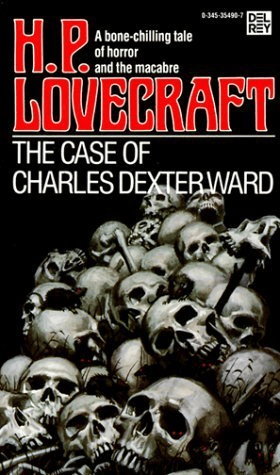
I had a lot of trepidation toward this book. H.P. Lovecraft is often called a ‘master of horror,’ a genre I do not enjoy. But when the opportunity came up to choose a Rhode Island author through the Reading New England Challenge, I decided to take the plunge and picked Lovecraft’s, The Case of Charles Dexter Ward.
Reincarnation—-Alchemy—-Calling in Demons and Spirits—-The Slave Trade
The story concerns young Charles Dexter Ward who begins innocently enough to research a 17th century ancestor, Joseph Curwen, but becomes so caught up in the work that it is obvious to all around him he has gone too far. And soon it looks like Charles begins to actually become Curwen, through reliving his life as a mage and master of the black arts of Renaissance magic. Charles finds Curwen’s journal and papers, learns the rites and rituals, the formulas, the chants, and he learns of his trafficking in slaves who were kept for unimaginable purposes. Charles spends several years traveling throughout Europe in search of obscure manuscripts and books and to study in secret with other masters of this lost art.
He also learns Curwen met a violent end when his neighbors had enough of his odd behavior, the odors and otherworldly sounds that came from his house, the changes in weather, the depressive and ghostly feelings that emanated throughout the town and the many suspect incidents surrounding him forcing the men of the town to confront him. On that fateful night, they marched to his home, but whatever it was they saw in his house it caused some to go insane and the rest such fear no one ever spoke of it.
One hundred and fifty years later his young relative Charles Dexter Ward, who bears a striking resemblance to Curwen, after researching his life and himself learning the rites and rituals of the alchemic mage comes across Curwen’s ashes and is able to reanimate him. But Curwen kills him and resumes his evil life as well as pretending to Charles’s family he is their son. However, his personality, his handwriting and vocabulary are so archaic that he is deemed insane and is placed in a mental institution. It is only after Charles’s life-long physician Dr. Willett, who has never lost hope he could help Charles get through his insanity, the truth of this horrendous mystery is solved.
But what is the horror? While there are nebulous descriptions of human torture, repetitions of magical incantations that leave Charles’s parents and servants scared and concerned, Dr. Willett’s absolutely harrowing escape through the laboratory of alchemy, descriptions of evil presences that leave traces in rooms, so little is actually detailed. We are taken on this journey throughout multiple centuries with hints, generalizations and whatever our imaginations can create. The blood and gore is vague, what the ‘organic creatures,’ who have been living in the bowels of the lab for centuries really are with their howls and sounds of pleading, is not so much horrifying as it is mysterious. Lovecraft gives just enough information to make you want to know more, to keep going with the story in hopes something concrete will explain everything.
This is the kind of horror in our minds, what we create from what we think someone is saying. Like Shirley Jackson’s, The Haunting of Hill House where the horror isn’t of the concrete monster-type or of blood and guts flung about, but is determined by how active is our individual imagination. There is so much power in words, so much power in tiny suggestions that scare us in our own minds that subtlety is all that is needed to make the reader see the absolute worst.
I am not sure if this way of story-telling was intentional by Lovecraft or just the way I received it, but it was very effective and in the end, I was left with so many questions and that ache to know more. Which means this story was successful, because that one untied string or element left unsolved keeps me in the story, keeps me in the mystery.
Well done, Mr. Lovecraft, you just made a new horror convert…or at least, a new Lovecraftian!