
Murder on the Orient Express (1934), Agatha Christie

Neatly folded on the top of the case was a thin scarlet silk kimono embroidered with dragons.

“So,” he murmured. “It is like that. A defiance. Very well. I take it up.” 

This is my first Agatha Christie and my introduction to the famous Belgian detective, Hercule Poirot. As a novice Christie reader and one who doesn’t read crime fiction all I can say is…the ending! Was it obvious to more seasoned readers? It took me by surprise even after it was revealed the passengers knew each other and the further revelation they were connected due to a celebrated murder case in the States. Such is my inability to ever figure out, “whodunit.” 

The story takes place aboard the luxury train Orient Express which is departing Istanbul, destination London. In the first class section we are introduced to an international cast of people whose actions, glances, presence seem suspicious or at least that’s the perspective of M. Poirot, the famed international detective, that oddly from my perspective, a name everyone seems to know. Once the murder is committed he looks at everyone as a subject. Is this a trait of his profession or is it because everyone IS a suspect? Most of the passengers pertinent to the story are stereotypes of culture and country including, a loud wealthy American woman, the prim and proper female missionary, an English governess, a Russian princess and her devoted maid, a suspicious Italian, a count and countess and a private investigator. Among the other passengers is the murdered man’s secretary and translator, and his valet.

When the passengers awake on the first morning of the journey, they find the train is not moving having come to a standstill in the middle of the night due to do a snowstorm. Coincidentally, it is discovered one of the passengers has been murdered, American tycoon Samuel Ratchett. He had come to Poirot the night before asking him to investigate the threatening letters he’d been receiving, but Poirot refused the case. Now, he’s declared himself in charge of Ratchett’s murder investigation. Examining the victim’s body he finds 12 stab wounds and looking through his cabin among other evidence he sees the window is open, a pipe cleaner and a fragment of a handkerchief are on the floor as well as a bit of burned paper with the name ‘Armstrong’ still visible. A detail to come later is the brief sighting of a woman in a scarlet kimono flitting down a corridor that some of the passengers noticed…or did they, though no one saw the face?

As the suspects are interviewed, Poirot weighs and measures their alibis that seem plausible and honest, until he finally pieces together how each is connected to one another and to the murdered man…..

This is basically a police procedural and it was interesting to see the French detective’s investigative skills. But to be honest, I had some trouble keeping the many characters’ accounts straight and was certain this would prevent my understanding the outcome. But the process of Poirot’s deductive methods drew me as did the variety of characters and their stories that kept the narrative moving. I read on anxious to find out the killer. And boy, I did not see that coming!
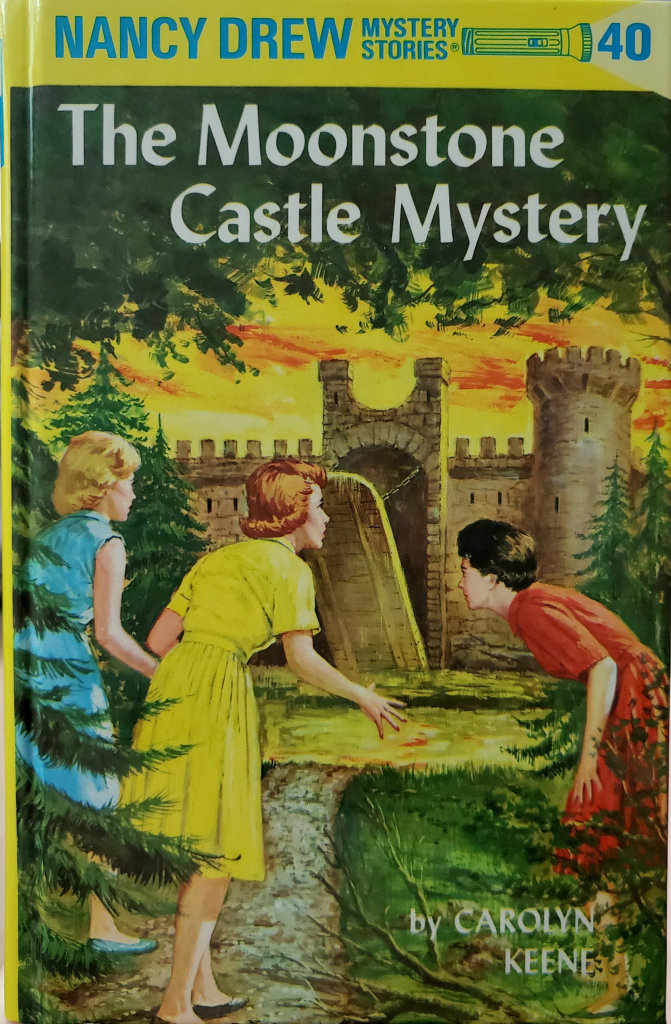
The Moonstone Castle Mystery (1963), Carolyn Keene

Bess and George were always interested in observing Nancy’s sleuthing procedures. They often wondered whether it was her charm, her straightforward manner, or her businesslike approach that unfailingly gained her entrance to offices and officials. Now, with little explanation on her part, the girls were ushered into the president’s office.

I am house sitting for my sister while she and my brother in law are in Massachusetts welcoming a new grandchild, who is now overdue, refusing to vacate the premises voluntarily. So, I am in San Diego a lot longer than I thought I would be!

While going through my sister’s bookshelves I found she has many of our old Nancy Drew books and since one of the book challenges I signed up for this year calls for a building in the title, I decided to give The Moonstone Castle Mystery a try. Like many girls of a certain age (ahem), Nancy Drew “girl detective” was a popular series along with Cherry Ames “nurse detective” and the Little House books.

As I began to read, I wondered how dated this would feel and if it had any relevance to me, now, or for today’s young readers.

Nancy lives with her lawyer father and housekeeper, Hannah Gruen (her mother died when she was a baby) and often helps her father with his cases. This is book number 40, so Nancy is a young woman at this point, with many cases under her belt. She is a skilled, confident and bold investigator and easily puts together answers from the clues she and her trusty girlfriends, Bess and George, find.

In this particular case, her father has asked her to go to the town of Deep River to find the whereabouts of a missing child as he suspects the heiress of a fortune is actually a fraud and the missing child in Deep River the real heir. With Bess and George, Nancy drives her beloved convertible to Deep River.

As in many mystery stories that start out with a simple question, Nancy and friends are soon caught up in something much bigger than a missing child. Someone is on to her and does not want her to discover the truth.

In the course of the trip she is followed by an unknown man, her car is stolen, while boating a crazed man rams her boat, she is briefly kidnapped, spied upon, chased and then is the chaser, figures out how to keep the drawbridge at the castle from rising, she interviews creepy people and decodes their answers and discusses the next move with Bess and George.

In short, nothing daunts Nancy Drew. She is not shy or hesitant. She does not question herself and willingly goes into the unknown. With Bess and George, who have accompanied her on many cases, these young women have honed their investigative skills and are game for any challenge. When more than one lead has to be tracked down at once, the young women divide up the duties, meeting later to discuss what they found.

So it was a real shock when Nancy invited their boyfriends, who happened to be counselors at a camp nearby, up for the weekend to help with this case. From the moment Ned, Dave and Burt arrive, Nancy defers to Ned with questions she had already gone over with Bess and George, letting Ned take the lead when she is perfectly capable of figuring out things herself.

Thankfully, the young men are only there for the weekend, because they all get into more scrapes and dangerous situations while the men take charge! In fact, Ned is the reason Nancy is kidnapped while they are checking out the castle. His, “wait here while I go down to the cellar, because it is too dangerous,” left Nancy alone where she is drugged and pulled into a closet. Nancy would never have balked about going down to the cellar herself.

When I asked myself if the original Nancy Drew is still relevant, despite the obvious awkwardness above, I found the actual mystery held my attention. Though some of the language and concepts are dated and obsolete (think doing detective work without computers or cell phones, getting a busy signal at the hospital because ‘the wires are crossed’ and referring to someone as queer, but not in reference to their sexuality), it is a good story with complex and layered clues leading to even more complicated situations.

These books have gone through many reprints and some modern updating since they were first published in the 1930s, but their portrayal of young women who are smart, confident, think for themselves, work together and trust each other is timeless and universal and certainly relevant in the 21st century.

Have you read any of the Nancy Drew mysteries as an adult?