Frankenstein (1818), Mary Shelley

Perhaps a corpse would be re-animated;…perhaps the component parts of a creature might be manufactured, brought together, and endued with vital warmth.”

Mary Shelley

“Alas! I had turned loose into the world a depraved wretch, whose delight was in carnage and misery…”

Victor Frankenstein

The catalyst for Frankenstein Mary Shelley explains, is that she and her husband Percy were visiting the home of Lord Byron one dark and stormy night, when Byron laid down the challenge that each must tell a ghost story. Byron and Percy were able to create a story on the spot, but it took Mary a few days. In fact, she dreamed it. The result is one of the world’s most well-known classic tales of necromancy and Gothic story-telling.

As often happens when I read a classic novel that has seen countless film adaptations, I was very surprised that the book tackles far more than just the ‘monster parts.’  Shelley proposes thoughtful and deep topics and asks questions about personal responsibility, the quest for life’s purpose and leaves me wondering whether a monster has a soul?

Frankenstein is told as a story within a story by Robert Walton who is at sea and is corresponding with his sister, Margaret. But when the ship gets stuck in the ice floes of the Arctic, in the span of a few hours two very odd things happen. First, the crew spots a huge human-like creature driving a sledge with a pack of dogs passing at a distance. The next morning, they find another man, but more normal-looking, who is also driving a sledge, floating near them on the ice. He is near dead. The crew rescues him, revives him and while recuperating tells Walton how he came to be floundering on an ice floe in the middle of the Arctic. Walton records the tale for his sister in a journal. Frankenstein is the story of Victor Frankenstein, youthful scientist and budding necromancer whose interest in natural philosophy takes a turn from the traditional path of changing lead into gold to the perilous route toward creating life from death.

At university, Victor studies physiology, anatomy, the life process and the progression of death; he visits charnel houses and sees how the body corrupts and wastes away after the bloom of life.

After days and nights of incredible labour and fatigue, I succeeded in discovering the cause of generation and life; nay, more, I became myself capable of bestowing animation upon lifeless matter….It was already one in the morning….I saw the dull yellow eye of the creature open; it breathed hard, and a convulsive motion agitated its limbs.

After two years of working toward this goal of animating life from death Frankenstein succeeds. But instead of celebrating the work, he is horrified. He has created a creature, a monster. He cannot sleep for the nightmares that consume his waking and sleeping hours and falls into a many-month illness. From the very beginning that sparked the life of the monster, Victor is unable to accept responsibility for what he has created or the repercussions of the monster’s actions. This weakness in character will hound him for the rest of this life.

Meanwhile, the monster flees the town. He is a fully formed human-like man and as he roams the countryside coming into contact with people he not only sees, but feels their fear and disgust. He shows up near Victor’s home and kills his younger brother. Victor is still at university when he hears William has been murdered; he knows it is the monster. Unable to confess to the authorities what he knows for fear of being branded insane, he keeps quiet. An investigation and trial is held for the murder and through circumstantial evidence Justine, a trusted family servant of the Frankensteins is convicted of the crime and hanged. “The first hapless victims of my unhallowed arts.”

The monster is desperate for a place of refuge and finds it in an abandoned hovel near a cottage. The cottage is occupied by a brother, sister and their father. Through watching the interactions of the siblings as they care for their blind father he learns how they take care of one another, how they speak in kindness toward each other and what it means to be part of a family. Aware of his physical deformities he knows to keep out of sight, but he takes a chance on the father when the children are away during the day and forms a friendship with him. But the day comes when the children see him and the family flees the cottage. Brokenhearted, the monster understands his kindness or concern for others will always be outweighed by his physical appearance. There is no place on earth for him.

Where were my friends and relations? No father had watched my infant days, no mother had blessed me with smiles and caresses;…From my earliest remembrance I had been as I then was in height and proportion. I had never yet seen a being resembling me, or who claimed any intercourse with me. What was I?

The monster finally confronts Frankenstein and describes his life, how he came to speak, to think, to understand society by watching this family. And now, by bitter experience he will never be able to live as they do, in a family or as a common man.

Remember, that I am thy creature; I ought to be thy Adam; but I am rather the fallen angel, whom thou drivest from joy for no misdeed. Every where I see bliss, from which I alone am irrevocably  excluded. I was benevolent and good; misery made me a fiend. Make me happy, and I shall again be virtuous.

He pleads with Frankenstein to make him a companion like himself, so he can live as he sees others doing.

You must create a female for me, with whom I can live in the interchange of those sympathies necessary for my being….I now indulge in dreams of bliss that cannot be realized

What I ask of you is reasonable and moderate; I demand a creature of another sex, but as hideous as myself….we shall be monsters…Our lives will not be happy, but they will be harmless, and free from the misery I now feel.

The monster compels Frankenstein to this task and promises to live in secret, perpetrating no violence to any animal and away from any human contact.

Victor Frankenstein indeed created a monster, but what is amazing about this one is his heart, soul and intelligence. He has the potential to be every bit as kind and compassionate, moral and honest as any other man, yet he will never be accepted because of his physical appearance. No matter his good works or heroic deeds, his physical presentation will always negate his integrity.

My Thoughts

Victor Frankenstein turns his back on what he created. He abandons him on the first night, but once he hears his story, it is obvious this is a feeling, thinking human-type being, deserving of assistance, mercy and companionship. Would someone who created life really reject it like he did? The monster may be hideous to look at, but inside he is made like any other human being with the full capacity of feelings and outlook on life.

Would you reject a “nonperfect” child and would you expect it to fend for itself? Or is this something entirely different? Because the monster is not a helpless baby, but came into the world fully formed, who learned to speak, to cultivate his intelligence, to live in the world through observation, because he was made with wisdom already intact. Does he have a soul? He acts like it. He quickly becomes Victor’s intellectual equal. And Victor is given ample opportunity to make things right for him, instead he gives into fear.

Hounded for years by the being he created, Victor dies on the ship still unrepentant and without accepting any responsibility toward the monster; even as he lay dying he just wants the wretch dead.

The fate of the monster is sealed at Frankenstein’s death. Walton hears noises coming from the room where Frankenstein has died. He sees that it is the monster lamenting his existence that there will now never be redress against the man who created him.

Frankenstein forced him to a life of misery and neglect and now he will end his own on a “funeral pile triumphantly, and exult in the agony of the torturing flames….my ashes will be swept into the sea by the winds. My spirit will sleep in peace….”

Shelley goes through such pains to tell the monster’s story and she imbues the creature with humanity and sympathy as with any other human being. She shows his compassion, his intelligence; he is creative, hard-working and capable of contributing positively to society. He develops the full capacity of feelings, agency and responsibility for others and this is to me the tragedy of Frankenstein and his monster.

Because the monster is a victim. And it is easy to interpret Frankenstein as a warning for these modern times as science advances toward cloning and other forms of creating genetically modified life. Can we use Frankenstein as a forewarning to illustrate imagination gone wrong, to get us to think about the results of such experimentation and to ask how and what we are responsible for when we take these steps? Is creation and human life about outward appearances as we go about creating perfect people? What do we owe to them when they turn out to be not so perfect?

Once I falsely hoped to meet with beings, who, pardoning my outward form, would love me for the excellent qualities which I was capable of unfolding. I was nourished with high thoughts of honour and devotion….When I run over the frightful catalogue of my sins, I cannot believe that I am the same creature whose thoughts were once filled with sublime and transcendent visions of the beauty and the majesty of goodness. But it is even so; the fallen angel becomes a malignant devil. Yet even that enemy of God and man had friends and associates in his desolation; I am alone.
Dracula (1897), Bram Stoker

“We are in Transylvania; and Transylvania is not England. Our ways are not your ways, and there shall be to you many strange things.”

Reading Dracula was like reading Little Women. Steeped in the film versions, I thought I knew what I would find in the books. Both were a surprise, even though I know films always change things and leave out a lot. When will I learn not to judge a book by a film?

Dracula is told entirely through the journals of four of the six principal players: Mina Murray, whose best friend Lucy Westenra has become mysteriously sick; Johnathan Harker, Mina’s fiancé then husband; the psychiatrist Dr. Seward, who runs a mental institute and Professor Van Helsing of Amsterdam, Seward’s former professor who is an “obscure diseases” specialist. Lucy’s two suitors, Arthur Holmwood, later Lord Godalming and the American Quincey Morris, make up the final six.

There is literally no straight narrative in the structure of the book. Stoker uses detailed journal entries, newspaper clippings, letters, bills of lading to tell the story. I found this to be extremely effective, because by keeping things in the first person, the story has immediacy and suspense as one ‘scene’ cuts away to another and we see how each experience is seen and interpreted in multiple ways. While this device is sometimes distracting or hard to follow here, each character has a distinct and unique voice, which makes it easy to know which character is writing.

Because I am used to film and popular culture portrayals of Dracula I was shocked at how little Count Dracula personally features in the book. In addition to his human persona he shape-shifts into various creatures, but is mostly absent. The book is really about the quest to find and kill him. It is the lore around vampires, the ancient curse that shows up in the superstitious townspeople, the effect of vampire bites on Lucy and Mina and the knowledge Professor Van Helsing has that forms the story.

In film versions, the suave and charming Count is afforded lots of screen time with special effects liberally showcasing his pointed teeth, lips dripping with blood, the (Bela Lugosi’s) famous accent, the bat persona and the abundance of mist whenever he is about to appear. While in these versions he is sometimes portrayed as a sympathetic character in the book he is an evil creature without any redeeming qualities living only to satisfy his evil desires without regard to the human cost.

I was struck by the technological inventions Stoker makes use of that existed at the end of the 19th century.  They remind me of H.G. Wells and Jules Verne and seem to fit right in with today’s Steampunk subculture.

Blood transfusions are given to Lucy as Dracula’s fatal bite causes her body to waste away. Dr. Seward transfuses her with Arthur, Quincey, Van Helsing and himself (without knowledge of blood type?) with limited results.

The typewriter: When it is discovered that Mina is an expert typist, she types up everyone’s journal, in copies, so as to give a cohesive structure as to what each is experiencing; she also types up the notes of their planning meetings.

The dictaphone: Dr. Seward speaks his journal into this machine that records on a record player, which Mina types up.

The London Underground and train schedules: Mina is obsessed with the train schedules of the Underground and suburban/cross country trains and has their timetables memorized.

Hypnotism: In an effort to find the whereabouts of Dracula Professor Van Helsing hypnotizes Mina frequently at sunrise and sunset.

When Dracula flees London for his hometown in Romania, the six follow him knowing they must ritually kill him by stabbing him through the heart and cutting off his head. This is the only way to stop a vampiric future and to save Mina, who although has not ‘changed’ yet, is exhibiting some debilitating symptoms.

As they plan and prepare for their journey in Dr. Seward’s living room, Mina makes a disturbing, but necessary request, of which they all must swear. If she becomes so changed that she poses a threat to herself or to them, they must “drive a stake through me and cut off my head.” And in a scene reminiscent of something out of a Medieval romance where knights on a quest pledge their honor to their lady, the men faithfully drop to their knees one by one and swear, as (“Lady”) Mina asks, to kill her if they are unable to ritually rid the world of Dracula so her soul may rest.

Quincey was the first…He knelt down before her and taking her hand in his said solemnly, “ I am only a rough fellow…but I swear to you by all that I hold sacred and dear that, should the time ever come, I shall not flinch from the duty that you have set us.” And each in turn makes the same vow.

Mention should be made here of Mina. She disparages the ‘New Woman,’ of their independence, their call to buck social convention. Yet, she herself is the prime example of such a woman: smart, intelligent, technologically savvy whose work is key in organizing and pursuing the search for Dracula. It is Mina whose facility with a typewriter and organizational skills, her intelligence and coping mechanism in the face of the horror that is happening to her, her obsession with train schedules that basically saves the day. And apparently, she is also an expert on the the criminal mind through the work of Max Nordau, which Stoker, in a bizarre “show and tell” scene, has her recite his philosophy about criminals in reference to Dracula’s own criminality. The irony of this anti-New Woman aspect about Mina is probably not lost on most readers, so it is curious.

The last quarter of the book does feel to me like knights on a sacred quest to rid the world of evil like Arthur and his knights, or Harry, Ron and Hermione against He-Who-Must-Not-Be-Named, and of all the films and books where ordinary people band together against the darkness that would overcome humanity.

Sadly, unlike the notoriety of these epic stories, this particular one will forever stay with the six, because it is too fantastical. No one would ever believe them.

When we got home we got to talking of the old time—which we could all look back upon without despair… I took the papers from the safe where they have been ever since our return so long ago. We were struck with the fact, that in all the mass of material of which the record is composed, there is hardly one authentic document; nothing but a mass of type-writing, except the later notebooks of Mina and Seward and myself, and Van Helsing’s memorandum. We could hardly ask anyone, even did we wish to, to accept these as proofs of so wild a story.

I didn’t find Dracula scary. I found it hopeful and encouraging. And nothing like the films….

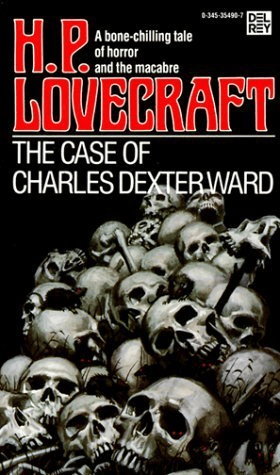
The Case of Charles Dexter Ward (1941), HP Lovecraft

…he was never a fiend or even truly a madman, but only an eager, studious, and curious boy whose love of mystery and of the past was his undoing. He stumbled on things no mortal ought ever to know, and reached back through the years as no one ever should reach; and something came out of those years to engulf him.

I had a lot of trepidation toward this book. H.P. Lovecraft is often called a ‘master of horror,’ a genre I do not enjoy. But when the opportunity came up to choose a Rhode Island author through the Reading New England Challenge, I decided to take the plunge and picked Lovecraft’s, The Case of Charles Dexter Ward.

Reincarnation—-Alchemy—-Calling in Demons and Spirits—-The Slave Trade

The story concerns young Charles Dexter Ward who begins innocently enough to research a 17th century ancestor, Joseph Curwen, but becomes so caught up in the work that it is obvious to all around him he has gone too far. And soon it looks like Charles begins to actually become Curwen, through reliving his life as a mage and master of the black arts of Renaissance magic. Charles finds Curwen’s journal and papers, learns the rites and rituals, the formulas, the chants, and he learns of his trafficking in slaves who were kept for unimaginable purposes. Charles spends several years traveling throughout Europe in search of obscure manuscripts and books and to study in secret with other masters of this lost art.

He also learns Curwen met a violent end when his neighbors had enough of his odd behavior, the odors and otherworldly sounds that came from his house, the changes in weather, the depressive and ghostly feelings that emanated throughout the town and the many suspect incidents surrounding him forcing the men of the town to confront him. On that fateful night, they marched to his home, but whatever it was they saw in his house it caused some to go insane and the rest such fear no one ever spoke of it.

One hundred and fifty years later his young relative Charles Dexter Ward, who bears a striking resemblance to Curwen, after researching his life and himself learning the rites and rituals of the alchemic mage comes across Curwen’s ashes and is able to reanimate him. But Curwen kills him and resumes his evil life as well as pretending to Charles’s family he is their son. However, his personality, his handwriting and vocabulary are so archaic that he is deemed insane and is placed in a mental institution. It is only after Charles’s life-long physician Dr. Willett, who has never lost hope he could help Charles get through his insanity, the truth of this horrendous mystery is solved.

But what is the horror? While there are nebulous descriptions of human torture, repetitions of magical incantations that leave Charles’s parents and servants scared and concerned, Dr. Willett’s absolutely harrowing escape through the laboratory of alchemy, descriptions of evil presences that leave traces in rooms, so little is actually detailed. We are taken on this journey throughout multiple centuries with hints, generalizations and whatever our imaginations can create. The blood and gore is vague, what the ‘organic creatures,’ who have been living in the bowels of the lab for centuries really are with their howls and sounds of pleading, is not so much horrifying as it is mysterious. Lovecraft gives just enough information to make you want to know more, to keep going with the story in hopes something concrete will explain everything.

This is the kind of horror in our minds, what we create from what we think someone is saying. Like Shirley Jackson’s, The Haunting of Hill House where the horror isn’t of the concrete monster-type or of blood and guts flung about, but is determined by how active is our individual imagination. There is so much power in words, so much power in tiny suggestions that scare us in our own minds that subtlety is all that is needed to make the reader see the absolute worst.

I am not sure if this way of story-telling was intentional by Lovecraft or just the way I received it, but it was very effective and in the end, I was left with so many questions and that ache to know more. Which means this story was successful, because that one untied string or element left unsolved keeps me in the story, keeps me in the mystery.

Well done, Mr. Lovecraft, you just made a new horror convert…or at least, a new Lovecraftian!