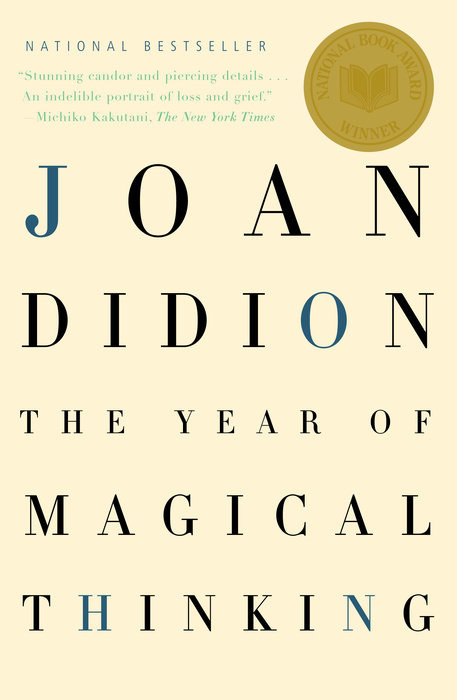
The Year of Magical Thinking (2006), Joan Didion

I like Joan Didion’s work, but when this was originally released my best friend was dying and I just couldn’t touch it. Even though the book wasn’t about cancer, I didn’t want to read about death, as if doing so would be a jinx. And ha! now I understand that was MY bit of magical thinking.

“You sit down to dinner and life as you know it ends.”

On December 30, 2003, as John Dunne was drinking Scotch and talking to his wife as she made them dinner, he had a massive heart attack.

Didion kept notes as a way to chronicle the many stages of grief she experienced during that first year after her husband’s death. I want to say right away this is not a depressing book. There are many moments of humor as is common even in the most grievous of situations. Instead, she chronicles the large and small thoughts and experiences as she tries to come to terms with his death.

The crazy thoughts that run through her mind ask—“could I have prevented his death in some way? Or could he? Were there clues to this impending tragedy that we both missed?”

~When John asked that they move back to New York City, she put him off, but if she hadn’t would that have affected his heart?

~If she alerted him to studies about the efficacy of low dose aspirin would that have saved him (even though she knew he was on the more powerful anticoagulant Coumadin)?

~In that last conversation before dinner he asked if the drink she made him was with single malt Scotch or the other Scotch, “because I don’t think you should mix them.” Did she miss the meaning there?

~Was he trying to tell her something a few years ago when he wondered if they were frittering away their lives and not really living?

“As I recall this I realize how open we are to the persistent messages that we can avert death.”

In the end, her grief turns to mourning as this first year passes into the second. Already some aspects of her husband are fading and she thinks of this as a betrayal. But she has to go on. She is still here.

Remembering bits of a conversation when they were swimming to a cave where the tide had to be just right to swim in, John said, “You have to feel the swell change. You have to go with the change.”

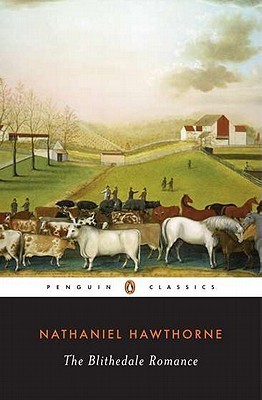
The Blithedale Romance (1852), Nathaniel Hawthorne

It was our purpose…to give up whatever we had heretofore attained, for the sake of showing mankind the example of a life governed by other than the false and cruel principles on which human society has all along been based.

The Blithedale Romance is Nathaniel Hawthorne’s not so thinly based autobiographical account of his 8 months at Brook Farm, a socialist utopian community outside of Boston. The narrator is Miles Coverdale, a writer, who approaches this experiment with the expectation that the natural country air and physical labor of farm work will aid the writing projects he expects to do at night. And while we certainly get an idea of the workings of a utopian community, Hawthorne chooses to tell this story with that on the periphery.

Instead, The Blithedale Romance turns out to be more of a mystery novel centering on three characters Coverdale meets at the farm. The philanthropy-obsessed Hollingsworth who envisions building an institution for the reform of criminals on the Blithedale property; strong maternal Zenobia, whose early groundedness belies a future of intrigue and tragedy; and the wraith-like Priscilla who might not be of this world. Her entrance one night, unannounced, with the only goal that she is to serve Zenobia stymies everyone. Zenobia, is startled, but accepts this action as another sign underscoring the mystery of the romance of Blithedale.

Three quarters of the novel is about these three and their cryptic connections to each other that manifest as they busily pursue their utopian dreams. Their secret pasts and surprising familial connections are uncovered, one sinks further into insanity and sadly another commits suicide; strangers slink around the woods to ask questions first about Zenobia, then about Priscilla only to disappear; Zenobia tells the spell-binding story of the mysterious Veiled Lady, Coverdale almost dies of the flu and the city-slicker-turned-farmers almost ruin the community’s first seed-planting. So much for the peaceful pastoral life of a utopian society.

In fact, I was disappointed that Hawthorne told of his adventures in this way. I was hoping for more daily life, success and failures, the philosophical dream versus the reality of life, in utopia. I am with Henry James who although praised the novel also commented, “[I would] have liked to see the story concern itself more with the little community.”

While the stories of Zenobia, Hollingsworth and Priscilla are gripping at times and filled with pathos at others, they could have existed in myriad other settings removed from Blithedale farm. If Coverdale is a thinly disguised Hawthorne, am I to believe these characters and their trials and tribulations were HIS main focus? Ah well, I don’t like reviews that bemoan a book for not being about something else, so I will look for other sources about Brook Farm and its community.

On the positive side, Hawthorne IS a master at drawing fully formed characters, so in that regard, this novel does not disappoint. With all the shady folks moving in and out, the tale of the Veiled Lady, suspicious motivations and coincidental happenings, The Blithedale Romance would be a perfect read during the scary month of October!

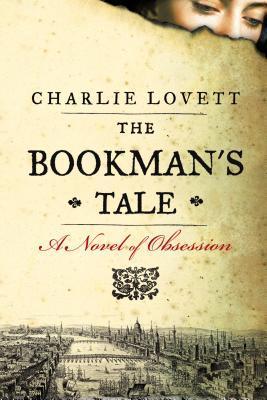
The Bookman’s Tale (2013), Charlie Lovett

When I read a book I want to be affected in some way, to think differently, maybe to investigate a part of the story that captivated me. At the very least, I want something to have shifted.

Charlie Lovett’s The Bookman’s Tale, satisfied all of the above, with intriguing subject matter and his ability to tell a grand, complicated story.

This is a book about books and those who care about and conserve old ones and the sometimes dirty and dangerous world of antiquarian book selling; it details the practice of historical document forgery; the provenance, over centuries, of one particular book that concerns whether Shakespeare did or didn’t (write his own plays); there is one murder and almost three; two love stories and the beginning of another; there is a centuries old family feud; and a main character with social anxiety disorder, who creates a fruitful life anyway. Throw in intrigue, blackmail and people dying before their time, this is a book I could not put down.

How did this book affect my world? Where do I start? With the pros and cons of the legitimacy of Shakespeare as the writer of his plays? Learning to forge historical documents? Or perhaps a trip to an antiquarian bookshop in hopes of finding a mysterious picture stuck inside a book? And what about rare book conservation and restoration? Should I learn how to do it? What a noble vocation!

The idea of provenance strikes me as well: imagine coming across a centuries old book with a list of the owners marked inside the cover, who just happen to be well-known historical figures?

This is the kind of book I didn’t want to end and rationed pages to slow down the inevitable.

And it is also the kind of book that shouts for more:

Dear Mr. Lovett, your protagonist is young. Please give Mr. Byerly more adventures. I would like to go along for another ride.

Muir Among the Animals (1986), John Muir

Any glimpse into the life of an animal quickens our own and makes it so much the larger and better in every way.

John Muir (1838-1914), the naturalist, is well known as an advocate for the preservation and celebration of natural places through his life and exploration of the Sierra Nevada mountain range and other wild regions of the American West. He was a co-founder of the Sierra Club and his writings were influential in the development of the National Park Service.

Born in Scotland, Muir’s preacher father moved the family to a Wisconsin farm when he was 11. Muir and the Animals is a collection of his writings about his relationship to the farm animals and family pets of his childhood and the untamed wild ones he encountered as he traversed the trails of the Sierras. A singular feature of Muir’s writing is its opposition to his father’s stern Christian faith and the manner in which it perceives the natural world, where creation is for man’s use and control regardless of the consequences.

In Muir’s world animals have a certain anthropomorphic quality about them whether predator or prey, wild or domestic. No animal is too small-ants and bees, or too large-bears and wolves to escape his thoughts. Nor does he shy away from attacking man’s insatiable appetite for meanness and destruction of animal or habitat for what man believes God gave to us to use.

This star, our own good earth, made many a successful journey around the heavens ere man was made, and whole kingdoms of creatures enjoyed existence and returned to dust ere man appeared to claim them.

Muir thinks of animals as ‘fellow citizens,’and calls them’insect people’ and ‘feathered people’ “with rights that we are bound to respect.” Animals have a worth apart from what man wants to use them for. He hoped for a “recognition of the rights of animals and their kinship to ourselves.” He noted the interconnectedness of all living things at a time when the slaughter and massacre of so-called pests, like the coyote, caused a plague of hares; pointing out that ranchers killed coyotes for poaching their sheep, but in turn eliminated the natural predator of rabbits, whose unchecked proliferation damaged fields of crops.

The book is divided into chapters delineating types of animals: Herbivores, Birds, Domestic Animals, Insects and Predators. Edited by Lisa Mighetto, she has collected material from his various books, magazine articles and unpublished works spanning the years 1874-1916.

As someone who hikes and spends time in Nature, I should be more familiar with Muir’s writings, especially having spent a summer in the Owen’s Valley, but he has escaped me until now. I have only read snippets of his work and various quotes, but being this is the 100-year anniversary of the National Park Service it’s time I read more.

I have known many dogs, but to none do I owe so much as to Stickeen. At first the least promising and least known of my dog-friends, he suddenly became the best known for them all. Our storm-battle for life brought him to light, and through him as through a window I have ever since been looking with deeper sympathy into all my fellow mortals.

Here are several descriptions of John Muir’s encounters and observations of his “horizontal brothers.”

When the Gold Rush of the 1840s ended, tourists from the Midwest and the East began exploring the ‘wilds’ of California. Yosemite and the Sierras were on many an itinerary. Muir spent several years working in Yosemite Valley and when he heard people decry the absence of wildlife he counseled: “…if such would go singly, without haste or noise, away from the region of trails and pack-trains, they would speedily learn that these mountain mansions are not without inhabitant, many of whom, confiding and gentle, would be glad to make their acquaintance.”

In the section on birds, Muir hoped to gain them sympathy, because they were often slaughtered to extinction. His piece on one town’s massacre of the passenger pigeon is particularly poignant and the killing of robins for Sunday dinner “with shameful enthusiasm,” vividly told. But in this happier account, he writes about his encounter with mountain quail, speaking of them like a crowd of humans from another country:

Once when I was seated at the foot of a tree on the headwaters of the Merced, sketching, I heard a flock up the valley behind me….Soon one came within three or four feet of me…Presently along came another and another….At last one of them caught my eye, gazed in silent wonder for a moment, then uttered a particular cry, which was followed by a lot of hurried muttered notes that sounded like speech. The others, of course, saw me as soon as the alarm was sounded, and joined the wonder talk, gazing and chattering, astonished but not frightened. Then all with one accord ran back with the news to the rest of the flock “What is it? Oh, you never saw the like. Not a deer, or a wolf, or a bear; come see, come see!

As a child, the Muir family had a dog named Watch and although he couldn’t read books “we soon learned he could read faces, was a good judge of character, always knew what was going on and what we were about to do.” Unfortunately, Watch had an appetite for chickens from the surrounding farms and for these acts of stealing was condemned to death. After the execution, Muir’s father examined his stomach contents and found numerous chickens. This made Muir muse on the fact though humans eat the same dish without penalty, “our fellow mortals “who eat what we eat….” are doomed for it, instead. Muir takes comfort that the “vast multitudes of creatures, great and small and infinite in number, lived and had a good time in God’s love before man was created.”

On the advantages of growing up on a farm Muir writes:

is the gaining a real knowledge of animals as fellow-mortals, learning to respect them and love them, and even to win some of their love. Thus godlike sympathy grows and thrives and spreads far beyond the teachings of churches and schools, where too often the mean, blinding, loveless doctrine is taught that animals have neither mind nor soul, have no rights that we are bound to respect, and were made only for man, to be petted, spoiled, slaughtered, or enslaved.

On the grasshopper, who is a “jolly fellow”:

I was much interested with the hearty enjoyment of the one that danced and sang for me on the Dome this afternoon. He seemed brimful of glad, hilarious energy…A fine sermon the little fellow danced for me…a likely place to look for sermons…A large and imposing pulpit for so small a preacher…Even the bear did not express for me the mountain’s wild health, and strength and happiness so tellingly as did this comical little copper…To him every day is a holiday…

How many mouths Nature has to fill, how many neighbors we have, how little we know about them, and how seldom we get in each other’s way! Then to think of the infinite numbers of smaller fellow mortals, invisibly small, compared with which the smallest ants are mastodons.

And finally, this plea:

The universe would be incomplete without man; but it would also be incomplete without the smallest transmicroscopic creature that dwells beyond our conceitful eyes and knowledge. From the dust of the earth, from the common elementary fund, the Creator has made Homo sapiens. From the same material He has made every other creature, however noxious and insignificant to us. They are earth-born companions and our fellow mortals….Plants are credited with but dim and uncertain sensation, and minerals with positively none at all. But why may not even a mineral arrangement of matter be endowed with a sensation of a kind that we in our blind exclusive perfection can have no manner of communication with?

But, glad to leave these ecclesiastical fires and blunders, I joyfully return to the immortal truth and immortal beauty of Nature.

Me, too!

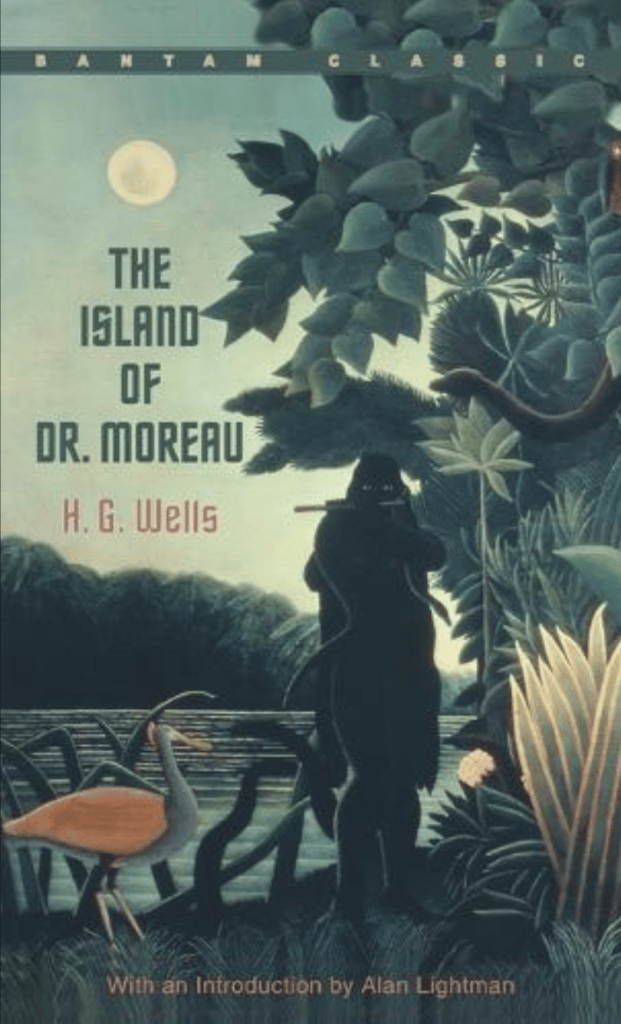
The Island of Dr. Moreau (1896), HG Wells

These creatures you have seen are animals carven and wrought into new shapes. To that, to the study of the plasticity of living forms, my life has been devoted.

There are so many ways to approach this novel: as a horror story, an adventure story, a scientific experiment gone bad. But it is definitely a novel about morality and the biblical idea of man’s dominion, or some would say, responsibility, over animals. And does that extend to our medical interference with their nature: we have the techniques, but do we have the right?

The story is told by Edward Prendick, who is lost at sea and discovered by a passing ship. He is taken under the wing of a passenger named Montgomery who with his strange assistant is taking an odd assortment of animals to an undisclosed location. Prendick’s situation as extra baggage on the ship gets him in hot water with the captain and after a harrowing struggle not to be thrown overboard he winds up in Montgomery’s party and disembarks with them on an island.

The island is off the charts and secluded for reasons made clear right away. It turns out it is a laboratory run by infamous vivisector, Dr. Moreau who was run out of London for doing what he is doing here: conducting torturous experiments on animals by changing their physical body as well as their minds into half men, half beasts and keeping some animals alive for weeks as he cuts and modifies and grafts parts of them from one to another. He justifies his work as science, for the greater good to humans that the established scientific profession is too afraid to consider. From Prendick’s days as a biology student, the name ‘Moreau’ brings back the memory of the scandal that caused him to be hounded out of London.

It dawned upon me to what end the puma and the other animals…were destined; and a curious faint odour, the halitus of something familiar… suddenly came forward into the forefront of my thoughts. It was the antiseptic odour of the dissecting room. I heard the puma growling through the wall, and one of the dogs yelped as though it had been struck.

After an uneasy sleep, Prendick’s first morning on the island is disturbed by a sharp, hoarse cry of animal pain coming from the locked door of the laboratory. Its depth and volume sounded like the puma. Throughout the morning as he eats his breakfast then tries to read the sounds of screaming and agony coming from the laboratory continue in intensity, as if all the pain in the world had found a voice. It is when suffering finds a voice and sets our nerves quivering that this pity comes troubling us.

He is terrified and the puma’s cries force him from his room.

The emotional appeal of those yells grew upon me steadily, grew at last to such an exquisite expression of suffering that I could stand it…no longer.

A short distance from the laboratory enclosure he has his first meeting with what he believes is an inhabitant of the island, but cannot figure out what it is. He initially thinks it a man, but does not understand why it is walking on all fours and is the color of copper with black hair and of a ‘grotesque ugliness.’ He comes upon an open space.

Before me, squatting together upon the fungoid ruins of a huge fallen tree and still unaware of my approach, were three grotesque human figures. One was evidently a female; the other two were men. They were naked save for swathings of scarlet cloth about the middle; and their skins were of a dull pinkish-drab colour, such as I had seen in no savages before. They had fat, heavy, chinless faces, retreating foreheads, and a scant bristly hair upon their heads. I never saw such bestial looking creatures.

[One] seemed to me to be reciting some complicated gibberish…and spreading his hands he rose to his feet….I noticed then the abnormal shortness of the legs, and their lank, clumsy feet…The three creatures engaged in this mysterious rite were human in shape, and yet human beings with the strangest air about them of some familiar animal—some now irresistible suggestion of a hog, a swinish taint, the unmistakable mark of the beast.

Prendick confronts Dr. Moreau about all he has seen. Moreau justifies what he is doing as benefiting science and mankind.

You forget all that a skilled vivisector can do with living things. For my own part, I’m puzzled why the things I have done here have not been done before. Small efforts, of course, have been made, amputation, tongue-cutting, excision….You have heard, perhaps of a common surgical operation resorted to in cases where the nose has been destroyed; a flap of skin is cut from the forehead, turned down on the nose, and heals in the new position. This is a kind of grafting in a new position part of an animal upon itself. Grafting of freshly obtained material from another animal is also possible,–the grafting of teeth, of skin and bone is done…

But the possibility of vivisection does not stop at a mere physical metamorphosis. A pig may be educated. The mental structure is even less determinate than the bodily. In our growing science of hypnotism we find the promise of a possibility of superseding old inherent instincts by new suggestion, grafting upon or replacing the inherited fixed ideas. Very much of what we call moral education, is such an artificial modification and perversion of instinct.

To this day I have never troubled about the ethics of the matter.

However, Moreau IS troubled by his inability to keep these creatures from falling back into their animal state after he has physically and mentally trained them up to a certain level of ‘intelligence.’ They have rudimentary speech and behavior. But they are more like children, who have learned to live their life through fear (of Moreau and his House of Pain). They are given a set of Laws* recited by the Sayer of the Law, which they repeat back with the refrain: Are we not Men? But alas they aren’t. To Moreau’s frustration, no matter how much or how many times he makes adaptations that allow for a certain level of higher function, his creations always revert to their ‘bestial ways.’

My Thoughts

*I* am troubled by a scientist gone rogue whose perversion of his profession has out-weighed his moral conscience. Moreau’s only concern is his experiments, his ‘creations’ and how this will garner him attention from contemporaries who think he is only a madman. He doesn’t care that the price for this infliction of pain and torture is on sentient beings, who cannot give consent or protect themselves against this infringement on their life and liberty. In Wells’s day vivisection was approved by the British medical establishment if it was used to benefit human diseases and conditions.

In the 21st century, we also accept that medical science has the right to experiment in order to help heal and cure diseases in humans. But as regards to using animals in this way, it is tempered with the moral injunction against causing them harm and pain. In fact, many researchers and scientists, sensitive to animal suffering or who have moral objections against their use in science, have spoken against using animals in experiments. Computer models with data gathered from the past is sufficient, they say, and that ultimately, a procedure or medication has to be tested on humans anyway, who CAN give consent.

I have spent this week contemplating many of the ideas of this book. On a personal note, I was a little taken aback when Moreau mentioned working on skin grafts and skin flaps. Both are well-respected procedures that have been in use, for example, for skin cancer procedures in which the initial operation has removed a lot of skin with the cancer leaving a hole that must be closed. I benefited from a skin graft procedure on my face for basal cell skin cancer. I was grateful that such a procedure was possible. But I will forever look at it differently, wondering if some poor animal had to suffer for it.

Ack. I read to be entertained, but I also read to learn. Now I just have to figure out if this particular learned thing was worth it!

********************

* Here is the infamous Law Moreau taught to one of his more astute creatures in order to control behavior and to point out the hierarchy (some say to point out Moreau’s divinity) on the Island. All are to repeat each line after he says it. When Prendick stumbles upon them, the first thing they say is he has to know the Law.

It is a man. He must learn the Law. Say the words:

 Not to go on all-fours; that is the Law. Are we not Men?

 Not to suck up Drink; that is the Law. Are we not Men?

 Not to claw the Bark of Trees; that is the Law. Are we not Men?

 Not to chase other Men; that is the Law. Are we not Men?

His is the House of Pain.

His is the Hand that makes.

His is the Hand that wounds.

His is the Hand that Heals.

His is the lightning flash.

His is the deep, salt sea.

His are the stars in the sky.

Eat roots and herbs; it is His will.

Some want to follow things that move, to watch and slink and wait and spring; to kill and bite, bite deep and rich, sucking the blood. It is bad. ‘Not to chase other men; that is the Law. Are we not Men; that is the Law. Are we not Men? Not to eat Flesh or Fish; that is the Law. Are we not Men?
A Separate Peace (1959), John Knowles

Finney never left anything alone, not when it was well enough, not when it was perfect. “Let’s go jump in the river,” he said under his breath as we went out of the sunporch. He forced compliance by leaning against me as we walked along, changing my direction; like a police car squeezing me to the side of the road, he directed me unwillingly toward the gym and the river.[i]

 My Thoughts

This was my first reading of a book many read as teenagers. The novel is told as a flashback when Gene Forrester comes back to his prep school alma mater, the Devon School in New Hampshire 15 years after he graduated. He has come back to make peace with the disastrous events that occurred in his last year of school. As he walks through the campus he feels the same sense of fear as he did when he entered as a boy and frankly, this feeling of something bad or ominous in the making lurked through each page I turned.

…. like stale air in an unopened room, was the well known fear which had surrounded and filled those days, so much of it that I hadn’t even known it was there. Because, unfamiliar with the absence of fear and what that was like, I had not been able to identify its presence.[ii]

 The story begins during the summer of 1942 and continues through the academic year of 1942/43, a time of world war that factored into the minds and hearts of the boys who knew their immediate future after graduation would include military service. For Gene and his best friend Phineas (Finney), this is a tragic year.

“I don’t really believe we bombed Central Europe, do you,” said Finney thoughtfully.

 …Bombs in Central Europe were completely unreal to us here, not because we couldn’t imagine it—a thousand newspaper photographs and newsreels had given us a pretty accurate idea of such a sight—but because our place here was too fair for us to accept something like that. We spent that summer in complete selfishness, I’m happy to say. The people in the world who could be selfish in the summer of 1942 were a small band, and I’m glad we took advantage of it.[iii]

Against the backdrop of WWII, Knowles effectively creates an insular sense of boarding-school life; that even though the world was deep into the war the boys’ world was concerned with their athletic prowess and academic victories, their complicated and confusing relationships with each other, secret societies, and the rule-breaking of boys living so intimately with each other.

As someone who attended a large public college, I have always been fascinated by small eastern schools. I fantasize about the ideal setting, atmosphere, students and course work. But I have never come up with such a notion as the Super Suicide Society of the Summer Session, where Gene was forced by Finney to start each meeting by jumping off a tree branch into a river.

In fact, while I was drawn into the story by Knowles’ well-defined setting and characters, the main characters I found hard to like. Finney’s manipulation of the boys, especially Gene and Gene’s inability to stand up for himself against Finney was hard to take. The pall of danger cast over the novel from the beginning made me fear a catastrophe akin to Lord of the Flies might break out any minute.

And when it happened, when a death came, it was almost a relief! I don’t know what this says about me as a person, but I was glad for this break-through in the atmosphere of doom. And as the novel came to a close, I found I liked Finney and Gene better once I understood their story.

I think the dynamics between the students, their idiosyncrasies, their individual perspectives on the world that were so well-defined still makes this a relevant choice for today’s teenage and adult audiences.

Phineas, [said Gene], “you wouldn’t be any good in the war….”

 “They’d get you some place at the front and there’d be a lull in the fighting, and the next thing anyone knew you’d be over with the Germans or the Japs asking if they’d like to field a baseball team against our side. You’d be sitting in one of their command posts, teaching them English. Yes, you’d get confused and borrow one of their uniforms, and you’d lend them one of yours. Sure, that’s just what would happen. You’d get things so scrambled up nobody would know who to fight any more. You’d make mess, a terrible mess, Finny, out of the war.”[iv]

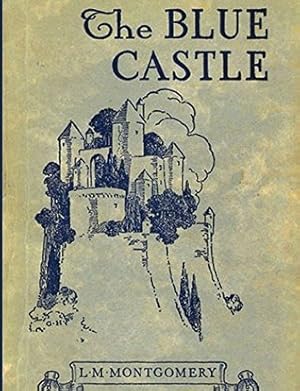
The Blue Castle (1926), LM Montgomery

The moment when a woman realizes that she has nothing to live for—neither love, duty, purpose nor hope—holds for her the bitterness of death.You see—I’ve never had any real life…I’ve just –breathed. Every door has always been shut to me.

 Valancy Stirling is 29 years old and miserable. Unmarried, without prospects and living at home as women designated to “hopeless old maidenhood” are, she lives a controlled and conventional life under the thumb of her mother, her relatives, her own fears about life and the strict moral and cultural constrictions that rule every part of her inner and outer life.

“The greatest happiness,” said Valancy, “is to sneeze when you want to.” Each day is monotonously the same. She eats the same thing for breakfast (even though she hates oatmeal), she knits with her mother and Cousin Stickles every evening (even though she hates that) and every word or action is rated and criticized by her clan. She is not even permitted to be alone in her room except when she sleeps, because people who want to be alone, could only be alone for some sinister purpose,” says her mother.

However, while words and actions can be controlled, dreams can’t. Valancy has an escape hatch, called the Blue Castle where she is queen. Each night, lying in bed, she flees to the Blue Castle from her futile, dreary world. Here, in this colorfully decorated, sensual home that she has created herself she is a beautiful woman with many suitors, who come and go at her whim. She can say and do what she wants without objection.

Against this somber backdrop that purports to last forever, “we are horribly long-lived,” Valancy laments, is a very real fear about her health. The pain around her heart has gotten worse and is now accompanied by dizzy spells and shortness of breath. Without telling her meddlesome family, she finds her own way to the doctor and is examined. Weeks later, the diagnosis comes to her in the form of a letter: she has a terminal heart ailment and has between a few months to a year to live and must live a quiet moderate life until the end. So much for those health genes.

I’ve been trying to please other people all my life and failed…After this I shall please myself. I shall never pretend anything again. I’ve breathed an atmosphere of fibs and pretenses and evasions all my life. What a luxury it will be to tell the truth! I may not be able to do much that I want to do but I won’t do another thing that I don’t want to do. Mother can pout for weeks—I shan’t worry over it.

With this prognosis, Valancy lets loose! Her pent up rage and emotions drive her to break all the rules of verbal conduct. She cannot keep her mouth shut for anyone. She tells her mother exactly what she thinks, pokes fun at her relatives who have been poking fun at her all her life and even swears, causing her surprised family to believe she is mad.

Breaking the taboo against leaving home as an unmarried woman she moves into the house of Cecilia Gay, an old friend who is dying of a lung disease who now lives with her father, is shocking enough. After her friend dies, realizing she cannot give up the freedom of being out of her family home, she asks Barney Snaith, a man she has gotten to know while caring for Cissy, to marry her. She tells him about her heart condition, so the marriage will only be for short while. He agrees and they marry, which pushes her family over the edge.

My Thoughts

Valancy Stirling has a lot in common with Montgomery’s other heroines, Anne Shirley and Emily Byrd Starr. They are similarly brought up in strict, conventional homes, surrounded by elders who toe the moral and cultural lines of the day. When these young women are ‘too emotional’ and speak their thoughts and feelings too freely or bristle against duties they don’t believe in or can’t accept, they are punished for acting out of the norm and breaking long-held rules. Yet, they push on, unwilling to give up on their dreams and a life that matters

Valancy is also a product of that liminal state of the older unmarried woman who though chronologically is an adult is still seen as a child due to her lack of a husband. There is no place for her in a society that only gives women worth and status by the luck of having a husband.

As only one of two novels by L.M. Montgomery purportedly geared to adults, I would have to disagree. This is a novel of a woman breaking free from the confines of a narrow world view in order to discover what is truly right for her. She breaks through her fears of safety and security to walk off into the unknown. She literally finds her voice and her own moral compass. I think this book is perfect for adolescent girls, who could benefit from Valancy’s journey.