Daniel Deronda (1876), George Eliot

“But now look up the river,” said Mordecai, “See the sky, how it is slowly fading. I have always loved this bridge: I stood on it when I was a little boy. It s a meeting-place for the spiritual messengers. It is true—what the Masters said—that each order of things has its angel…Here I have listened to the messages of earth and sky; when I was stronger I used to stay and watch for the stars in the deep heavens. But this time just about sunset was always what I loved best. It has sunk into me and dwelt with me…it was my own decline:…it waited till at last it brought me my new life—my new self—who will live when this breath is all breathed out.” 

I found this to be an important book for two reasons. Firstly, there are an incredible amount of characters, both main and secondary. Daniel Deronda and Gwendolen Harleth both feature at the top, but so do their families and friends, including the Jewish Polish refugee Mirah, her ‘sisters,’ her brother and dear Uncle Hugo. Eliot manages to tell all of their stories without the reader getting confused, because their lives are intertwined and in the grand scheme of the novel, all feed off of and move due to one another.

The second reason I find this book important is because of Daniel and his personal journey that ends in the discovery that he is Jewish. Classic literature is rife with anti-Jewish sentiment and the stereotypes are disappointing. However, I am a very firm believer that context is everything (in this case, that the time period must be taken into consideration) and I can still, for example, enjoy Edith Wharton’s novels despite some nasty anti-semitic barbs. So the positive portrayal Eliot describes of Judaism and the London Jewish community Daniel encounters is surprisingly refreshing.

When the story opens we are introduced Gwendolen Harleth and Daniel Deronda who have a chance encounter at a gaming table in the fictional town of Leubronn, Germany. She is winning easily at roulette until the gaze of this stranger unnerves her causing loss after loss. The next day she receives a letter from her mother telling her the family is in financial ruin and she must come home immediately. Without money Gwendolen is forced to pawn a necklace to buy a ticket home. The next day the necklace is mysteriously returned. Daniel, who saw her go in to the pawn shop, paid it off. The story is next told in split flashbacks alternating between the two.

With Gwendolen’s stepfather dead and her mother and sisters without funds her aunt and brother in law finance a very modest home for them, but it doesn’t include their upkeep. Gwendolen is fiercely independent having vowed never to marry, but with no immediate prospects she feels obligated to find some means to support what is left of her family. She is horrified when offered a governess position and frantically makes other plans hoping she can develop her voice into a singing career; when she is heard by a professional musician she is dismayed to learn she has no talent. Just when she comes to terms her life as a governess, she meets Henleigh Mallinger Grandcourt a charming, but rather harsh, calculating man.

There has always been an undercurrent of attraction between Daniel and Gwendolen, but when he became involved in discovering his biological family she was in no position to wait. But then Gwendolyn discovers Grandcourt had a mistress, Lydia Glasher, who he is still supporting along with their several children. Shocked, she runs away to her friends in Germany, though soon realizing her independence is fruitless. She returns and concedes to marry Grandcourt with the assurance he will take care of her mother and sisters and hoping she can manipulate him with her her beauty and wit, believing she is to him a prize he won and that will be enough.

It is devastating for Gwendolen when she realizes Grandcourt will forever treat her abominably, knowing she knows about his past and finding ways to throw it in her face. She tries to be brave in this marriage for her mother’s sake, but her life is miserable. However, the resolution for this misery is quite shocking.

Daniel has been raised by his Uncle Hugo, in a kind and comfortable household, but Hugo has always refused to discuss Daniel’s biological parents. Daniel is curious, but has never pushed Hugo to reveal. In what will become a turn of the utmost in his fate, Daniel befriends Mordecai, a Jewish mystic, who sees in Daniel a kindred spirit and spiritual brother who feels Daniel’s Jewishness before he knows it himself. Daniel attends synagogue services, spends Shabbat dinners with Mordecai’s friends, the Cohen family and feels very attracted to their Jewish life. As Daniel is drawn deeper into this community he is keen to study Jewish theology, history and even Kabbalah.

Myles Birket Foster’s Kew Bridge from Strand on the Green

Into the mix comes Mirah Lapidoth. a young Jewish woman, who arrives in London from Poland, after escaping her abusive father. He has always insisted her mother and brother were dead, but she has never believed him. She is penniless and in the futility of the search and her loneliness she attempts to take her life by jumping in to the Thames. She is rescued by Daniel who happens to be rowing past at that exact moment. He takes her to his friends Mrs. Meyrick and her three daughters, who treat her like a part of the family, where she begins to heal her body and spirit. Her Jewishness is acknowledged and though Mrs. Meyrick hopes she will become a Christian it is without deprecation, because Mirah herself could never let that go.

One of the key moments for Daniel is the revelation of his biological parents. Sir Hugo arranges a meeting with his mother and he learns the reasons she abandoned him; that the expectations her strict Jewish father placed on her were impossible for her to fulfill. A free spirit chomping at the bit of marriage, she chose freedom when her husband died, giving up her son to her close friend. The legacy of Daniel’s grandfather is also a discovery that changes his world.

Out of so much tragedy for so many characters, there are happy endings and promises of self-realization for everyone. And I have to say after staying with this bunch for over 700 pages that is fine with me!

Thoughts on the Judaism of this Book

As I said at the beginning, Eliot paints one of the most knowledgeable and sympathetic portraits of Jewish life I have ever read in a classic novel. Of course, I am only speaking to my experience and not “the Jewish question” in classic literature in general. For example, Mordecai’s knowledge of Jewish history and its mystic elements and the sympathetic and detailed life of the Cohen family and the Jewish community of which they are involved is so specific, it made me wonder at Eliot’s preparation for writing the novel.

And that made me remember a book I picked up long ago on George Henry Lewes, Eliot’s romantic partner. George Henry Lewes and George Eliot: A Review of Records, by Anna Theresa Kitchel (1933) is a narrative collection of Lewes diaries, letters and other documents that contains numerous references to George Eliot and her books.

Kitchel uses Lewes’s diary entries during the summer of 1873 on a trip to Germany to describe collecting “data” with Eliot when Daniel Deronda was still in the development stage.

July 28th : Strasbourg. Bought book on Jewish subjects for Polly’s novel.

July 31st: Bought books.

August 15th: Left for Mainz—found synagogue and hour of service.

August 16th: To synagogue—rarity of Jewish type.

It is fascinating for me to read the research methods of authors and in this case, instructive to see how ‘hands on’ Eliot regarded her experience for a factual representation of Judaism and the Jewish community.

I am a Jew….And it’s not only that I am a Jew, but I come of a strain that has ardently maintained the fellowship of our race—a line of Spanish Jews….My grandfather preserved manuscripts, family records stretching far back, in the hope that they would pass into the hands of his grandson. And now his hope is fulfilled, in spite of attempts to thwart it by hiding my parentage from me.

Do not think of me sorrowfully on your wedding-day. I have remembered your words—that I may live to be one of the best of women, who make others glad that they were born. I do not yet see how that can be, but you know better than I. If it ever comes true, it will be because you helped me. I only thought of myself, and I made you grieve….You must not grieve any more for me….it shall be better with me because I have known you. Gwendolen Grandcourt 
Jude the Obscure (1895), Thomas Hardy

He sounded the clacker till his arm ached, and at length his heart grew sympathetic with the birds’ thwarted desires. They seemed, like himself, to be living in a world which did not want them…They took upon them more and more the aspect of gentle friends and pensioners—the only friends he could claim as being the least degree interested in him, for his aunt had often told him that she was not. “Poor little dears! You shall have some dinner—Eat, then, my dear little birdies, and make a good meal.” A magic thread of fellow-feeling united his own life with theirs. Puny and sorry as those lives were, they much resembled his own. 

Jude Hawley is a heart-breaking character. As the titular protagonist he has been trying to fulfill a dream since his youth, but is thwarted at every turn by a personal moral code that forces him to do the right thing while watching his dream fade until its fulfillment is impossible. That this is also a novel about love and living out an unconventional relationship, it incurred such nasty criticism against Hardy, he abandoned fiction writing after his next novel, The Well-Beloved.

When the novel opens we meet young Jude who has just been left with an elderly aunt, because his parents have given him up. She does not hide her disdain at having to take him in. The pain of feeling unwanted will affect Jude for the rest of his life as he extends the sensitivity to his own pain to that of others forcing him into decisions that will ruin the onward focus of his life. Even now, at the beginning of his life, this sensitivity expands to the animal kingdom, in this case the birds he is tasked with “clackering” out of a farmer’s fields so they don’t eat his grain. Feeling their hunger he lets them eat and upon discovery is severely beaten.

Walking one day he goes on the top of a roof and notices the lights of a city in the distance. A mystical vision takes hold of him.

He had heard that breezes traveled at the rate of ten miles per hour, and the fact now came into his mind. He parted his lips as he faced the north-east, and drew in the wind as if it were a sweet liquor,“You,” he said, addressing the breeze caressingly, “were in Christminster city between one and two hours ago, floating along the streets, pulling round the weather-cocks,…and now you are here, breathed by me—you, the very same. 

Suddenly there came along this wind something towards him—a message from the place—from some soul residing there, it seemed. Surely it was the sound of bells, the voice of the city, faint and musical, calling to him, “We are happy here!” 

Christminster becomes the goal out of his miserable life as a chance meeting with a stranger tells him what the university town has to offer. Jude decides to study theology and begins a years-long study. For the rest of his childhood and throughout adolescence and young adulthood, he spends hours in the evenings laboring through Greek, Latin and the Church Fathers.

Jude grows into a decent, but naive young man, who is taken advantage of by women for whom marriage is the only endgame in this rural town. First, is Arabella, who raises and slaughters pigs and fakes a pregnancy thereby forcing his better nature into marrying her. Even after she tells him there is no child he continues in the relationship foregoing his studies to concentrate on the marriage, but there is no love here and Arabella leaves him without divorcing him, which will cause problems later.

Jude has been told of a cousin, Sue, living in the vicinity and when he discovers her, though he doesn’t speak to her at first, falls in love. Once he reveals himself he finds her views on marriage and relationships very out of the ordinary. She does not want to marry, wanting instead to live with him as a married couple. However, she succumbs to the stability offered by an older, professionally stable man leaving Jude heartbroken.

Jude’s life becomes more and more complicated and his dreams of studying at Christminster fade as Sue leaves her husband and goes back to Jude where the years pass and three children are born. Then Arabella resurfaces asking Jude to take her young son so she can go back to work. Jude takes on all these responsibilities willingly, but there is finally the realization that all his studying is for naught; life throws cogs into his every wheel and the vision of a life in Christminster will never become a reality.

There is no way to brighten up this picture and the ending is most pathetic and sad. However, this novel portrays a good man, whose moral code is based on kindness and sensitivity no matter how cruel the manipulation and lies of others. One of the best books I read last year, though it was painful, I highly recommend this journey with Jude.

A note on Jude and Sue’s relationship—living together as husband and wife, but not actually married—was so controversial at the time that the criticism Hardy received ended his novel-writing career. In fact, the criticism came to the US even before the book was published here, emphasizing disgust at the relationship, instead of recognizing the major ark of Jude’s story as a moral man of failed dreams. The book was even burned by a few bishops. Jude the Obscure gradually found sympathetic readers, but the damage was done and Hardy soon turned full time to writing poetry, for which he is also well-known.

After Sue leaves her husband, he says to a friend,

“Yes….I would have died for her; but I wouldn’t be cruel to her in the name of the law. She is, as I understand, going to join her lover. What they are going to do I cannot say. Whatever it may be she has my full consent to.” Says the friend, “Some men would have stopped at an agreement to separate.”

I’ve gone into all that, and don’t wish to argue it. I was, and am, the most old-fashioned man in the world on the question of marriage—in fact I had never thought critically about its ethics at all. But certain facts stared me in the face, and I couldn’t go against them.” 

Sue on marriage:

Fewer women like marriage than you suppose, only they enter into it for the dignity it is assumed to confer, and the social advantages it gains them sometimes—a dignity and an advantage that I am quite willing to do without. 

…I feel just the same about it now as I have done all along. I have the same dread lest an iron contract should extinguish your tenderness for me, and mine for you, as it did between our unfortunate parents…I think I should begin to be afraid of you, Jude, the moment you had contracted to cherish me under a Government stamp, and I was licensed to be loved on the premises by you—Ugh, how horrible and sordid! Although, as you are, free, I trust you more than any other man in the world. 

Murder on the Orient Express (1934), Agatha Christie

Neatly folded on the top of the case was a thin scarlet silk kimono embroidered with dragons.

“So,” he murmured. “It is like that. A defiance. Very well. I take it up.” 

This is my first Agatha Christie and my introduction to the famous Belgian detective, Hercule Poirot. As a novice Christie reader and one who doesn’t read crime fiction all I can say is…the ending! Was it obvious to more seasoned readers? It took me by surprise even after it was revealed the passengers knew each other and the further revelation they were connected due to a celebrated murder case in the States. Such is my inability to ever figure out, “whodunit.” 

The story takes place aboard the luxury train Orient Express which is departing Istanbul, destination London. In the first class section we are introduced to an international cast of people whose actions, glances, presence seem suspicious or at least that’s the perspective of M. Poirot, the famed international detective, that oddly from my perspective, a name everyone seems to know. Once the murder is committed he looks at everyone as a subject. Is this a trait of his profession or is it because everyone IS a suspect? Most of the passengers pertinent to the story are stereotypes of culture and country including, a loud wealthy American woman, the prim and proper female missionary, an English governess, a Russian princess and her devoted maid, a suspicious Italian, a count and countess and a private investigator. Among the other passengers is the murdered man’s secretary and translator, and his valet.

When the passengers awake on the first morning of the journey, they find the train is not moving having come to a standstill in the middle of the night due to do a snowstorm. Coincidentally, it is discovered one of the passengers has been murdered, American tycoon Samuel Ratchett. He had come to Poirot the night before asking him to investigate the threatening letters he’d been receiving, but Poirot refused the case. Now, he’s declared himself in charge of Ratchett’s murder investigation. Examining the victim’s body he finds 12 stab wounds and looking through his cabin among other evidence he sees the window is open, a pipe cleaner and a fragment of a handkerchief are on the floor as well as a bit of burned paper with the name ‘Armstrong’ still visible. A detail to come later is the brief sighting of a woman in a scarlet kimono flitting down a corridor that some of the passengers noticed…or did they, though no one saw the face?

As the suspects are interviewed, Poirot weighs and measures their alibis that seem plausible and honest, until he finally pieces together how each is connected to one another and to the murdered man…..

This is basically a police procedural and it was interesting to see the French detective’s investigative skills. But to be honest, I had some trouble keeping the many characters’ accounts straight and was certain this would prevent my understanding the outcome. But the process of Poirot’s deductive methods drew me as did the variety of characters and their stories that kept the narrative moving. I read on anxious to find out the killer. And boy, I did not see that coming!

Herland (1915,1979), Charlotte Perkins Gilman

There was no accepted standard of what was ‘manly and what was ‘womanly.’…When Jeff said to Celis, “Women should not carry anything…they are not built for heavy work. Celis looked out across the fields to where some women were working, building a new bit of wall out of large stones; looked back at the nearest town with its woman-built houses; down at the smooth, hard road they were walking on; and then at the little basket he had taken from her. “I don’t understand, are the women in your country so weak that they could not carry such a thing as that?[i]

I was so disappointed by Edward Bellamy’s depiction of women in his utopian novel, Looking Backward, that I found myself pining for a more positive view. I remembered I had Herland on my shelf and pulled it off only to find in the introduction the author was inspired by Bellamy! Charlotte Perkins Gilman was already known for her autobiographical,  The Yellow Wallpaper, which exposed the chilling and harrowing methods of the ‘rest cure’ forced on some women when depression and the inability to cope made living impossible. Surely, she had a more affirmative and supportive concept about women in her utopia?

Happily for me, Herland presents a stable and progressive environment, a well-planned framework for a new way of life. The novel, in a parallel to  Looking Backward, is based around conversations, in this case, between the three male explorers and their three female teachers.

The plot is simple enough. Three young men, Terry the rich boy, Van the sociologist and Jeff the doctor and friends since college have joined an expedition somewhere in Central or South America, the exact location is not made clear, where the native guides tell tales of a land of women high up in the mountains where there are no men or male children. One of the guides shows them a piece of cloth made with extraordinary skill that looks nothing like the work of local people. The three men vow to come back and find this land which they do a year later.

And the tales they heard are true. It IS a land of women, who have created a country of beauty, peace, culture and education without the aid of men. And poor Terry, who is certain the women have been waiting centuries for him ,spends the entire trip trying to prove it, but to no avail. Van and Jeff are eager to learn and understand the history and society of the country and it is through conversations with their three teachers, Zava, Moadine and Somel that we learn how the land came to be.

Two thousand years ago, after a series of wars, though they built fortresses and had skilled warriors, the men were unable to stave off attacks from other tribes and all were killed. This left women, young girls and old slave women as the only inhabitants when the final blow, a volcanic outburst, sealed off the pass below and penned them up against the mountains. There was no escape. After the initial despair where some women suggested suicide, the majority made the decision to live. The slave women taught them invaluable skills and they learned to work the tools and equipment of various trades. They had records and archives with their history, which they learned and added to as the centuries went by.

But the question had to be asked: if there were no men for two thousand years, how did they populate? For about 10 years after they were sealed in by the volcano, the remaining women plucked up the courage to plan a future as best they could. They cleaned up the land by working together and grew strong and wise and more and more mutually attached, until a miracle occurred: one young woman bore a girl child… a direct gift from the gods, they believed. She bore four more—all girls. The miracle continued as each woman, upon reaching the age of 25, bore her first child, until she, too, had five. But as the centuries passed and overpopulation threatened the land, the process settled on one child a piece.

“Babies are raised communally after a year spent with their mother, though even then, the mother is never far from her child. School and education is an environment calculated to allow the riches, freest growth….”[ii]

The children grow up in a system of education that draws out their talents and abilities to things they love and are good at so when they enter the work force work is a delight and a joyous contribution to the nation. This notion that education is for discovering what we’re good at and love is like Bellamy’s system, except that his excludes women, whose highest contribution to society is to procreate, with ‘careers’ only auxiliary, not part of the needs of the nation.

I should mention here that in Herland, motherhood, too, is lauded as the supreme achievement with babies loved and adored by the whole community. However, it is acknowledged that not every woman will have or want to have a child, a decision that is honored and respected. In Bellamy’s new world as in his real 19th century world, a woman who does not want to have children is looked on with derision, even suspicion.

It may be that Gilman’s perspective on motherhood is also a reflection of her ideas about women and work and the insistence that women have choices over their life. This may have also been a reaction against the criticism Gilman received when she gave up her daughter to be raised by her first husband so she could concentrate on her work. He remarried her best friend and the three were close, but the act of voluntarily giving up her child for such a “selfish” reason was looked upon as extremely “umotherly.”

Gilman also explores femininity in Herland. The women here are not ‘feminine’ in the way Terry, Van and Jeff are accustomed. It is confusing enough for them that society functions just fine in every area without men and Gilman uses this as a platform to explore this new womanhood. The three are educated about Herland for months together and individually by their three teachers, Zava, Moadine and Somel, whom they affectionately call “The Colonels.” The lack of sexual dynamics and their notions of femininity are confusing to the men. That the women of Herland created a land of peace and plenty, built streets and edifices, figured out food sources and methods of feeding 3 million people, developed laws and education without the guidance and organization skills of men, is an almost impossible concept for Terry, Van and Jeff.

Van: “Here you have human beings…but what we were slow in understanding was how these ultra-women, inheriting only from women, had eliminated not only certain masculine characteristics…but so much of what we had always thought essentially feminine….The tradition of men as guardians and protectors had quite died out. These stalwart virgins had no men to fear and therefore no need of protection.”

Terry, with sarcasm, “It’s likely women—just a pack of women—would have hung together like that! We all know women can’t organize—that they scrap like anything—are frightfully jealous.”

Jeff: “But these New Ladies didn’t have anyone to be jealous of, remember?”[iii]

What a blow to Terry who is observing a land where he is not needed and that frankly works better without men!

And in fact, Terry, the prized catch of manhood in his former life has the most difficult time. I think Gilman uses him to illustrate every sexist and chauvinistic word men ever said about women! Even after the men are accepted into society, learn the language and are educated on the history of the county, Terry refuses to accept that a country can actually exist without men and that in truth, the women MUST have been waiting just for him. As imagined, he causes the most problems, cannot accept what he sees and longs to get home to ‘real women.’ In a remarkable observation Van says, “those feminine charms we are so fond of are not feminine at all but mere reflected masculinity—developed to please us because they had to please us and in no way essential to the real fulfillment of their great process.”[iv]

Gilman explores many aspects of society, including religion

…they had a clear established connection between everything they did—and God. Their cleanliness, their health, their exquisite order, the rich peaceful beauty of the whole land, the happiness of the children, and above all the constant progress they made—all this was their religion….They applied their mind to the thought of God, and worked out the theory that such an inner power demanded outward expression. They lived as if God was real and at work within them.[v]

And relationships, because of course, there is romance! But between whom and whether they stay in Herland would be a spoiler, so you’ll have to read the book to find out. Hint: Poor Terry….

That this beautiful, stable, evolving world exists because women are cooperative with each other, that they are smart, are able to take their talents and abilities both physical and mental to their highest potential, have created culture and art is what Charlotte Perkins Gilman, writer and feminist, was working for in 19th/20th century America. It is hard to remember women once had to fight for the right to be smart and capable, to freely take their talents and abilities as far as they could, to create whatever kind of life they wanted.

It makes me laugh, knowing all I do now, to think of us three boys—nothing else, three audacious impertinent boys—butting into an unknown country without any sort of a guard or defense. We seemed to think that if there were men we could fight them, and if there were only women—why, they would be no obstacles at all.[vi]

Was Herland a reaction to Looking Backward? Or Gilman’s singular attempt to design a world where women were not only safe from the violence of men, they were also physically competent and smart and educated enough to build and care for their own society? Looking forward, taking the best from both, they have the potential to create a good decent society where each person is valued for their individuality, yet part of the whole.

The Bunner Sisters (1916), Edith Wharton

The Bunner sisters were proud of the neatness of their shop and content with its humble prosperity. It was not what they had once imagined it would be…and it was long since their hopes had soared higher.

Edith Wharton is known for her sharp observations about the excesses of the upper classes and expats of New York during the turn of the last century, but in the Bunner Sisters she turns her attention to working class shop owners and their day to day survival.

In novella form, this is a story about two sisters who are just scraping by with their small hat shop on a side street in a fading area of New York City. Ann Eliza, the oldest and Evelina the younger are loving and supportive of each other until Herman Ramy, who owns a clock repair shop, comes on the scene. As he gets to know the sisters he settles on Ann Eliza and proposes, but she tells him she has vowed never to marry. It is an easy switch for him to the younger sister, who does not know about the previous proposal.  They marry quickly and he spirits her off to St. Louis where he has been offered a job. 

Ann Eliza has given Evelina her share of the money they had saved up when her sister tells her how expensive St. Louis is and that Ramy will not get a raise until he’s been on the job for many months. Alone for the first time in her life Ann Eliza does the best she can, but without another person to run to other shops for supplies and food, it becomes challenging.

When her sister’s letters stop coming she fears the worst. Spending the little money she has she goes to St. Louis. Remembering the name of the shop in which Ramy was supposed to be working she finds he was fired for opium addiction and the owner has no idea where he is now. So Ramy wasn’t sick, which was one of the reasons the sisters felt sorry for him; he was addicted to opium even them. Ann Eliza returns to New York City fearing her sister is lost forever. When Evelina finally shows up alone, she has a harrowing story to tell.

Wharton packs such an emotional punch in her novellas that I always feel like I have been put through a ringer! This affected me similarly.

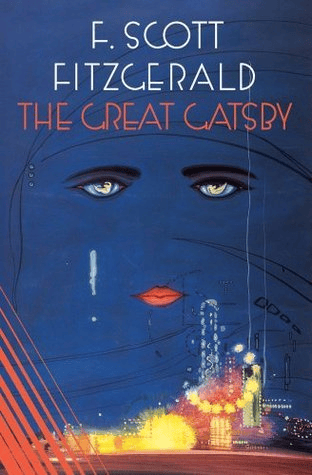
The Great Gatsby (1925), F Scott Fitzgerald

They were careless people…they smashed up things and creatures and then retreated back into their money or their vast carelessness, or whatever it was that kept them together, and let other people clean up the mess they had made…. 

If I didn’t feel obligated to read this book for Jazz Age June, I probably would have stopped reading it at some point–not because it was boring, badly written or uninteresting. It’s because it made me feel empty, just like the characters the book portrays. I am a visceral reader and an emotionally affected reader. I just didn’t want to feel so void of the life force as I turned page after page. But The Great Gatsby is so well-regarded as an anthem to the Jazz Age, the quintessential look at the Roaring Twenties, that I felt it right to finish. And I suppose, in the end, I am glad I did.

The book is narrated by Nick Carraway, who moves into the house next door to Jay Gatsby in West Egg, Long Island, New York. Gatsby is a mystery, both as to his present life and his past. Almost everything anyone knows of him can be contradicted by what the next person thinks he knows. Is he an Oxford man or not? Did he fight in the war or was he really a German spy? “He’s a murderer, you know.” “No, he could never have killed anyone.” His car is huge, his house is huge, his Saturday night parties fill his home to the brim with people he doesn’t know and he feeds them only the best food. But his business dealings are shady and probably illegal and no one really knows how he makes so much money.

Nick has a cousin, Daisy who lives with her husband Tom across the bay in East Egg. Tom is having an affair with Myrtle Wilson, whose husband owns the gas station in West Egg. Gatsby and Daisy were in love with each other five years ago, before he went off to war and so she married Tom, but both have carried a flame for each other ever since. Some of the more touching moments of the novel have to do with Gatsby’s nervousness in seeing Daisy for the first time in all these years, but their affair ends with a tragedy that almost feels like karma.

It’s funny how reading has gone for me this year. Several times I have read books back to back with main characters with the same first name, similar themes or similar odd word usage. This book and recently The Glimpses of the Moon have much in common theme-wise (and first name-wise) when it comes to relationships. I am not a prude and am all for finding true love, but in both these books the idea that marriage vows have meaning is certainly put to the adultery-test. And the bit of comical hypocrisy when Tom, who is having an affair with Myrtle, becomes incensed when he suspects Daisy is seeing Gatsby, is not lost on me.

There isn’t much narrative to the novel, except for the narrator, Carroway. He’s come to New York after college to start his accounting career and finds himself involved in the myriad dramas of the people around him. He is the moral one, the “good man,” the voice of the adult while the adolescents break the rules to their peril. They act like they’ve been shut up for years and finally found the way out of the chains of the straight and narrow prison that held their thoughts and feelings in check. Without restraints everything they do is in excess and through a restless lens. I couldn’t help but feel this emptiness in their motivations and that their hearts were devoid of the spark of life.

This novel supposedly illustrates the effect of the new found prosperity and personal freedom of post-war America in its loosening of boundaries between people in all aspects of life; the notion of the self-made and re-made “man” that is grander than anything before it. But with this freedom Fitzgerald shows that people can act with incredible selfishness and indecency leaving human wreckage in their wake.

I found this a profoundly depressing book. Even though Nick is the shining light in an otherwise morally bankrupt universe, I am still left with a void. I find it hard to believe this book is the ‘quintessential social commentary’ of America in the 1920s. If that were really true how did we survive the decade!

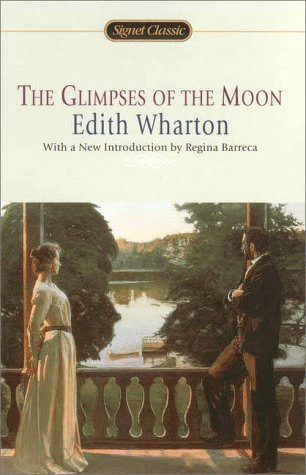
Glilmpses of the Moon (1922), Edith Wharton

He knew on how frail a thread the popularity of the penniless hangs, and how miserable a girl like Susy was the sport of other people’s moods and whims. It was a part of his difficulty and of hers that to get what they liked they so often had to do what they disliked.

Nick Lansing and Susy Branch of The Glimpses of the Moon are the answer key to Lawrence Selden and Lily Bart in The House of Mirth, whose motivations and actions often confused me. Where the problems exist in Edith Wharton’s, The House of Mirth, The Glimpses of the Moon is its “redo.”

Wharton, who was born in New York City to a wealthy and prominent family, writes realistically of upper class society in the early 20th century piercing its contradictions and exposing its hypocrisy. She is also masterful at portraying another part of this society: the dependents, the bright, pretty things of wit and intelligence hoping to break into the community of the wealthy and achieve some level of stability and status.

When Nick and Susy meet they recognize kindred spirits. Both are charming, beautiful and likeable; the kind the wealthy enjoy having around to enliven parties and animate conversations. They live off the good graces of their rich friends and all expenses are paid whether for a weekend in the country or a 3-month tour of Europe. They first see each other at their mutual friends, the Fulmer’s, where Susy is staying. Nick has come to visit and after several days of conversation they realize they are in the same position in society, but might do much better as a couple. “I don’t know how you feel; a man’s popularity is so much less precarious than a girl’s–but I know it would furbish me up tremendously to reappear as a married woman.” They both know the ropes, can spot opportunities and will be a novelty as a married couple. “We’re both rather unusually popular–why not be frank?–and it’s such a blessing for dinner-givers to be able to count on a couple of whom neither one is a blank.” So they make a bargain that they will marry with the understanding that if either finds a better situation the other will release them.

And it works. Due to Susy’s calculations she has figured out they could honeymoon for a year all over Europe on the invitations of friends for whom lending their homes to the newlyweds is a happy prospect. And so their life together begins with their first stay in a villa in Italy owned by a close friend of Susy’s, Charlie Strefford. They entertain the wealthy of their set who pop by in their boats or buggies to spend afternoons at home or evenings out.

Next, they move on to the home of Nelson and Ellie Vanderlyn where on the first night Susy finds an unexpected complication to their stay. Not expecting either to be home, she assumed their daughter would be with them. But in a letter left by Ellie to Susy she apologizes for leaving their 8 year-old daughter Clarissa and hopes Susy will be a good friend and care for her. Then Ellie asks for another favor. There are several letters to her husband she would like to have mailed, one each week. The post-mark is from the house, which Susy realizes means Ellie and Nelson are not together and Nelson thinks Ellie is home…Susy is sick with worry, disgust and fear all night going back and forth as to what to do. Should she participate in this deception against Nelson, should she aid in Ellie’s adultery, should she tell Nick even though Ellie begs her not to?

In the morning, she is resigned to play the game: in order for her and Nick to live this luxurious life as guests of other people they will always have to do something distasteful in return and this won’t be the last time. She and Nick, as a matter of course, will always have to do the dirty work of others.

However, this is a revelation to Nick who is stunned when by accident he finds out about Susy’s part in Ellie Vanderlyn’s affair.

Well–doesn’t our being together depend on what we can get out of people? And hasn’t there always got to be some give-and-take?…You’ve lived among these people as long as I have; I suppose it’s not the first time–”

By God, but it is….I have never in my life done people’s dirty work for them–least of all for favours in return. I suppose you guessed it, or you wouldn’t have hidden this beastly business from me.”

And Nick’s final blow against Susy:

“You knew I wouldn’t have stayed here another day if I’d known.”

“Yes: and then where in the world should we have gone?”

“You mean that–in one way or another–what you call give-and-take is the price of our remaining together?

As if Nick had forgotten their bargain and the compromises and concessions they’d have to make, he tells her they must part.

The two separate and continue to live at their various friends’ homes continuing to miss each other yet too proud to confess. It is many months since they have seen each other and Nick has taken a position as a secretary to their mutual friends, the Hicks’ aboard their yacht and cruises the Mediterranean. It is assumed he will marry their daughter, Coral.  Susy finds herself receiving attention from her old friend Strefford whose wealthy relatives have died leaving him a wealthier man than when she stayed at his villa. It is assumed she will marry him.

The manner in which the newly married, now separated Lansings are treated among their friends is almost matter of fact. At this period, divorce is not the stain on a woman’s reputation as it was only a decade or so earlier. Both are free to marry when the divorce is final. Some of the characters, though, are very puzzled by the decision to divorce, and in a not so very subtle way tell Susy she can stay married and find love elsewhere.

Because everyone is doing it….having affairs, that is. For their upper class friends cheating on your spouse is practically an obligation or at least usual. Nelson Vanderlyn eventually finds out about Ellie and though devastated, it is short-lasting. At one point, Susy hears that Nelson, Ellie and her new man are all dining “cheerfully together.” In this world of wealth, position and family ties marriage is to secure riches and status, not because of love. And to be married for many decades to someone you may not particularly like is a tedious prospect. So spouses cheat, and if discovered let it go, because they are doing it themselves.

When Nick and Susy reunite, it is not to live as their friends do. The parting has forced them to give up their pride and say they love each other. They will not cheat as their friends do to keep the family fortune, as they know they will have no fortune. The difference between Nick and Susy and their friends is that they married for love. If only Lawrence and Lily could have said it….

Frankenstein (1818), Mary Shelley

Perhaps a corpse would be re-animated;…perhaps the component parts of a creature might be manufactured, brought together, and endued with vital warmth.”

Mary Shelley

“Alas! I had turned loose into the world a depraved wretch, whose delight was in carnage and misery…”

Victor Frankenstein

The catalyst for Frankenstein Mary Shelley explains, is that she and her husband Percy were visiting the home of Lord Byron one dark and stormy night, when Byron laid down the challenge that each must tell a ghost story. Byron and Percy were able to create a story on the spot, but it took Mary a few days. In fact, she dreamed it. The result is one of the world’s most well-known classic tales of necromancy and Gothic story-telling.

As often happens when I read a classic novel that has seen countless film adaptations, I was very surprised that the book tackles far more than just the ‘monster parts.’  Shelley proposes thoughtful and deep topics and asks questions about personal responsibility, the quest for life’s purpose and leaves me wondering whether a monster has a soul?

Frankenstein is told as a story within a story by Robert Walton who is at sea and is corresponding with his sister, Margaret. But when the ship gets stuck in the ice floes of the Arctic, in the span of a few hours two very odd things happen. First, the crew spots a huge human-like creature driving a sledge with a pack of dogs passing at a distance. The next morning, they find another man, but more normal-looking, who is also driving a sledge, floating near them on the ice. He is near dead. The crew rescues him, revives him and while recuperating tells Walton how he came to be floundering on an ice floe in the middle of the Arctic. Walton records the tale for his sister in a journal. Frankenstein is the story of Victor Frankenstein, youthful scientist and budding necromancer whose interest in natural philosophy takes a turn from the traditional path of changing lead into gold to the perilous route toward creating life from death.

At university, Victor studies physiology, anatomy, the life process and the progression of death; he visits charnel houses and sees how the body corrupts and wastes away after the bloom of life.

After days and nights of incredible labour and fatigue, I succeeded in discovering the cause of generation and life; nay, more, I became myself capable of bestowing animation upon lifeless matter….It was already one in the morning….I saw the dull yellow eye of the creature open; it breathed hard, and a convulsive motion agitated its limbs.

After two years of working toward this goal of animating life from death Frankenstein succeeds. But instead of celebrating the work, he is horrified. He has created a creature, a monster. He cannot sleep for the nightmares that consume his waking and sleeping hours and falls into a many-month illness. From the very beginning that sparked the life of the monster, Victor is unable to accept responsibility for what he has created or the repercussions of the monster’s actions. This weakness in character will hound him for the rest of this life.

Meanwhile, the monster flees the town. He is a fully formed human-like man and as he roams the countryside coming into contact with people he not only sees, but feels their fear and disgust. He shows up near Victor’s home and kills his younger brother. Victor is still at university when he hears William has been murdered; he knows it is the monster. Unable to confess to the authorities what he knows for fear of being branded insane, he keeps quiet. An investigation and trial is held for the murder and through circumstantial evidence Justine, a trusted family servant of the Frankensteins is convicted of the crime and hanged. “The first hapless victims of my unhallowed arts.”

The monster is desperate for a place of refuge and finds it in an abandoned hovel near a cottage. The cottage is occupied by a brother, sister and their father. Through watching the interactions of the siblings as they care for their blind father he learns how they take care of one another, how they speak in kindness toward each other and what it means to be part of a family. Aware of his physical deformities he knows to keep out of sight, but he takes a chance on the father when the children are away during the day and forms a friendship with him. But the day comes when the children see him and the family flees the cottage. Brokenhearted, the monster understands his kindness or concern for others will always be outweighed by his physical appearance. There is no place on earth for him.

Where were my friends and relations? No father had watched my infant days, no mother had blessed me with smiles and caresses;…From my earliest remembrance I had been as I then was in height and proportion. I had never yet seen a being resembling me, or who claimed any intercourse with me. What was I?

The monster finally confronts Frankenstein and describes his life, how he came to speak, to think, to understand society by watching this family. And now, by bitter experience he will never be able to live as they do, in a family or as a common man.

Remember, that I am thy creature; I ought to be thy Adam; but I am rather the fallen angel, whom thou drivest from joy for no misdeed. Every where I see bliss, from which I alone am irrevocably  excluded. I was benevolent and good; misery made me a fiend. Make me happy, and I shall again be virtuous.

He pleads with Frankenstein to make him a companion like himself, so he can live as he sees others doing.

You must create a female for me, with whom I can live in the interchange of those sympathies necessary for my being….I now indulge in dreams of bliss that cannot be realized

What I ask of you is reasonable and moderate; I demand a creature of another sex, but as hideous as myself….we shall be monsters…Our lives will not be happy, but they will be harmless, and free from the misery I now feel.

The monster compels Frankenstein to this task and promises to live in secret, perpetrating no violence to any animal and away from any human contact.

Victor Frankenstein indeed created a monster, but what is amazing about this one is his heart, soul and intelligence. He has the potential to be every bit as kind and compassionate, moral and honest as any other man, yet he will never be accepted because of his physical appearance. No matter his good works or heroic deeds, his physical presentation will always negate his integrity.

My Thoughts

Victor Frankenstein turns his back on what he created. He abandons him on the first night, but once he hears his story, it is obvious this is a feeling, thinking human-type being, deserving of assistance, mercy and companionship. Would someone who created life really reject it like he did? The monster may be hideous to look at, but inside he is made like any other human being with the full capacity of feelings and outlook on life.

Would you reject a “nonperfect” child and would you expect it to fend for itself? Or is this something entirely different? Because the monster is not a helpless baby, but came into the world fully formed, who learned to speak, to cultivate his intelligence, to live in the world through observation, because he was made with wisdom already intact. Does he have a soul? He acts like it. He quickly becomes Victor’s intellectual equal. And Victor is given ample opportunity to make things right for him, instead he gives into fear.

Hounded for years by the being he created, Victor dies on the ship still unrepentant and without accepting any responsibility toward the monster; even as he lay dying he just wants the wretch dead.

The fate of the monster is sealed at Frankenstein’s death. Walton hears noises coming from the room where Frankenstein has died. He sees that it is the monster lamenting his existence that there will now never be redress against the man who created him.

Frankenstein forced him to a life of misery and neglect and now he will end his own on a “funeral pile triumphantly, and exult in the agony of the torturing flames….my ashes will be swept into the sea by the winds. My spirit will sleep in peace….”

Shelley goes through such pains to tell the monster’s story and she imbues the creature with humanity and sympathy as with any other human being. She shows his compassion, his intelligence; he is creative, hard-working and capable of contributing positively to society. He develops the full capacity of feelings, agency and responsibility for others and this is to me the tragedy of Frankenstein and his monster.

Because the monster is a victim. And it is easy to interpret Frankenstein as a warning for these modern times as science advances toward cloning and other forms of creating genetically modified life. Can we use Frankenstein as a forewarning to illustrate imagination gone wrong, to get us to think about the results of such experimentation and to ask how and what we are responsible for when we take these steps? Is creation and human life about outward appearances as we go about creating perfect people? What do we owe to them when they turn out to be not so perfect?

Once I falsely hoped to meet with beings, who, pardoning my outward form, would love me for the excellent qualities which I was capable of unfolding. I was nourished with high thoughts of honour and devotion….When I run over the frightful catalogue of my sins, I cannot believe that I am the same creature whose thoughts were once filled with sublime and transcendent visions of the beauty and the majesty of goodness. But it is even so; the fallen angel becomes a malignant devil. Yet even that enemy of God and man had friends and associates in his desolation; I am alone.

Anna Karenina (1878), Leo Tolstoy

I feel that I am flying headlong over some precipice but must not even try to save myself. And I can’t…I have no wishes at all. . . except that everything were at an end.

One of my biggest accomplishments this year is reading my first Russian novel. I am not sure what I feared all of these years, but it was unfounded. At over 800 pages Anna Karenina is full of unforgettable characters and their stories of triumph and tragedy. Though there were parts that felt a little tedious, especially the politically philosophical sections discussing the responsibility of land-owning aristocracy over the peasants, I was so engrossed I don’t think I skipped one word. That one of my favorite characters was part of these conversations, I plowed through.

While the action centers on three couples and includes the rites of courting, marriage and infidelity, the book is also about other kinds of relationships. The elite of the novel divide themselves into the city elite and country elite with high passions defending the perspective of each. There is the relationship some have with the Church and some who are disbelievers.  And in each character whether rich or poor, man or woman, government official or country land owner, they are fighting the relationship with the inner demons of their personal truth.

The action takes place during the 1870s and centers around the extramarital affair between Anna Karenina and a young cavalry officer, Count Alexei Kirillovich Vronsky that scandalizes the community of Saint Petersburg when Anna makes the decision to make public this liaison by leaving her husband. The pair to flee to Italy and try in vain to live a normal life. Happiness eludes them and they return to Russia, where everything gets worse.

There are several parallel and revolving stories including Anna’s brother Prince Oblonsky and his wife, Dolly who themselves are dealing with an extramarital affair, his. Kitty, Dolly’s sister, is of marriageable age and is being courted by Konstantin Lëvin, a wealthy country landowner. Kitty has to work through her attraction to Vronsky, before she is able to accept Levin’s marriage proposal. Levin has issues with the management of his estate, because he is caught between the traditional feudalistic aspect of the landowner/peasant relationship and the new reforms that see workers as autonomous beings. He is also plagued by his struggle to accept Christianity, a necessity in order to marry.

There is so much going on in this novel that held my interest whether it was watching a character’s journey or enjoying the details of daily life; even the descriptions detailing the bureaucracy of the system of government at that time kept my attention.

In my edition, the front matter includes a three-page character list, with Russian names that are themselves long! I found that extremely intimidating wondering how I would keep everyone straight, but due to Tolstoy’s very well drawn characterizations and the themes that make up this book I needn’t have worried. And the struggles the characters go through hold interest in their universality: love and marriage; infidelity that is expected for men, but scandalous for women; the power of the Church in matters of relationships, raising of children and divorce; the issues of peasants rights at a time when a feudal society is changing.

I did not like Anna at first, because she had no guilt about her feelings toward Vronsky and how this affected her husband or child, especially after their affair came to light. But in a system that gives only the wronged party the power to divorce when feelings change in a relationship, leaving with your lover may be the only recourse. And as the pair try to live a normal life as a couple, it is clear they will never be free to do so, because her status makes her a pariah within the Russian expat communities in which they socialize.

Vronsky is able to move more freely through society. He considers Anna his wife and wants her to be treated as such. But in a society where female agency is not recognized, the act of leaving a husband and living with another man is shameful and their peers react accordingly. Vronksky sees their kind of relationship as a modern construction and believes in the sifting progress of “public opinion” regarding such relationships.

But he very soon noticed that though the great world was open to him personally, it was closed to Anna. As in the game of cat and mouse, the arms that were raised to allow him to get inside the circle were at once lowered to prevent Anna from entering.

Anna’s inability to move freely causes her great mental and spiritual pain, in part because her forced seclusion keeps them from forming a social life as a couple. Vronksy spends time with his friends and she fears he will tire of her, something his mother would like to see. As the months in this liminal state drag on, Anna’s anxiety over Vronsky’s willingness to stay with her reach a breaking point. After a heated argument, Anna is convinced he will leave her and as her mental state breaks down further thinks of suicide as her only relief. As one of the world’s classic novels and as the subject of many films Anna’s fate is well-known, but her end is still shocking.

Tolstoy illustrates his themes against a backdrop of a changing Russian sensibility in all areas of life. Levin, the land owner, is caught up in the new land reforms developing throughout Europe and there is a considerable amount of discussion over whether these reforms would work in Russia. Levin wants to understand the people who work his land and some poignant scenes include his working alongside them, experiencing the celebratory effects of physical labor and working communally. How different is his life compared to his friends in the city.

Levin: You can’t imagine how strange it all seems to me who live in the country…We try to get our hands into a state convenient to work with,…but here people purposely let their nails grow until they begin to curl,…we try to get over our meals as quickly as we can, so as to be able to get on with our work, here you and I try to make our meal last as long as possible….

Oblonsky: Of course, the aim of civilization is to enable us to get enjoyment out of everything.

Levin is my favorite character, especially as he wrestles with his questions about the existence of God, a disbelief which concerns Kitty. The other characters seem to take the Church for granted whether they believe or not participating in its rites because ‘that’s just what one does.’ Levin is an agnostic struggling honestly with his disbelief. After a lightning storm catches Kitty and their son when they are outdoors their safe deliverance causes in him a change of heart in that he understands that he does believe at least in the goodness of God even though he will always have questions and may never feel as righteous as others. He understands that his belief cannot be reasoned out, but “I shall still pray, and my life, my whole life, independently of anything that may happen to me, is every moment of it no longer meaningless as it was before, but has an unquestionable meaning of goodness with which I have the power to invest it.”

My Thoughts

There is no adequate way to write a blog post about this novel. From all the details of daily life–there is a lot of eating and different kinds of food in this book which I particularly enjoyed!–that show the corruption of those in government jobs, to the differences in the way city people live against those in the country who work the land, to the role of established Christianity in major life-cycle events and with those who struggle to believe.

It is easy to invest yourself in the outcome of each character’s story, because their struggles feel very present; they transcend time and place. Tolstoy manages to show the major issues that plague the personal, the political and spiritual are really universal and concern 21st century folk as they did in the 19th.

O Pioneers! (1913), Willa Cather

The land belongs to the future….We come and go, but the land is always here. And the people who love it and understand it are the people who own it⁠—for a little while.

O Pioneers! tells the story of the Scandinavian, Bohemian and French immigrants who settled in the Nebraska prairies during the turn of the 20th century to farm, raise families and have the success impossible in the old country. But the land is harsh and uncooperative, the crops often fail and livestock die. Some families sell out and move to the city and some stay and try to tame the land. The Bergsons, who left Sweden 10 years prior, are one such family. As father Bergson is dying he gathers his children around him pleading with them to stay with the land; to follow the lead of their sister, Alexandra, to whom he leaves the farm and to make a go of it no matter what it takes.

But the difficulties aren’t only with the land. Alexandra is constantly fighting her brothers, Oscar and Lou, who see their neighbors leaving their farms and moving to the cities to work in factories. Alexandra will not give up on her promise to her father even when it looks grim. Drought and an unforgiving climate are not the only reason neighboring farms are failing; the tried and true methods of farming that worked in the old country are not relevant here. When Alexandra hears the communities “down river” are thriving she takes a trip to find out why. Upon her return she tells her brothers they have to sell their cattle and corn and buy up more land and they have to be open to innovation.

The rigidity in refusing to learn new farming methods as well as choosing different crops has raised another issue: gossip⁠—no one wants to make any innovation that their neighbor isn’t making. This fear of what others think affects many of the farmers including Oscar and Lou and they bring this up with regularity. But after her trip they see it is pointless to fight her; she has worked out all the financials and the new methods of tending the crops they will have to employ. Begrudgingly, Oscar and Lou accept Alexandra’s terms and after several years the farm is a great success

Parallel to the growth and success of the land the people also flourish. The courtings, marriages and children populate the land along with the crops. Alexandra herself is like the generative force of nature, a divine spirit who resolves conflicts not only about the land, but with her neighbors. She sacrifices personal love and family for the greater love of honor to her father and for the greater good of the community.

Under Alexandra’s counsel the land and the people flourish. She doesn’t try to fight the land or to force certain crops, she tries to understand its needs. To see the land as it is and to not be afraid to go against the traditions of the past makes her land bloom. And this is how she is with her neighbors, a Mother Earth figure resolving arguments with compassion and understanding. Under her benevolent, but firm hand, the land and the people prosper.

Her face was so radiant…For the first time, perhaps, since that land emerged from the waters of geologic ages, a human face was set toward it with love and yearning. It seemed beautiful to her, rich and strong and glorious. Her eyes drank in the breadth of it, until her tears blinded her. The Genius of the Divide, the great, free spirit which breathes across it, must have bent lower than it ever bent to a human will before. The history of every country begins in the heart of a man or a woman.

One of the engaging aspects of this novel is in the crafting of the characters⁠—the Bergson family and their friends and neighbors. They have an archetypal feel that gives this novel depth and a larger purpose.

  • Ivar the Fool, the solitary old man of odd habits and perhaps a little “touched in the head,” but whose knowledge of animal welfare is unsurpassed; his connection and ability to heal them is at once a boon to his neighbors as well as the source of their suspicion of him
  • Emil (Alexandra’s youngest brother) and Marie-the requisite Doomed Lovers
  • Oscar and Lou Bergson-the Evil Brothers, the naysayers, who want to undermine Alexandra’s success
  • Carl Linstrum-the childhood best friend who becomes the Delayed Love Interest
  • Alexandra-Demeter, the Great Goddess of the Harvest who brings fertility to the Earth
  • The Land-the Life Force, a sentient being that begs to be understood

The novel ends on a triumphal note, but not before a great tragedy occurs. Love and death are central themes in O Pioneers!

My Thoughts

The narrative describes many of the great themes in the settling of the US; immigration, taming the land, individual freedom and independence as well as the importance of community, love of tradition as well as innovation. Through the Bergsons and their neighbors the failures and successes of the immigrant families who made America, especially in this area of the country, are illustrated with a detailed and perceptive hand.

I found this book to be quite profound. The writing is spare, with a matter-of-fact style that is deep and poetic, but without sentimentality. For example, when Ivar discovers the bodies of Emil and Marie, above them

…two white butterflies from Frank’s alfalfa-field were fluttering in and out among the interlacing shadow; diving and soaring, now close together, now far apart; and in the long grass by the fence the last wild roses of the year opened their pink hearts to die. 

And the ending thus

Fortunate country, that is one day to receive hearts like Alexandra’s into its bosom, to give them out again in the yellow wheat, in the rustling corn, in the shining eyes of youth!

I remember when I reviewed Rebecca, by Daphne du Maurier and some of the commenters said they wished they hadn’t read the book, so they could read it again for the first time. I feel this way about O Pioneers! This is a multi-layered book with insights that continue long after reading. And for me a prose that sings to the love of Nature and the land that sustains us. This is reading as pleasurable as it can be.