Cranford (1853), Elizabeth Gaskell

I spent the past week with the ladies of Cranford. It was a delightful time listening to stories of their girlhood friendships and family life and the bittersweet present where many of their dreams were not realized.

Still, I was captivated at this group of women trying to maintain their dignity through the aging process unwilling to lower the standards of status and respectability regardless of the capriciousness of financial matters.

Having known each other all of their lives, they are still competing for dominance, for favor; they argue and infuriate each other, but never hesitate to come together in support at deaths, at changes in finances and to defend each other against gossip and lies.

I would go back if they’d have me….

First serialized in Charles Dickens’ magazine, Household Words beginning in December of 1851, he encouraged Gaskell to write more episodes as the chapters were called. The completed book was published 18 months later.

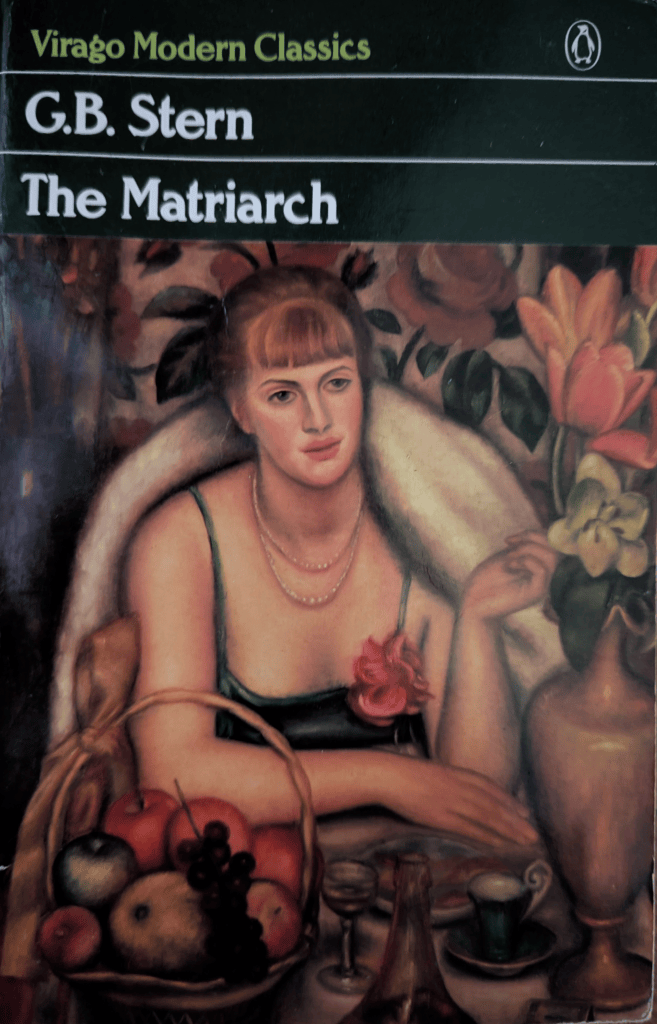
The Matriarch (1924), GB Stern

…In a typical chronicle of the Israelites, it would be taken for granted that the girls did not count at all…if they give birth to a boy who will grow into a man, they have fulfilled their destiny in the only possible way. When you have heard more about the adventure of being a Rakonitz, you will recognize why I have called them the very topsy-turvydom of Jews. It was a family of women bucaneers [sic]. They were thrown forward, and the men receded a very little bit into dependence. 

GB (Gladys Bronwyn) Stern is a “lost lady” of literature: well-known in her time, but little heard of today. She was born in London in 1890 and at the age of 16 traveled with her parents to the continent and studied in Germany and Switzerland. She was a novelist, memoirist, playwright and short story writer; several of her novels were turned into movies. The Matriarch is the first book in the Rakonitz Chronicles, a semi-autobiographical account of the Rakonitz, Bettleheim and Czelovar families, who are well-to-do cosmopolitan Jews with various family members having settled in England, Hungary, Poland, Russia, and Austria.

To say this is a sweeping generational saga of three families gives an idea of the breadth of characters. In fact, there are so many a detailed family tree is provided in the back of the book. However daunting a read this seemed at the beginning-the narrative is constructed in such a way that the generations and their stories are told together rather than in a linear pattern of one generation building upon the last-it works very well. The narrative has the feel of conversations at big family gatherings where the oldest person tells anecdotes about old uncle Saul with the smelly pipe who knew all the important people and who was important himself or beautiful cousin Elizabeth who refused an arranged marriage scandalizing the family when she married for love or the great-granddaughter Toni who decided to work for a living to support her family when her father died.  

The action moves from Vienna to Paris to London to Italy, Russia and to Central and South America, beginning with Simon and Babette Rakonitz who marry in the early 19th century. The wealthy, upper class Rakonitz family are very assimilated, but retain elements of their religion. The story takes in the larger cultures and societies in which they live that make the novel so interesting. They are a well-accepted noteworthy family having made their money in the diamond and other precious gems trade. The women hold the family together, especially after the financial tragedy that robs each household of their husbands, uncles and fathers.

Against the backdrop of tradition that each family member is expected to accept, the younger generations fight for their personal independence against loyalty to the family name. And some try to balance both, making life difficult when cracks appear in the family armor that call for intervention. This is not a somber or dark tale of prejudice or oppression, but a story of a dynamic family that is engaged in living life to the fullest and that through the generations is fully invested in the world around them.

A Little Princess (1905), Frances Hodgson Burnett

Somehow, something always happens just before things get to the very worst. It is as if the Magic did it. If I could only just remember that always….What next, now? Something will come if I think and wait a little…the Magic will tell me.

I was deeply touched by this book. The coping mechanism that helped Sara Crewe survive the cruelty thrown at her, tugged at my heart strings. She reminded me of countless children who find themselves in situations beyond their control, and figure out a way to rise above the physical pain and heartache. The ability to develop an imagination that becomes so visceral that you can feel warmth when you are cold or feel full when you are hungry helped Sara survive.

Her life is happy for her first seven years and though her mother died at her birth, she is very close with her father who gives her the best in material and emotional comfort. Sara was born in India, so it is with great sadness that she leaves her father and the surroundings she feels safe in, to come to London to finish her education. Her father believes Miss Minchin’s Select Seminary for Young Ladies is the best place for Sara and is not disappointed when the two arrive at the school and he is promised Sara will be given everything he wants for her. Sara has her own room, a pony, dolls and toys and beautiful custom made clothes of the richest materials. He leaves Sara believing she is in good hands.

Sara is a kind and friendly girl and wants nothing more than the friendship of other girls that she lacked as a solitary child in India. Even at such a young age, though, she is intellectually more advanced than most of the older girls and this, coupled with the discovery of Mr. Crewe’s business in diamond mines makes Sara fodder for mockery as a princess who is too good for the other girls. Miss Minchin does nothing stop the growing distance between the various factions at the school and in fact encourages it with her obviously mean-spirited elevation of Sara’s position at the school. For four years, Sara lives in a liminal state of sometimes acceptance and sometimes suspicion among the school girls, but handles it with poise and the knowledge of her father’s love.

Sara’s fortunes literally change overnight when her father dies. She is immediately stripped of all her possessions and moved to an attic room that is dirty, bare of comfort and comes with a resident rat. Sara’s position is now that of drudge, errand girl and the object of abuse from the staff. Miss Minchin takes particular delight in Sara’s downfall believing herself magnanimous for not turning her out into the street. Sara’s misery is extensive as she is worked to exhaustion in all kinds of weather in clothes that are too small and with shoes with holes. The older girls also delight in Sara’s situation never missing the opportunity to humiliate or mock “the heiress” of the diamond mines as they taunt her. 

…From day to day the duties given to her were added to. It was found she could be made use of in numberless directions. She could be sent on errands at any time and in all weathers. She could be told to do things other people neglected. The cook and housemaids took their tone from Miss Minchin, and rather enjoyed ordering about the “young one” who had been made so much fuss over for so long….it was frequently convenient to have at hand someone on whom blame could be laid. 

But Sara has managed to hold her tongue throughout all this verbal and physical abuse by imagining herself as a secret princess of lost fortune, who will somehow be vindicated. As such she must maintain an even, if not happy, countenance, because that’s how a princess would behave. It is important to note that Sara doesn’t pretend to be a princess in order to pretend she has no troubles; she imagines herself a princess to get through her troubles. She is very well aware of her ill treatment and willful abuse at the hands of the adults around her who should know better; this mistreatment by the staff, who see her as a scapegoat for their own feelings of frustration and inequality. Instead, she has chosen her behavior, which is key. In seeing herself as a princess it is her coping mechanism, but also her morality. A princess might be mad inside and want to lash out, but she overcomes that negative emotion to be kind. She’s not stuffing down her feelings, but making a choice to act differently. This is what both amazes as well as infuriates the older school girls as well as Miss Minchin.

There comes a cold, rainy day when Sara’s hunger is burning more than usual in her belly and her holey shoes and thin dress have chilled her to the bone. The weather has made her late returning to the school and she is sent upstairs without dinner. This is truly a turning point for Sara as she climbs the stairs cold and hungry, her dinner being withheld when she is never given enough to begin with–she is unable to mount anything positive to get her through.

To tell anymore would give away the story, that in a separate story line an Indian gentleman moves in next door, with an assistant Sara gets to know after capturing his escaped monkey. And because they have India and various customs in common he takes special note of her….

Thoughts

This is my first reading of A Little Princess, though I knew of it (and ok, I’ve seen the Shirley Temple film several times!), but I was surprised by the details of overwork and cruelty Sara and her partner in abuse, the scullery maid, Becky were subjected to. Children like this are worked as if they are not human. And sadly, if one can’t take it or is worked to death, there are always others to take their place. 

Burnett does a fine job with the contrast between rich and poor with Sara’s rise and fall and with the “Large” wealthy family that lives in the neighborhood. Peering through the windows at the well-dressed, well-fed children Sara knows there is still love in the world, even in her dark days. It is this and her imagination that allows her to live through all the humiliation and cruelty. 

This is a children’s story, but I think there is something here for adults. At least there is for me.

During the first month or two, Sara thought that her willingness to do things as well as she could, and her silence under reproof might soften those who drove her so hard. In her proud little heart she wanted them to see that she was trying to earn her living and not accepting charity. But the time came when she saw that no one was softened at all; and the more willing she was to do as she was told, the more domineering and exacting careless housemaids became, and the more ready a scolding cook was to blame her.

I must say I’ve often thought it would have been better if you had been less severe on Sara Crewe, and had seen that she was decently dressed and more comfortable. I know she was worked too hard for a child of her age, and I know she was only half-fed…The child was a clever child and a good child–and she would have paid you for any kindness you had shown her. But you didn’t show her any. The fact was, she was too clever for you, and you always disliked her for that reason. 

Perhaps there is a soul hidden in everything and it can always speak, without even making a sound, to another soul. But whatsoever was the reason, the rat knew from that moment that he was safe–even though he was a rat. He knew that this young human being sitting on the red footstool would not jump up and terrify him with wild, sharp noises or throw heavy objects at him…When he stood on his hind legs and sniffed the air, with his bright eyes fixed on Sara, he had hoped that she would understand this, and would not begin by hating him as an enemy. When the mysterious thing which speaks without saying any words told him that she would not, he went softly toward the crumbs and began to eat them. 
A Stitch in Time (1976), Penelope Lively

Eleven year-old Maria Foster talks to inanimate objects. She has conversations with cats and trees, too. It is clear she is curious and smart and the conversations she begins with her parents, based on what she has observed in the world or something she read leave them bewildered, as if they just don’t know what to do with a girl so serious and deep. So only-child Maria has created a world where objects listen and engage, give her advice and solace in ways her family cannot.

We meet the Foster family on their summer holiday to Lyme Regis. They are staying in an old Victorian house for a month. It has a resident cat, furniture that has seen decades of wear and an old tree in the backyard perfect for Maria to sit in and ponder. Next door is a small hotel where families of holiday makers are spending the summer and from her perch she notices one particular family with one particular boy. Once they meet Maria and Martin, after some initial hesitation, find in each other kindred spirits interested in the larger questions of life. They roam the hills and beaches picking up fossils, observing the varied geology of the land, which leads to a discussion of evolution when they visit a nearby museum.

Lyme Regis fossils.

In a complementary story line, Maria has become obsessed with a girl her age named Harriet who lived in the house Maria’s family is renting a hundred years ago. A photograph of a piece of Harriet’s embroidery with an ominous signature has captured Maria’s imagination. She is convinced Harriet died young and is determined to find out her story. She keeps most of her thoughts to herself until she makes a small attempt to share them with Martin. Mostly, though, she is content to have found an exploring buddy who shares her new found interests in the fossils and geology of the hills and cliffs they wander.

There are wonderful supernatural elements in the story that affect only Maria besides the cat, the petrol pump and the tree that she has conversations with: there is an insistent sound of a barking dog and the creaking noise of a swing in motion. Maria scours the neighborhood for physical evidence of these to no avail and as this part of the story unfolds they play an important part in the mystery of Harriet.

As Maria explores both her inner and outer worlds she grows in confidence and acceptance of herself and can acknowledge that what she thinks about and what interests her are genuine and noble. She has become communicative and expressive with her mother who is finally able to see and understand this daughter who had always seemed so shut up within herself.

A really wonderful book about a smart, serious, curious kind of girl that should be celebrated!

And thanks to Simon and Karen for creating these various clubs that have helped me find books and authors I may not have discovered otherwise.

The cat sat down beside her, disposed, it seemed, for a chat.

“No,” said Maria, “I don’t think I’m going to let you talk any more. Sometimes you say uncomfortable things. Though actually I think I am getting a bit better at not being made uncomfortable.” 

“P’raps” said Maria, “they turn into the kind of people they are because the things that happen to them make them like that.” Like I’m shy and I talk to myself because of the sort of family I live with and Martin’s like he is because he’s got a different kind of family.

“You are a bit peculiar sometimes,” [Martin] added, “You were talking to that tree yesterday. I heard. You were sitting in it and you suddenly said, ‘Oh, Quercus ilex…’”

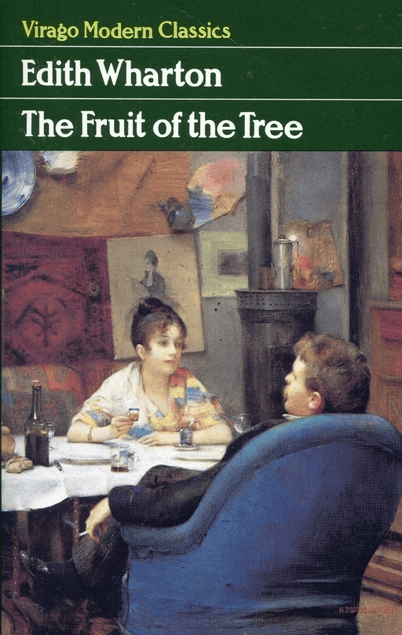
The Fruit of the Treed (1907), Edith Wharton

Human life is sacred,” he said sententiously.

“Ah, that must have been decreed by someone who had never suffered!” Justine exclaimed.

The Fruit of the Tree is a departure from most Edith Wharton novels that deal with the superficiality and hypocrisy of the lives of the upper class. While that plays a role here, the novel concentrates on the life of factory assistant manager, John Amherst, whose interest in bettering the conditions of the workers put him at odds with the wealthy owners. He is in a constant battle of explaining the evils of exploitation and the benefits of humane working conditions to the Westmore family who are not supportive

Now, young Richard Westmore, the owner of the mills, has died and his wife is named heir and overseer. When John Amherst and Bessy Westmore meet for the first time, he takes her on a tour of the factory and she meets some of the laborers. As they explain their jobs she sees through Amherst’s explanations that the dangers they are confronted with could be mediated by more updated equipment and a different philosophy of production. She is shocked by a recent accident on the factory line that left a young family man hospitalized, whose livelihood is now in jeopardy. John continues to speak of the morality of a working environment that is clean and safe, where the workers don’t have to come in sick because they have medical care or worry about their babies due to onsite child care and where adult education gives them opportunity for advancement. 

As John and Bessy fall in love it is more than an opportunist’s dream for John who is convinced he has turned Bessy from a disinterested carefree young woman to his partner in humanizing the lives of the people she has become responsible for. But the first blush of altruism for Bessy begins to fade when she realizes the time that must be spent “working” though she is still supportive of John’s aims and goals.

When Bessy’s childhood friend, the idealistic nurse Justine Brent, meets John at the bedside of an injured worker conflict arises between the three.

The marriage between John and Bessy is never peaceful. Bessy’s business advisors, friends of her deceased first husband, are always at odds with John’s plans for the factory and are constantly challenging her to stop him. They tell her that she should be concerned with the financial outlay and that John’s ideas do not guarantee a return on the money. When a horse riding accident puts her life in jeopardy any support for John and the factory wanes. John never loses his motivation for reform, though, and tries to press on. He has also lost the encouragement of Justine whose own life takes a turn when she makes a devastating decision prompting her to leave.

Thoughts

Wharton tackles many social and personal issues in this novel. One in particular reminds me of The House of Mirth. Without giving away an important plot twist, she has a character deal with the problem of chronic pain and the medical use of drugs. When Wharton was writing The House of Mirth she went to a chemist to understand sleeping draughts and their potency. She asked how a person would know to increase the dosage without killing themself. While the question in that novel considers a death by suicide or natural causes, the question in this novel is the morality euthanasia.

Wharton always draws her characters with such depth. It is easy to understand, though not always easy to agree on their motivations and here it is no different. John Amherst is committed to factory reform against all the odds thrown at him. Bessy grew up a typical materialistic girl, but has a big heart that has been opened to the inequities of real life. She struggles to do the right thing, but it is not easy for her, especially after she understands that John’s commitment to his beliefs infringe upon the luxuries she is accustomed to. Justine just wants everyone to be treated fairly, but comes up against the harsh lessons that being a woman of the working class entails. Suffice it to say, there is no happy ending for anyone in this novel, but perhaps with the passage time all the roughness with will smooth out….

But life is not a matter of abstract principles, but a succession of pitiful compromises with fate, of concessions to old traditions, old beliefs, old charities and frailties….And she had humbled herself to accept the lesson, seeing human relations at last as a tangled and deep-rooted growth, a dark forest through which the idealist cannot cut his straight path without hearing at each stroke the cry of the severed branch, “Why wounded thou me?”

Her world, in short, had been chiefly peopled by the dull or the crude, and, hemmed in between the two, she had created for herself an inner kingdom where the fastidiousness she had to set aside in her outward relations recovered its full sway. There must be actual beings worthy of admission to the secret precinct, but hither to they had not come her way; and the sense that they were somewhere just out of reach still gave an edge of youthful curiosity to each encounter with a new group of people. 

“I’ve no head for business—but I will try to.”

“It’s not business that I mean; it’s the personal relationship—just the thing the business point of view leaves out. Financially, I don’t suppose your mills could be better run; but there are over seven hundred women working in them, and there’s so much to be done, just for them and their children.”

“I have always understood that Mr. Truscomb did everything—“

“Do you leave it to your little girl’s nurses to do everything for her?”

Sister Carrie (1900), Theodore Dreiser

Nature is so grim. The city, which represents it so effectively, is also so grim. It does not care at all. It is not conscious. The passing of so small an organism as that of a man or woman is nothing to it. 

Carrie Meeber, or Sister Carrie as her family calls her, is a common type of her day—the small town girl, usually from the Midwest, who sets out to the big city to try her hand at independence before marriage, to send money home or to escape the strictures of domestic life altogether. Once in the city these young women are often rudely awakened and unprepared for the ruthlessness by which people exist, often falling into the temptation of making money at any cost. 

New industries springing up lure young and inexperienced women with promises of a steady paycheck, the thing they came to the city for in the first place. But once on the payroll they are exploited by long hours and tedious work with no real prospects of change. The thought of going back home is humiliating after being sent off by enthusiastic hopeful families. The only recourse besides marriage, if she can find a good man, is to harden herself to the exploitation and accept the challenges to her sexual and moral values.

Published in 1900 and one of the best books I’ve read this year, Sister Carrie tells the story of Carrie Meeber, who is fresh off the train from a small town in Wisconsin. She has come to Chicago to live with her sister’s family and to find work and a better life.

1893 Chicago World’s Columbian Exhibiton

She finds, however, that her enthusiasm and naivete for this new life has prevented her from realizing she has no skills, so she is only suited for the repetitive tedium and physical stress of factory work. A prolonged illness forces her to quit and her sister and brother-in-law threaten to send her home if she can’t financially contribute.

Life never really stabilizes for Carrie, even though she is rescued by a kindhearted salesman she meets on the train from Wisconsin, who sets her up in an apartment of her own. Though he is kind, it is assumed they will marry. But Carrie is swept off her feet by a wealthy sophisticated older, but married man, who promises her a secure loving future, although he keeps putting her off. In a moment of unpremeditated greed, he commits a crime and they escape from their obligations in Chicago.

Through several years on the run and with a deteriorating relationship and finances Carrie is fed up with being taken care of by others. Now in New York City, she tries her hand on the stage and in no time is the darling of the theater world with an income that gives her the material security she’s never known. Will she be happy and finally content?

Central Park

Dreiser writes a gripping and realistic narrative, peopled by those affected by the drudgery and monotony of factory life as well as those whose wealth is second nature.

The cities, too, of Chicago and New York are like secondary characters with mood swings of temperature and climate, of a humanity of impersonality and uncaring hearts. Both direct the course of daily life when thread bare clothes and holey shoes are no match for winter and a trek to a job is impossible; they kill, literally, when flop houses are booked for the night, bodies packed tightly in dirty beds or when a man is just pennies short of the fee and forced to spend the night in the elements. To survive seems like a combination of determined grittiness and just plain luck. A memorable, sad and poignant story.

Lower East Side

Dreiser’s Background

The inspiration for this novel comes from Dreiser’s own experience of coming to the city to make his fortune. Moving to New York to live with his sister, he experienced great difficulty in finding work. After a day of futility and disappointment—this was during the depression of 1893-94—he sat down on a park bench and found himself observing other men, the down and out, also looking for work. He had been introduced to the concept of social Darwinism and he began to imagine a society in which corporations and the control they had over workers, led to a City version of survival of the fittest. And Carrie Meeber was born.

“All men should be good, all women virtuous. Wherefore, villain, hast thou failed?”

“The long drizzle had begun. Pedestrians had turned up collars and trousers at the bottom. Hands were hidden in the pockets of the umbrella-less – umbrellas were up. The street looked like a sea of round, black-cloth roofs, twisting, bobbing, moving. Trucks and vans were rattling in a noisy line, and everywhere men were shielding themselves as best they could.”

“The nature of these vast retail combinations, should they ever permanently disappear, will form an interesting chapter in the commercial history of our nation.”

“She looked into her glass and saw a prettier Carrie than she had seen before; she looked into her mind, a mirror prepared of her own and the world’s opinions, and saw a worse. Between these two images she wavered, hesitating which to believe.”

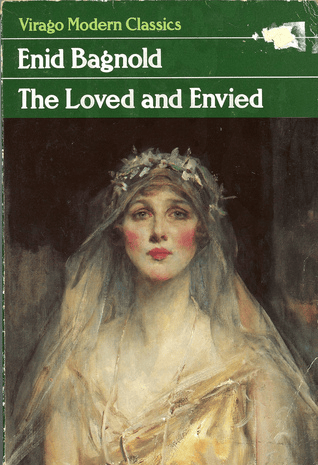
The Loved and Envied (1951), Enid Bagnold

He had come late to the study of himself and now that he was old he was struck that he had thought so little through his life about his reason for living. He had been like a thrown ball, which while it rolls is satisfied, but when at the end of its movement it lay still, wondered what it was doing on the ground.

Once she had said about death, “I’m sure it goes easily. One mustn’t fuss. The important thing is to get reasonably exhausted by life, and avoid this hankering for repetition. What you’ve had you’ve had.”

Enid Bagnold is best known as the author of National Velvet, the beloved novel of a girl and her prize winning horse. In The Loved and Envied, she tackles middle age and the fading class of expat aristocrats: American, Italian, and Scottish living in France in the 1950s. Centering on Lady Ruby Maclean (who is based on the real-life Lady Diana Cooper, a famous socialite of the early 20th century), the various, mostly middle aged characters, come to terms with their lives conscious of missed opportunities, regrets over actions they didn’t take and words they didn’t speak. Love is their biggest disappointment as well as the discovery that having great material assets isn’t enough for a fulfilling life.

Ruby is the “loved and envied” of the title, well aware that throughout her life most people she meets are either in awe of her or in love with her. It is fascinating to watch the interactions of these characters in relation to Ruby and their decades long friendships as they now deal with the life choices they made in their youth. Most are fraying around the edges wrestling with who they were then and what has become of them now. 

For example, Ruby’s husband Sir Gynt a good-hearted, but unsettled man is having a mid-life crisis and wants to move to India. Alberti, Ruby’s oldest friend, has defiantly remained single all of these years, but now that his health is declining decides to marry his long-time care giver, Celestine who has always aspired to marry into a titled family, which Alberti, as Duke of Roccafergolo, solves both their problems. Her friend Cora who gave up painting at marriage is invisible to her husband, a mediocre playwright; she courageously leaves him becoming a world-renowned painter.  In this novel of secrets and words left unsaid couples cheat on their spouses to hold on to their youth or yearn for a romance that will never come.

One of the plot devices Bagnold uses is to take us back in time to the youth of each character showing the circumstances of their life and the options chosen. The settings move from Scotland to Jamaica, to Paris and London as each character takes their starring turn in Ruby’s life.

Though the folly of past decisions is exposed and several characters die, this isn’t a depressing book. It is an insightful commentary on the ways people make peace with their youthful choices when they have not stood the test of time. They all have quirks or are downright eccentric as life deals them blows they can’t always overcome. I was captivated by their perseverance. The most successful of Bagnold’s characters accept the past’s unraveling and are brave enough to change their future. Ruby as the stable constant in all their lives recognizes the ebb and flow of all around her and manages magnificently to keep her poise and good humor. 

I’m haunted with a need to set things straight between me…and my reason for living.

I have never once in my life been in love with someone who loved me. Now I must be resigned to die without it.

There are women, who don’t, by nature, know what’s expected of them. They don’t know what place they ought to fill in men’s regard. I’m like that. You see me old now but it’s always been the same. I’m without what cannot be described to me, what’s not taught, and that to me doesn’t come naturally. And it has ruined my life.

At the Mountains of Madness (1936), HP Lovecraft

There was an odour…. 

William Dyer is a university professor at Miskatonic University and this is his report of the expedition he lead to the Antarctic and the unexpected discoveries his team uncovered. His first communications to the outside world are full of exciting finds and praise for his men and their dedication. As the expedition continues, however, there are horrific accidents, missing team members and puzzling evidence of a past civilization that doesn’t make sense on the timeline of evolution. So traumatized are he and his men over the events they witnessed, he would have preferred to forget all that took place, but when he finds out another expedition is forming he hopes a more detailed description will discourage them. 

His report begins soon after the company arrives in Antarctica. Once the team settles into base camp an advanced party, lead by Professor Lake, sets out in a transport plane bringing equipment that will allow the team to take core samples in the heretofore unexplored wilderness of Antarctica. Sled dogs are also brought for transportation over the icy surface as are all kinds of tools for scientific and geologic sampling. With each sighting of mountains or other geologic formation Lake relays back to Dr. Dyer who then communicates the findings to the University.  

In the first communications are descriptions of a mountain range higher by tens of thousands of feet in elevation than any known in other parts of the world with a geological formation that looks as if it was carved by human hands. When organic life forms are found and taken out of the layers of ice, Lake decides to dissect them. With each new discovery pulled from their icy resting place, the dogs became more and more agitated until a special compound has to be built for them away from camp.  

There is no consensus between Lake and Dyer if the forms are vegetable or animal in origin, but as Lake continues his dissection he discovers more and more of a complex internal design exciting both men. Suddenly, however, all communication from Lake ceases. After several hours pass in silence Dyer mounts a search party. 

Anyone who knows the tropes of science fiction novels, short stories or the set-in-the-Antarctic B movies of the 1950s and 60s knows what is going to be found at the camp of the missing party, because nothing good ever comes of an expedition to the Antarctic! Monsters? Aliens? Organic life deformed by a nuclear chemical accident? A small party goes out to explore and they all go missing? Dogs trying to give warning that something is off kilter, but are ignored, or worse, put outside?  

When Lake signs off for the night covering up the “creatures” after hours of dissection the suspense has been building up to this moment. He’s already described how the warmth of the air compared to the temperature underground has made the specimens more pliable. He describes a smell generated by the specimens and the annoyance of the barking dogs. Spoilers of all kinds swirl around through each passing page. You know what is going to happen. So what keeps you reading? 

The story telling. The dangling-the-carrot of possibilities of horror that are obvious and in plain sight. But it is in the details of the almost breathless manner in the way he writes Dyer’s communication of his findings that Lovecraft excels. It is his incredible imagination coupled with a solid understanding of science, anthropology, geology and a flair for conveying the fantastic that brings Dyer’s discoveries of this ancient civilization to compelling life once he finds the murals and sculptures that tell the story of the Old Ones who populated the land long before the known historical record. And by bringing in what IS known of the historical, the geological and the geographical record Lovecraft creates both a realistic understanding of the “authorized” version of evolved life and the challenge to that with these new discoveries. There is enough interest and great story telling not to deter the reader from continuing on this journey even though experience in the genre and pure common sense has you shouting, “don’t split up” or “the dogs are trying to tell you something” or “put those life forms back where you found them and bury them deep!”

RESEARCH 

The paintings of Nicholas Roerich were an influence on Lovecraft’s descriptions of the mountains Lake discovers.

I discovered Lovecraft had a life-long interest in the Antarctic and even as a child wrote stories based on books he’d read about the region. He followed the Byrd expedition which occurred just before he wrote the novel and he may have been influenced by the partial Antarctic setting of Poe’s novel, The Narrative of Arthur Gordon Pym of Nantucket. Having done his own research of the continent and knowing how little was explored, gave Lovecraft license to use his already active imagination to create a sophisticated singular epic tale of the already mysterious and inscrutable Antarctic. 

The ceaseless five-pointedness of the surrounding architecture and of the few distinguishable mural arabesques had a dimly sinister suggestiveness we could not escape.

The tremendous significance lies in what we dared not tell–what I would not tell now but for the need of warning others off from nameless terrors.

The beings seem to have had no trouble in adapting themselves to part-time residence under water; since they had never allowed their gill systems to atrophy.

These were the Great Old Ones that had filtered down from the stars when earth was young-the beings whose substance an alien evolution had shaped, and whose powers were such as this planet had never bred.

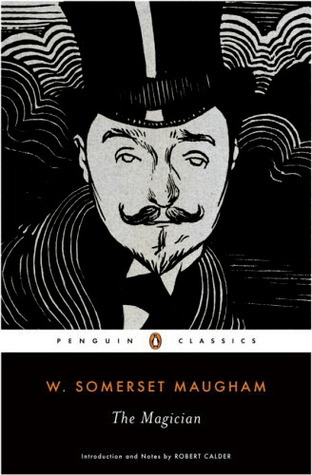
The Magician (1908) W. Somerset Maugham

Sometimes my mind is verily haunted by the desire to see a lifeless substance move under my spells, by the desire to be as God.

There is so much to unpack in this novel. Its theme of creating and reanimating life is so immoral, yet the narrative is guiltily compelling. Maugham presents a world of necromancy, sex magic, time travel, hallucinogenic spells and murderous revenge in which he leaves nothing to the imagination and where otherwise normal men and women are taken on an outrageous occultic ride. 

At her fiancé Arthur Burdon’s request Margaret Dauncey has moved to Paris to experience life before their wedding. Mary is an artist and has found a room with Susie Boyd, her former teacher, and together they explore the art world of Paris. Arthur, a surgeon, lives in London and is presently visiting Margaret occasionally meeting up with Dr. Porhoët, a former medical school professor who continues to mentor him.  

The four are taking an evening stroll when they meet Oliver Haddo an acquaintance of Porhoët. He is charming, intelligent, well-traveled and knows everything about any subject that comes up and as the days go by has insinuated himself into their lives. But something about him has unsettled them all. Margaret has an innate repulsion, Susie is fascinated though a little wary of his tales of Egyptian snake charmers and other stories that bend reality. Arthur, the scientific skeptic, is not impressed by these ridiculous events, while Dr. Porhoët listens quietly, as his hobby is research on the occult and unexplained phenomena. Porhoët tells them later Haddo is reputed to be a magician and practitioner of the dark arts, but finds such a negative assessment hard to believe in someone so charming and brilliant. 

But is there truth to these rumors? With each luncheon or tea or after dinner walk Haddo brings suspicion and fear to the four. One evening, he puts his hand on a horse, ostensibly to steady it, but it trembles so severely at his touch it almost collapses, then at Margaret’s house her little dog is so fearful of Haddo he hides in a corner. When Haddo forces the dog come to him, the dog bites him and Haddo kicks it causing Arthur to attack him. This event is the beginning of Haddo’s revenge toward Arthur and his power over Margaret. 

As the story unfolds we learn the truth of Haddo’s plans, of his mind control over Marget and watch as he degenerates into unspeakable experiments in his laboratory.

Maugham writes with such realism that I felt chills as I read through the necromancy operations. As I read later, this realism incensed Aleister Crowely the infamous mage and occultist of the time and model for Oliver Haddo whom Maugham had met in Paris. It is not a flattering portrait and Crowley, who has had great influence on modern magical and occult matters, irrationally accused Maugham of plagiarizing the story from other occult books.  

Maugham denied Crowley’s accusations saying his information on the black arts and human experimentation came from research he had done in the British Museum. But his five years of medical school must have also helped! 

Thoughts

I pondered the morality of reanimating the dead or creating a human body in a basin using the blood of a virgin and magical incantations with our own modern version that is medically and morally sanctioned. We herald as a great achievement creating life in a test tube with egg and sperm or stem cells that repair or regenerate other cells in the human body. Now, people who otherwise could not have children have a chance to be parents. And a devastating medical condition can be treated by our own stem cells. Is this the black arts reimagined, but for the Good? Will we regret any of this? I hope not….

At any rate, I enjoyed this book. It is a real page turner and I highly recommend it. For anyone participating in RIP it is perfect, but I do suggest no late night reading, unless all the lights are turned on!

The old alchemists believed in the possibility of spontaneous generation. By the combination of psychical powers and of strange essences they claim to have created forms in which life became manifest.

In vain they lit their furnaces, and in vain they studied their crabbed books, called up the dead, and conjured ghastly spirits. Their reward was disappointment and wretchedness, poverty, the scorn of men, torture, imprisonment, and shameful death. 

Desperate Remedies (1871), Thomas Hardy

“You speak truly. That we never meet again is the wisest and only proper course. That I regret the past as much as you do yourself, it is hardly necessary for me to say.”

After reading Jude the Obscure with a group on Instagram I decided to join their year-long Thomas Hardy Readalong—one book each month. First up, Desperate Remedies, which we read in January. This is Hardy’s second ‘first” novel, because his first was rejected by his publisher. After getting tips from his reader at the second publisher, the writer George Meredith no less, Hardy wrote Desperate Remedies which was published in 1871.

The novel opens with a love affair that ends in mystery: the woman breaks it off only to disappear leaving the man heartbroken. He does recover and after some years marries and has a daughter whom he names Cytherea. She is left an orphan when her father dies and is forced to find employment as a lady’s maid with the imperious Miss Aldclyffe. Cytherea has fallen in love with an architect in her brother’s firm, but he is engaged to marry his cousin, a match made years ago without any enthusiasm in the present. When Owen, Cytherea’s brother becomes very ill the steward of Miss Aldcyffe’s estate asks her to marry him with the promise to pay for Owen’s medical care. But is Aeneas Manston whom he says he is? What is his past, really? Will Cytherea discover the truth before it is too late?

And does this sound like a melodrama? Well, it is! However, it is not as superficial as it may seem due to Hardy’s way with storytelling and his ability to make every character, even the most minor, full of personality and life. A related technique is the dividing up of the story into time: The Twenty Second of August; The Fifth of January, Before Dawn; September the Twentieth, Three to Four p.m. This effectively brings the reader into the story.

Desperate Remedies is also a mystery. Why is Miss Aldclyffe so enamored of Cytherea, hiring her knowing she has no experience as a lady’s maid and then the next minute trying to force her into a marriage with a man she doesn’t love? Why do several characters have the same name? Does a certain man have two or three wives? Did a fire at an inn kill or not kill someone? This twisty-turny narrative works so well because many of the characters are interconnected. The book also has a Gothic romance feel combined with qualities of Victorian detective fiction.

I found this book highly entertaining and quite a page-turner. I am in the middle of February’s book, A Pair of Blue Eyes and I have to say, I am looking forward to what the rest of the year will show me about Hardy. At the moment, I feel I am being set up for a very good “Thomas Hardy Year.”

It was about four o’clock in the morning when Cytherea, though most probably dreaming, seemed to awake–and instantly was transfixed by a sort of spell, that had in it more of awe than of affright. At the foot of her bed, looking her in the face with an expression of entreaty beyond the power of words to portray, was the form of Miss Aldclyffe—wan and distinct. No motion was perceptible in her; but longing—earnest longing—was written in every feature.

They pondered on numerous schemes by which a young lady might be supposed to earn a decent livelihood—more or less convenient and feasible in imagination, but relinquished them all until advertising had been once more tried, this time taking lower ground. Cytherea was vexed at her temerity in having represented to the world that so inexperienced a being as herself was a qualified governess; and had a fancy that this presumption of hers might be one reason why no ladies applied.